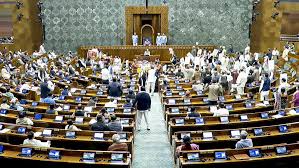
Unusual developments have taken place in Parliament. For the first time, the motion expressing thanks to the President for her address was passed in the Lok Sabha on Thursday by a voice vote. On this occasion, the Prime Minister did not come to the Lok Sabha to reply to the debate on the motion, which is without precedent.
Lok Sabha Speaker Om Birla stated that he had advised the Prime Minister not to attend the House due to security considerations, following an incident on Wednesday in which a few women Members of Parliament approached the Prime Minister’s seat. Congress MP Priyanka Gandhi later clarified that only three women MPs had gone near the Prime Minister’s seat and questioned the security assessment within Parliament.
Opposition leaders alleged that the Prime Minister’s absence was linked to the issues raised by Rahul Gandhi in connection with remarks made by former Army Chief General Manoj Naravane in his book. Congress spokesperson Pawan Khera questioned whether protesting women MPs should be viewed as a security threat.
Prime Minister Narendra Modi was scheduled to respond to the debate on the motion of thanks at 5 p.m. on Wednesday but did not attend the Lok Sabha throughout the day. Speaker Om Birla also remained in his chamber during this period.
Opposition parties stated that they would continue to disrupt proceedings until Rahul Gandhi was allowed to complete his speech in the Lok Sabha, citing references to General Naravane’s book. As a result, Lok Sabha proceedings were disrupted for three consecutive days. The government did not respond substantively to the issue during this period. Parliamentary Affairs Minister Kiren Rijiju made efforts to facilitate conditions for the Prime Minister’s reply, but these efforts were unsuccessful.
Rahul Gandhi indicated that he intended to present copies of General Naravane’s book to the Prime Minister in the House. The book reportedly states that during instances of Chinese military intrusions, political leadership did not issue specific directions to the armed forces. Continued disruptions in the House led to a legislative stalemate.
Rahul Gandhi had earlier told the media that the Prime Minister would not attend the House, and the Prime Minister subsequently did not appear. Some observers, including within the ruling party, reportedly believe that the situation might have been resolved had Rahul Gandhi been permitted to complete his speech.
Separately, the government faced questions from the opposition regarding the India–United States trade agreement. According to sources in the Commerce Ministry, the agreement has not yet been finalized, and discussions are ongoing, including on access for certain agricultural products. Despite this, statements were made by the US President regarding large-scale purchases by India and changes in India’s energy imports, prompting calls for clarification.
Although the White House Press Secretary issued an official statement, the Indian government did not provide detailed clarification. Commerce Minister Piyush Goyal stated that the proposed agreement would benefit India’s population and support exports but did not outline specific details.
These developments have raised broader questions regarding decision-making during periods of border tensions with China and the nature of political direction provided at such times, as referenced in General Naravane’s book. Observers have called for clear explanations on both national security matters and the status of the India–US trade discussions.
 akrishnarao
Leave a comment