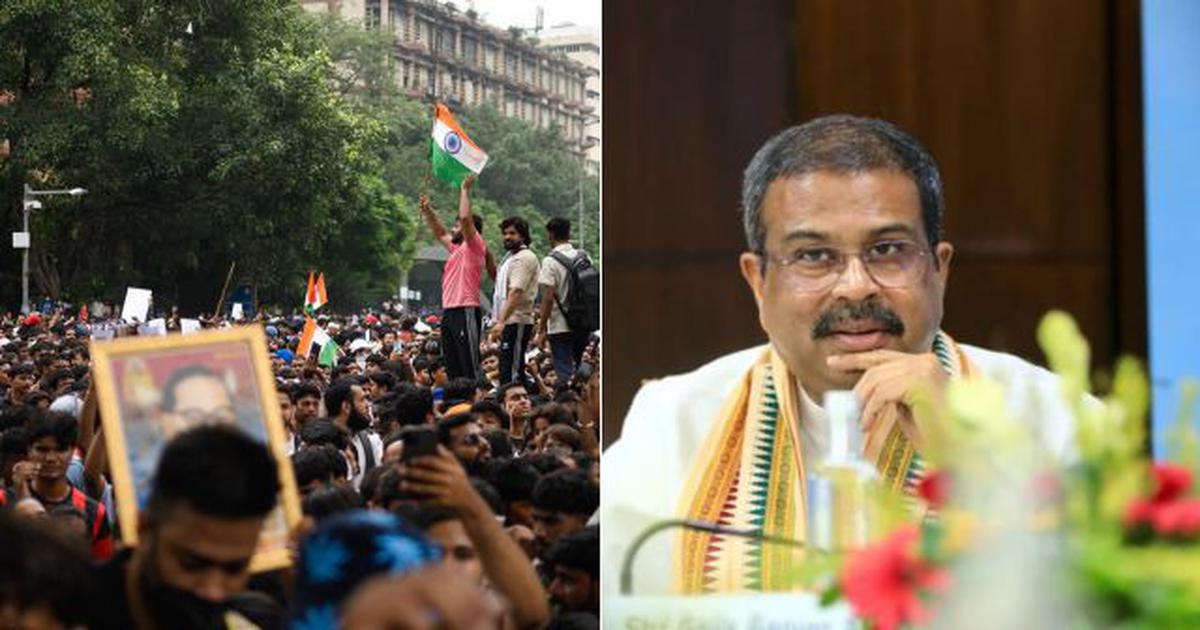
‘Today’s youth have not strayed from the right path. They are not acting without direction. One should engage in discussion with them, but not control them. They ask for reasons, not rules. They seek explanations. Curiosity is their trait. Rebellion is their nature’.. These words were spoken not by some Communist leader, but by Rashtriya Swayamsevak Sangh chief Mohan Bhagwat. On July 24, as he was speaking these words at the Vishwa Mangalya Sabha held at the Ambedkar International Centre.. just one kilometer away at Jantar Mantar, an aggrieved group of youth was expressing intense anger. Exactly 24 hours later, Union Education Minister Dharmendra Pradhan resigned from his post. ‘Though delayed, a good thing was done in the end..’ commented 92-year-old Murli Manohar Joshi. A day before Bhagwat made his statement, that veteran grandee commented that the lathicharge on students was atrocious. Joshi also justified that the students’ anxiety regarding the examination system was legitimate.
Examining these developments closely reveals that it was not only the pressure from the youth, but also the pressure from internal forces within the BJP and the Sangh that led to Dharmendra Pradhan’s resignation. It also becomes clear how much internal disquiet the intensity of the Cockroach Janata Party’s protest demonstration at Jantar Mantar created within the BJP, albeit belatedly. Sonam Wangchuk, an educator and environmental activist from Ladakh who strengthened the Cockroach Janata Party’s protest through his hunger strike unto death, was once a supporter of Modi. When Article 370 was revoked and Ladakh was separated from Jammu and Kashmir, he overflowed with joy. When the BJP promised to include Ladakh in the Sixth Schedule, he campaigned in favor of the BJP during elections. Wangchuk even turned down Rahul Gandhi’s invitation to participate in the Bharat Jodo Yatra. The BJP turned such a person against itself. Not just him, among the young men and women who came to Jantar Mantar, there were many who once admired Modi and the BJP and later turned against them. ‘I too voted for Modi along with my parents. When I was coming to the Jantar Mantar demonstration in Delhi, they did not raise any objection at all,’ said a young woman. BJP leaders themselves say that even in the houses of several Union Ministers and MPs, their children expressed solidarity with the CJP demonstration. In the Jantar Mantar demonstration, many engineers, fashion designers, MBA and law students, and children of farmer families were seen from several states along with Punjab, Mumbai, Haryana, and Telangana. Wearing loose jeans, t-shirts, various kinds of attire, and bands tied around their heads, these youth cannot be linked to any political party.
It is surprising that these very students are deciding the Parliament’s agenda today. After the commencement of the monsoon session of Parliament, the Lok Sabha functioned smoothly for the first time on Tuesday afternoon after seven days. The students were the reason for that. They were responsible not only for Dharmendra Pradhan’s resignation, but also for the government hastily bringing a bill to prevent irregularities in exams, for the Prime Minister announcing this bill late at night, and for the opposition finally agreeing to a debate. From Smriti Irani to Dharmendra Pradhan, four education ministers have changed during Modi’s tenure. During every education minister’s tenure, there was some controversy or the other. But the situation of having to resign due to student pressure arose only for Dharmendra Pradhan. When Dharmendra stepped into the Parliament premises after resigning, BJP MPs gave him a grand welcome chanting ‘Zindabad’ to him. They crowned him. For what? On whose orders and why did they honor him? It is clear that this was done to claim that even when knocked down, their upper hand remains. Who suffers the loss due to this? Is it not them?
Many people across the country connected with the young men and women who conducted a peaceful protest demonstration for over a month, demanding that the Education Minister take moral responsibility for the exam paper leak. When they marched towards Parliament and their heads were fractured by lathicharges, and pellet fragments penetrated the bodies of those youths, many felt deep anguish. If those in the CJP were anti-social elements, why did Union Ministers hold three rounds of discussions with their representatives? Why did they promise to discuss reforms in the education system with them as well?
In reality, in every movement, some amount of violence and destruction keeps taking place. Even in the Sampoorna Kranti movement led by Jayaprakash Narayan, there were allegations that a conspiracy was hatched to blow up railway bridges with dynamite. Violence broke out during the anti-reservation movement as well. Many times, after police brutality occurs, this angle of anti-social elements is brought forward to justify it. That alone does not take away credibility from the entire movement. Portraying every protest as a crime might work for a while, but it will not work at all times. Those in the ruling system must learn to respect the anger of protesters. Otherwise, a permanent hostility towards governance systems will be formed. This wisdom is evident in the comments made by Mohan Bhagwat, even if belatedly.
Actually, had Congress acted properly, the need for students to take to the streets would not have arisen. Congress did not raise its voice strongly until after seeing the response to the formation of CJP on June 6. After the paper leak occurred in the first week of May and the exam was cancelled on May 12, Congress did not make enough efforts to respond strongly and hold the government accountable. Rahul Gandhi, who organized a student rally named ‘Chatron Ki Goonj’ in Kota, Rajasthan on June 17, disappeared for the next 23 days and spent time in Germany. Rahul showed signs of movement again only after the founder of CJP entered Delhi and intensified their protest, with just three days left for the Parliament session to begin. It was proven that if there is no continuity and daily active presence in politics, the situation goes into someone else’s hands. Congress must realize that theatrically organizing dharnas and getting arrested as in the past will not gain public sympathy. Since 2014, Congress has been stalling Parliament and holding protests. What change has come in electoral politics or in the government’s stance? With just a month-long protest, the Cockroach Party was able to make the government back down. Why did Congress and the opposition lack such moral strength?
Just because bills are introduced in Parliament, it cannot be said that changes will come in the education system. Just by opening new IITs and medical colleges, the quality in higher education cannot be improved. To this day, not a single Indian university finds a place among the top hundred universities in the world. Even though the size of the Union Budget increases enormously every year, the share allotted to education in the Union Budget over the last 12 years has decreased significantly. In 2013–14, 4.65 percent of the total Union Budget was allocated to education, whereas by 2025–26, that share has fallen to 2.5 percent. Priority in the country is decreasing not just for education, but also for research. Going into the pages of history reveals that during the Congress regime, BJP leaders like Murli Manohar Joshi, Arun Jaitley, Sushma Swaraj, Narendra Modi, and others heavily criticized educational standards, facilities in educational institutions, and the lack of connection between higher education and employment. So to what extent has the situation changed now? Despite test papers leaking multiple times, why did the idea of setting up fast-track courts not arise earlier until students came onto the streets? In 2024, re-examinations were not conducted in certain test centers until the Supreme Court intervened. Now, the entire examinations had to be cancelled. Moreover, they are promoting it as a grand achievement that they are organizing exams properly on a war footing without loopholes. Days might even come when they claim in election manifestos that they conducted exams properly without paper leaks!
PM Modi described the intervening period until achieving Viksit Bharat by 2047 as Amrit Kaal. The protest by the swarm of cockroaches during this Amrit Kaal should be considered, in a way, an auspicious development that served as an eye-opener for the government. Dharmendra Pradhan’s resignation need not be considered a humiliation. It should be regarded as an opportunity to engage in self-introspection over the developments that occurred and take appropriate measures. Perhaps realizing this very fact, Infosys co-founder Nandan Nilekani was entrusted with the responsibility of Chairman of the Task Force on NTA exam reforms. It was under his leadership during the UPA tenure that the Aadhaar project, which stood as the largest biometric identification system, took shape. He played a key role in the digital transformation currently visible in the country. Technical experts and intellectuals have no affiliation with parties. That is why Modi entrusted him with key responsibilities. If the government moves forward in this same direction and takes steps to bring key changes in the governance system rather than always focusing on politics, there is no one who would not appreciate it. There is an opportunity to take such mid-course correction measures in another three years. If that does not happen, the ruling party itself stands to lose!

