Tag: bjp

  • Winning Without Contest: The New Politics of Power

    In the 2017 Legislative Council elections, some leaders from Rayalaseema exerted intense pressure on the Returning Officer, Satyanarayana Rao, who was then serving as the Assembly Secretary, to reject the nomination of a candidate. They also tried to influence him with inducements. Frightened and disturbed, that Returning Officer reportedly approached Chief Minister Chandrababu Naidu. It is said that he told the officer, “Do not yield to any pressures. Act fearlessly according to the rules.”

    In 2009, during the YSR era, Telugu Desam Party candidate Kadiri Baburao, who contested for the Legislative Assembly from Kanigiri, forgot to sign in one place in his affidavit. The Returning Officer, who maintained strategic silence without saying anything until 5 p.m., later rejected Baburao’s nomination papers on the grounds that the signature was missing. Baburao was known to be a close associate of the prominent film actor Nandamuri Balakrishna. These are merely examples to illustrate how crucial a role Returning Officers play in determining the fate of candidates. Just as Jayadratha in the Mahabharata possessed the power to prevent the Pandavas from entering the battlefield even for a single day, Returning Officers too occasionally play the role of Jayadratha in the electoral battle. Their power is that formidable.

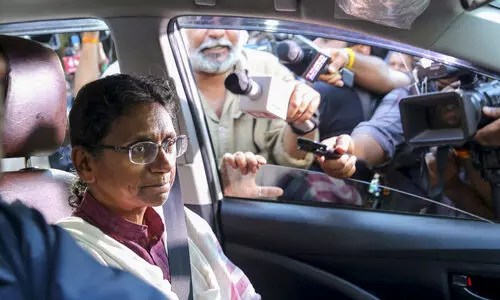
    Recently, in Madhya Pradesh, Returning Officer Arvind Sharma played a key role in rejecting the nomination papers of Congress candidate and party General Secretary Meenakshi Natarajan. Arvind Sharma, who is a Principal Secretary in the Madhya Pradesh government, had previously served as a Director in the Lok Sabha. The very fact that he came to Madhya Pradesh with the assistance of Narendra Singh Tomar, who was the Agriculture Minister during the period when farmers were protesting against the farm laws, indicates the strength of his connections with the BJP. Tomar is now the Speaker of the Madhya Pradesh Assembly.

    Perhaps BJP circles were aware of the complaint filed in Hyderabad against Meenakshi Natarajan even before they received official notification of it. Otherwise, they would not have fielded a third candidate despite lacking the necessary strength. Meenakshi filing her nomination, the BJP immediately reminding the Returning Officer about the case against her, the officer promptly rejecting her nomination, and then announcing the BJP candidate as elected unopposed—all of this happened in rapid succession. It appears that whatever the BJP does is executed with meticulous planning and considerable advance preparation.

    Although the Modi government convened special sessions of Parliament for three days last April, it failed to secure passage of the Delimitation and Women’s Reservation Bills, which it had introduced with great prestige. This was the first time since Modi came to power that the opposition succeeded in preventing the passage of such bills. Following the BJP’s first-ever sweeping victory with an overwhelming majority in West Bengal, the party’s confidence increased. It sought to employ all possible methods to increase its strength in both Houses of Parliament.

    As part of that effort, twenty Lok Sabha members belonging to the Trinamool Congress reportedly broke away from the party, joined an obscure party called the Nationalist Citizens Party, and declared support for the NDA. Three Rajya Sabha members belonging to that party resigned. Negotiations are reportedly underway with others as well. Leaders who until recently criticized Modi during the Bengal elections are now said to regard him as their leader. In Jharkhand, efforts are underway to field Parimal Nathwani, considered Ambani’s right-hand man, as an independent candidate and thereby attract legislators from the ruling party to their side. By strategically ensuring the rejection of Meenakshi Natarajan’s nomination, three BJP candidates from Madhya Pradesh were elected unopposed. Not only that, across the country nineteen BJP MPs won without any contest. These developments make it clear that the Modi government is preparing the ground to ensure that it faces no obstacles in either House and can pass the bills it desires. Although the NDA has not yet reached a two-thirds majority in both Houses, discussions are taking place in the national capital about how many more people the BJP might bring into its fold by the time the monsoon session begins in July.

    After the rejection of Meenakshi Natarajan’s nomination and the surrender of Trinamool Congress members to the NDA, a sense of anxiety regarding political survival has reportedly emerged in every party across the country. Reports suggest that even the Shiv Sena led by Uddhav Thackeray and the NCP led by Pawar are facing an existential test. In this context, it is becoming clear that the Modi government has prepared the ground to secure passage during the monsoon session of several important bills, including the Delimitation and Women’s Reservation Bills.

    The surprising thing is that although Returning Officers have behaved controversially in the past, no one has received as much sympathy as Meenakshi Natarajan. That may be because she is a Gandhian who leads a very simple life, making her a rare kind of political leader. There is little point in criticizing the Returning Officer here. “What can we do if orders come from above?” said one official from Madhya Pradesh.

    Rejecting her nomination on the basis of a case filed on the basis of a private complaint entirely unrelated to her appears completely unreasonable. Many individuals who have served as Returning Officers in legislative bodies say that under Section 33A of the Representation of the People Act, only cases in which a charge sheet has been filed, charges have been framed, and which are punishable with imprisonment of more than two years need to be disclosed. Even if the Returning Officer believed that the affidavit had not been fully completed, they say that a nomination should not be rejected solely for that reason and that the candidate should be given another opportunity to correct the error.

    On the very day Meenakshi Natarajan’s nomination was rejected in Madhya Pradesh, a BJP candidate in Jharkhand was given 24 hours to correct an error in his affidavit. There have been many such instances across the country where Returning Officers have acted fairly. Officials should facilitate a candidate’s democratic election, not create obstacles preventing that candidate from being elected. When officials act in accordance with the political interests of the ruling party, it becomes clear that democracy in our country is not in a healthy condition.

    Another surprising aspect is that courts also do not make efforts to dispose of election petitions quickly and thereby give wronged candidates an opportunity to be re-elected. Recently, even the Madras High Court criticized the Supreme Court on this issue. In a petition filed by a candidate who lost by just 49 votes in a constituency during the 2016 Tamil Nadu Assembly elections, it took the Supreme Court six years to deliver a verdict. What benefit is there in the court declaring that the defeated candidate had actually won? By then, the term of the Assembly had already ended. The Madras High Court criticized even the Supreme Court, saying that justice had become a mockery.

    A similar situation occurred in the case of Ponguleti Sudhakar Reddy versus Tummala Nageswara Rao. Although the case was filed in 1999 and Tummala had won, it took the High Court seven years to decide the matter.

    When Meenakshi Natarajan approached the Supreme Court claiming that her nomination had been unfairly rejected, it refused to intervene. The Supreme Court held that under Article 329(b), elections to legislative bodies cannot be challenged. The Court clarified that she could, if she wished, file an election petition in the High Court. The Supreme Court is also aware of the deplorable condition of election petitions in the country’s judicial system. A former Supreme Court judge said that, based on past experience, no one knows how many years it will take for Meenakshi Natarajan’s petition to be decided.

    In a speech in 2019, then Vice President Venkaiah Naidu also said that courts should establish special benches for election petitions and deliver decisions within six months. If the Supreme Court does not decide the matter and election petitions do not receive speedy judgments, who will protect the democracy that is being crushed in between?

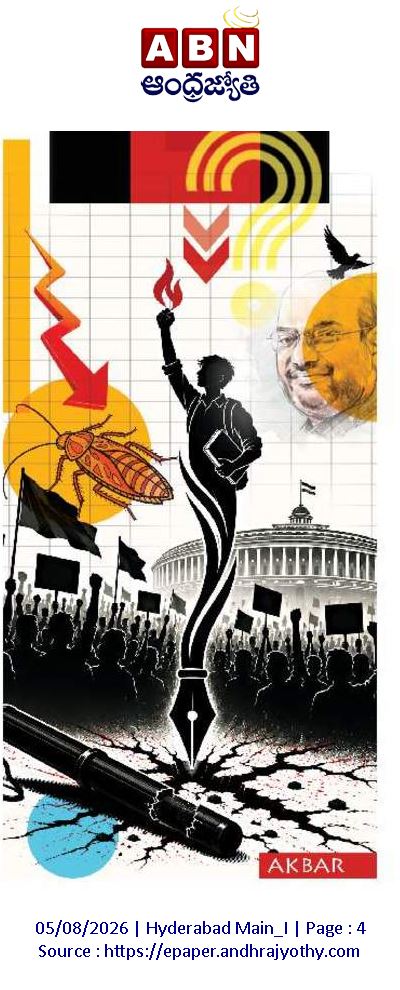
    Moreover, under the current circumstances in the country, the attitude adopted by the courts appears peculiar. A situation is arising in which the courts themselves characterize those filing cases on public issues as cockroaches, idle people, or obstacles to development. “The Centre is spending money to build roads. Who are you to question the progress of roads under the Right to Information Act? This is yellow journalism,” the Supreme Court reportedly told an RTI activist on Tuesday before dismissing the case.

    Some say that it is politics for the ruling party to try to secure majorities in legislative bodies and achieve its desired objectives. Others call it Machiavellian politics. Whatever one may call it, it is not wrong to question the methods being adopted and the institutions that are failing.

  • Modi’s Ascendancy and the Opposition’s Search for Direction

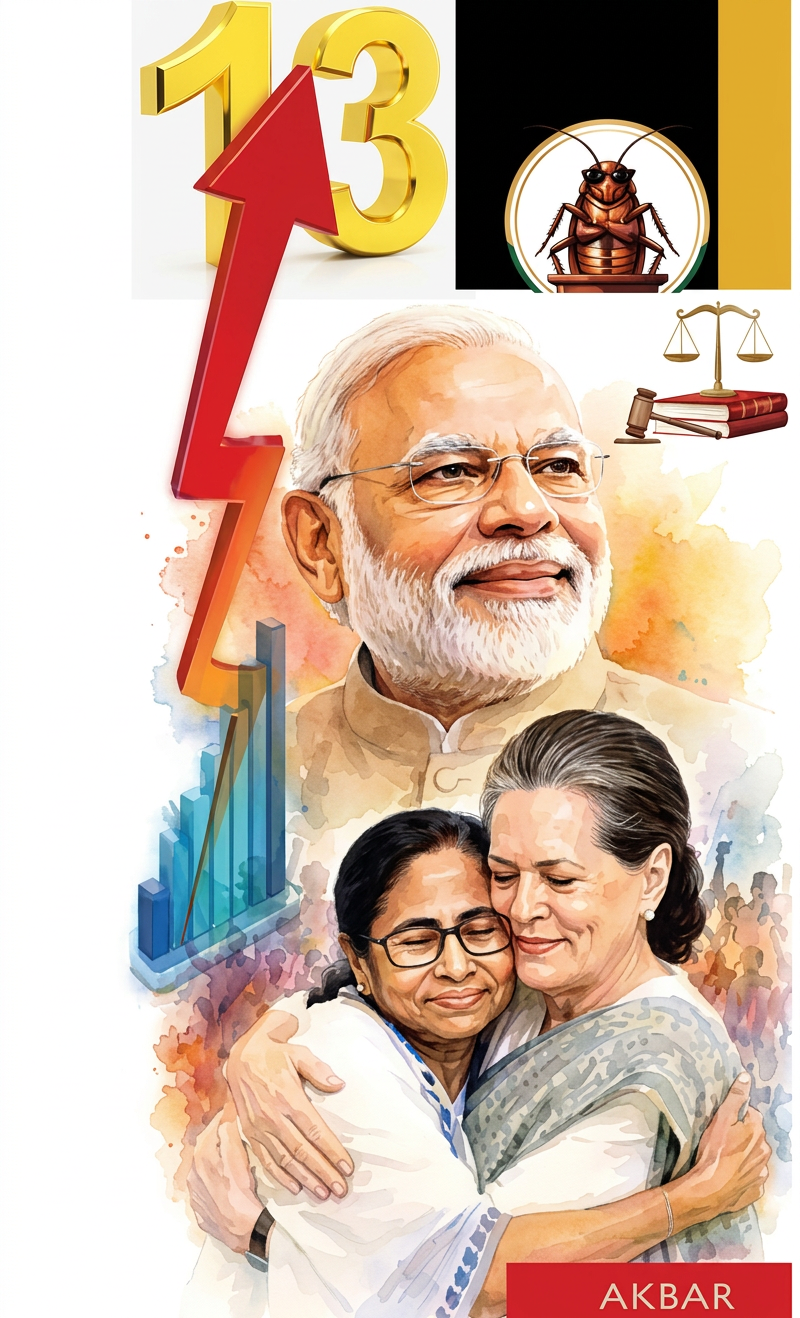
    On Monday, at the INDIA alliance meeting held in Delhi, Trinamool Congress supremo Mamata Banerjee, who appeared with a faded face, was tightly embraced by former Congress president Sonia Gandhi. Who other than one woman can understand another woman’s heart? “Some scenes cannot be expressed in words,” remarked a senior leader.

    These two were once described by international organizations as the most powerful leaders in the country. While Sonia ruled the country’s politics for more than ten years, Mamata Banerjee ruled Bengal politics for 15 years. But they are not unaware that the present circumstances are different.

    After the results of the five state elections announced last month, anti-BJP forces met again in Delhi. Mamata Banerjee and the Left parties, forgetting that until yesterday they were also fighting Congress, have become ready to join hands with Congress at the national level. Mamata Banerjee also appears to have forgotten that Rahul Gandhi, the Leader of the Opposition in the Lok Sabha, had only recently criticized her harshly over her anarchic and corrupt rule. She also may not now remember that in 2021 she dreamed of the Prime Minister’s post and declared, “Congress has become ineffective in the country. I alone will play the key role at the national level.”

    The tigress-like Mamata Banerjee, who rebelled against Congress in 1998 and launched her party by holding a rally in Kolkata while the AICC plenary session was taking place, now appears to have had her claws removed. Public representatives belonging to her party in both the Lok Sabha and the Assembly have declared rebellion against her. Her right-hand man Abhishek Banerjee, MP Kalyan Banerjee, and other party leaders are facing attacks on the streets. The same methods Mamata Banerjee once employed against her opponents are now being used against her by her rivals. While Mamata Banerjee and her followers are now crying in the wilderness on the streets of Kolkata, Congress leaders have become the ones standing by her. In this context, it appears that Mamata Banerjee has realized that Congress alone is her refuge if she is to face a mighty force like the BJP both in the state and in Delhi. Though Congress and the Left did not win many seats in the Bengal Assembly elections, they were able to damage the Trinamool considerably. In minority-dominated areas such as Murshidabad, Malda, and Uttar Dinajpur, the Congress–Left alliance ensured that Trinamool did not receive its traditional support. In 32 Assembly constituencies where Muslims constitute more than 50 percent of the population, Trinamool did not win even a single seat. In the Jangipur constituency, the Congress candidate secured 31,000 votes while the Trinamool candidate received only 10,542 votes. Likewise, in the Karandighi constituency, CPI(M) secured 39,000 votes, while the BJP candidate won with 20,000 votes. Perhaps the manner in which these results came has taught Mamata Banerjee lessons about her arrogance, authoritarian approach, and disregard for allies. That is why she is now seen on the streets of Delhi.

    Likewise, for the Left parties, whose ground is slipping from beneath their feet in the country, the streets of Delhi have also become a refuge. In the 140-member Kerala Assembly, the Congress-led UDF winning more than 100 seats, the BJP winning three seats, and the defeat of most ministers in Pinarayi Vijayan’s cabinet cannot be ignored. Analysts described the Left alliance’s defeat there as the result of Pinarayi Vijayan’s centralized and arrogant governance, severe disappointment among farmers, youth, and ASHA workers, dissatisfaction among party cadres, and public resentment against ten years of rule. Congress leaders such as Rahul Gandhi and Revanth Reddy criticized Pinarayi Vijayan, alleging that he was colluding with the BJP and encouraging corrupt elements. They questioned why central agencies had not investigated Vijayan. Be that as it may, the Left parties, which have reached a situation where they are not in power anywhere in the country for the first time in five decades, have realized that they have no option except to work together with other anti-BJP forces. Left leaders D. Raja and John Brittas, who attended the INDIA alliance meeting, have that clarity.

    The late CPI(M) General Secretary Sitaram Yechury, who passed away two years ago, understood the present situation in the country very well. When Congress inducted Prasenjit Bose, who had been expelled by CPI(M), Rahul Gandhi joked with Yechury, saying, “We have taken your comrade into our party.” Laughing, Yechury replied, “What is yours and ours? In this struggle, both of us are travelling in the same boat.” He had long ago understood the need for all anti-BJP forces to shed their narrow-mindedness and work together to confront the BJP, which was advancing unchecked across the country. Today, none of the parties in the NDA are fighting among themselves. But the parties in the INDIA alliance do not possess that level of unity. How much sincerity of purpose do the 23 parties that met at Delhi’s Constitution Club after nearly two years really have? What is the significance of the DMK and Aam Aadmi Party not attending? After the Emergency, in 1977, opposition parties contested against Congress under a single election symbol in the name of the Janata Party. How many parties today possess that same sincerity and fighting spirit? Can Congress provide leadership to other parties in the same way that the BJP has been able to guide even its allies along its ideological path?

    Two days after the INDIA alliance meeting, Prime Minister Narendra Modi organized a meeting of NDA allies on the occasion of completing 12 years in power. Though nominally an NDA meeting, it is in reality a BJP meeting. Leaving aside small states like Nagaland, Meghalaya, and Puducherry, Andhra Pradesh is the largest state where NDA rule is currently in effect. Until recently, Janata Dal (United) chief Nitish Kumar was the Chief Minister in Bihar. Now, even there, a BJP leader is Chief Minister. With his entry into the Rajya Sabha, the 12 JD(U) MPs in the Lok Sabha will have to regard Modi as their leader. While Trinamool has 28 MPs in the Lok Sabha, 20 MPs under the leadership of party chief whip Kakoli Ghosh Dastidar have decided to write to Speaker Om Birla seeking recognition as a separate group after rebelling against Mamata Banerjee. At some auspicious moment, they too may have no option but to join the BJP and wear the saffron scarf as BJP MPs. That means the BJP effectively already has a full majority in the Lok Sabha even without the support of the Telugu Desam Party. Moreover, seven MPs from Shiv Sena, five from Lok Janshakti Party, two from Janata Dal (Secular), two from Rashtriya Lok Dal, one from the NCP Pawar group, two from Apna Dal and Hindustani Awam Morcha, along with six MPs from northeastern states, are already supporting the BJP. Since Modi came to power, the Bharatiya Janata Party has earned the distinction of splitting several regional parties such as Shiv Sena, NCP, Lok Janshakti Party, Rashtriya Lok Samata Party, Aam Aadmi Party, and Trinamool, and also attracting many leaders from other parties into its fold. Not only that, during Modi’s tenure, parties such as BSP, BJD, DMK, and AIADMK have faced tests of survival, making their future uncertain. A situation has arisen in the country where many regional parties feel that their survival will be difficult unless they surrender to Modi.

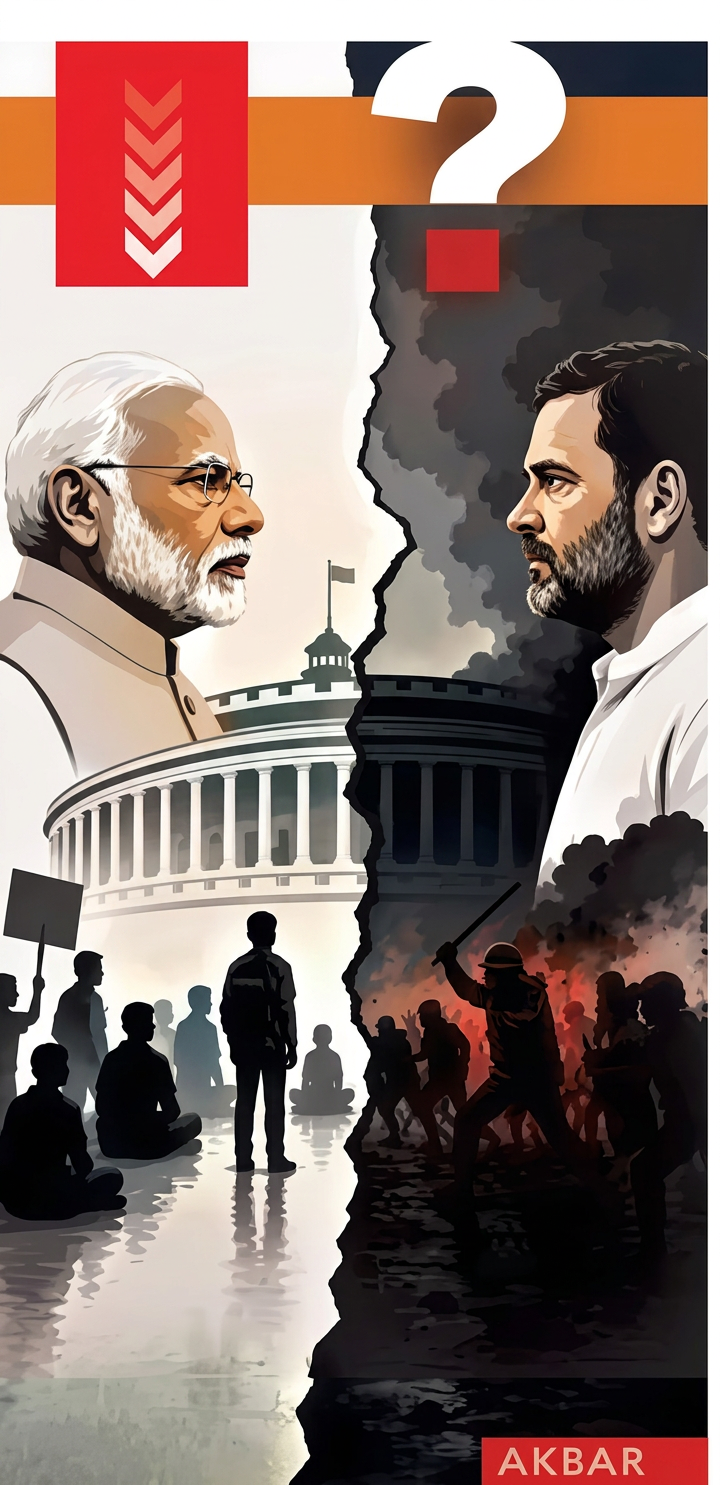
    In this context, as Modi enters his 13th year in power today, no one can deny that his political strength is increasing day by day, despite social media commentary about how intense his politics may become, developments such as the “cockroach party,” the weakening of democratic institutions, allegations that the judiciary has surrendered, and the flood of criticism over the failure of institutions such as NEET and CBSE to conduct examinations properly. Without eliminating their internal contradictions and creating an equally compelling alternative vision, what change can opposition parties or other non-BJP forces achieve, no matter how many meetings they conduct?

  • Modi’s Political Dominance and the Challenges of Governance

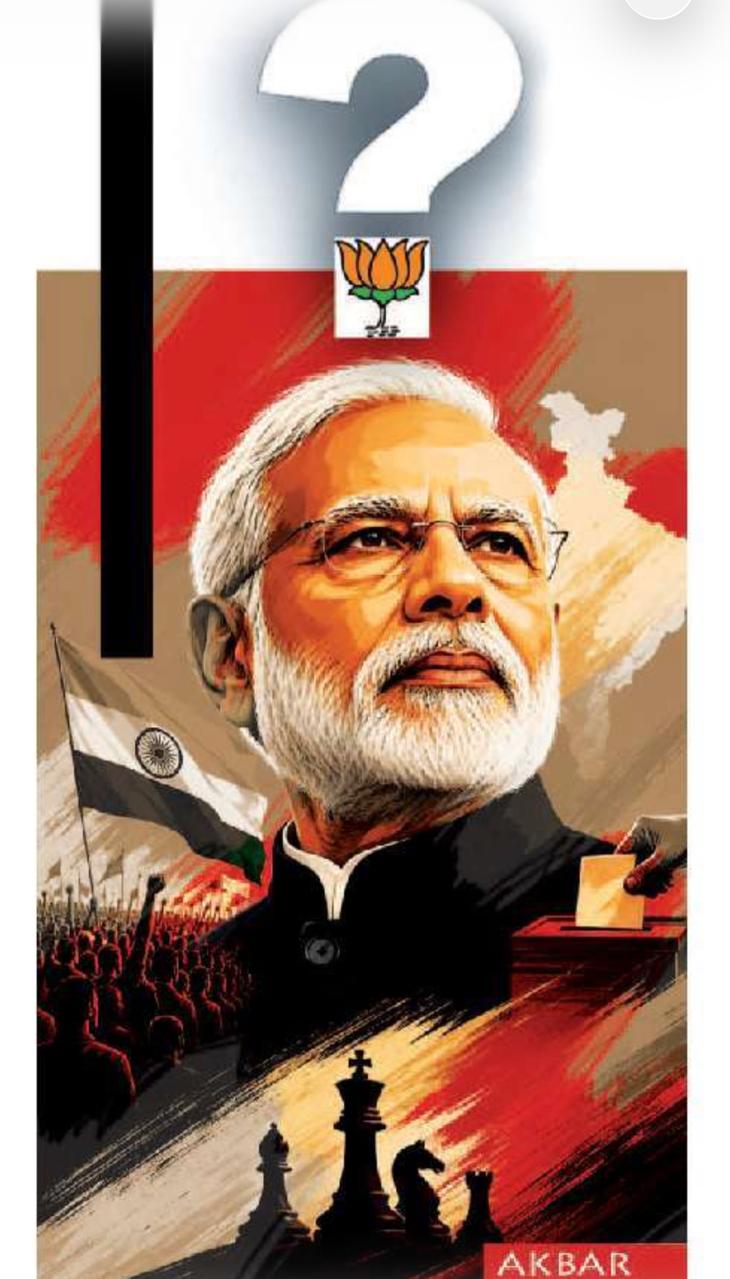
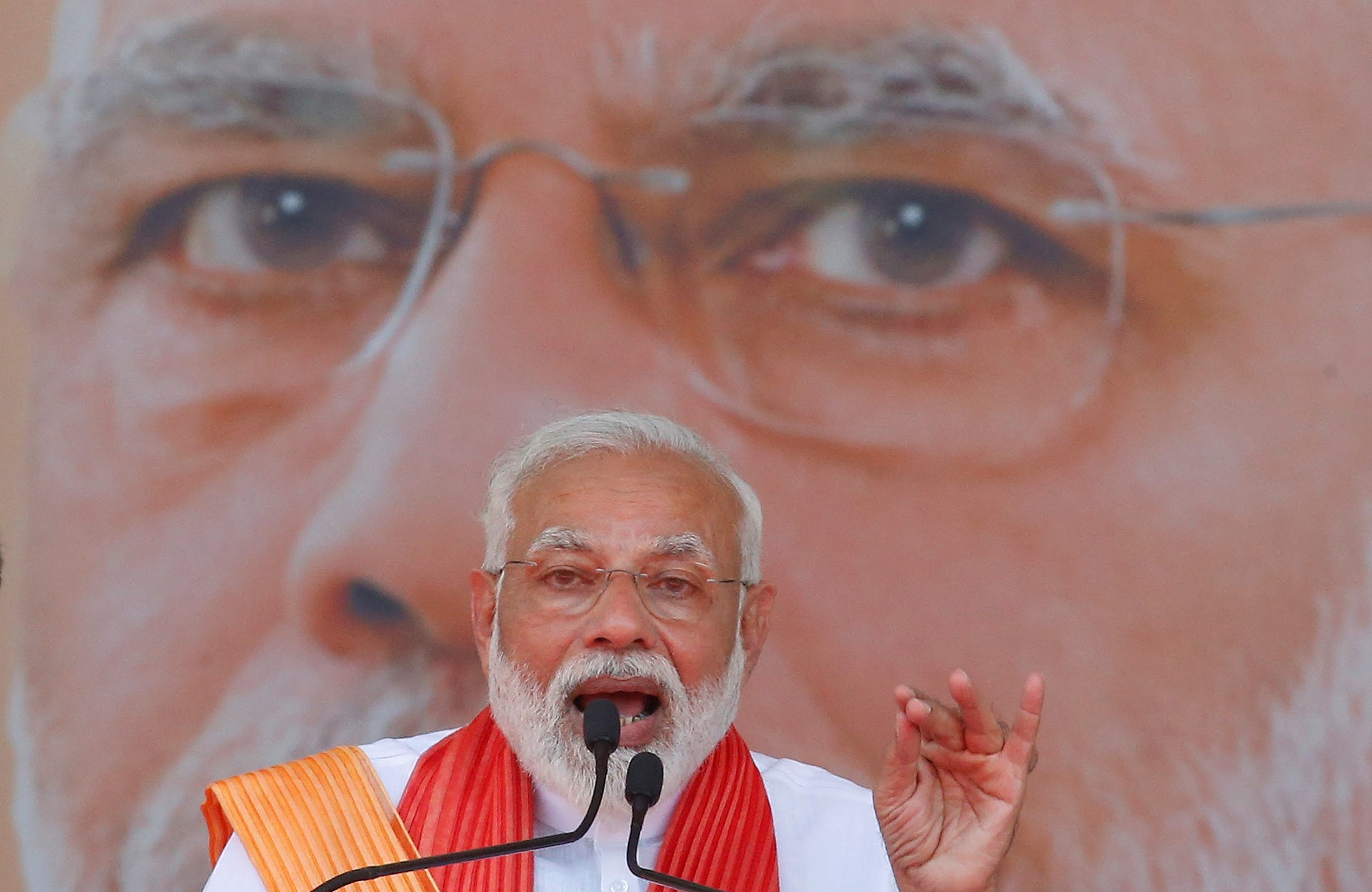
    “You win only when you play. If you don’t play, how can victory come?” Prime Minister Narendra Modi recently said while speaking to young children. Since joining the Bharatiya Janata Party (BJP) in 1987, Narendra Modi has been continuously playing in politics. Completing four decades in this political game next year, he has had no notable defeat so far. In 1987, when he was handed over the responsibility of the Ahmedabad Municipal Corporation as the BJP Gujarat General Secretary, he secured this victory for his party for the first time. Since then, he has never looked back.

    His journey of victory, which began in Gujarat with the corporation win, brought the party to power in the state, and later led to him personally taking over power as Chief Minister, delivering an unchallenged governance for 12 years. Without stopping there, even after taking over the responsibilities as the Prime Minister of the country in 2014, Modi has been continuously continuing in office for 12 years so far.

    By 1987, when Modi entered active politics, the Congress was in power at the Centre and in 15 states. With the recent victory in West Bengal, the BJP and its allies under Modi’s leadership have achieved power in 21 states. In a way, Modi is now in the ascendant phase of his political life. While on one hand preparing for the celebratory milestones of his 12 years of governance, on the other hand, he is getting ready for massive changes in both the party and the government. He is setting the stage for his next political game.

    “Victory is not just a game, it is also like riding a tiger,” political scientists often describe. Once you get down from it, it will swallow you. Baba Saheb Ambedkar said long ago that democracy is not just about victory in elections. Although Modi’s government is unchallenged in politics, India’s economic situation remains worrisome. Economists say that GDP growth is gradually declining, average inflation is doubling, and the pace of development is moving sluggishly. The monthly review prepared in May by the Ministry of Finance under the leadership of Union Finance Minister Nirmala Sitharaman made it clear that international developments are severely impacting India’s economic conditions. The value of the rupee is falling day by day. Crude oil import bills are rising. Reports are coming that petrol and diesel prices have increased four times since May 15 after the assembly election results, and there are chances of them rising again. For the second consecutive week, the decline in India’s foreign exchange reserves is clearly visible. Economists like former Economic Advisor Arvind Subramanian and representatives of the National Institute of Public Finance and Policy are warning that private investments in the country are also declining.

    In May last year, NITI Aayog CEO B.V.R. Subrahmanyam announced that India had overtaken Japan to become the fourth largest economy, but according to the World Economic Outlook recently released by the International Monetary Fund, India has dropped to the sixth largest economy. Regardless of this matter, irrespective of statistical details, everyone knows that the per capita income in the country is at a very low level. Economists state that since 1991, while per capita income in China has increased 38 times, it has increased only 8 times in India.

    The fact that Prime Minister Narendra Modi himself is appealing to the people to practice austerity measures indicates the severity of the situation. Economists say that the government is taking short-term measures from time to time but is not undertaking long-term measures. What are long-term measures? Discussions are ongoing whether it means further accelerating reforms or allowing foreign investments to enter more freely. No one has clarity on what steps Modi is taking in this direction. Organizations like NITI Aayog are also not transparently publishing reports on the country’s economic situation. It has been a long time since such organizations stopped trying to tell the government the actual situation, as they are instead eager to exaggerate minor developments into mountains. Will the situation improve merely by changing the heads of ministers as part of a cabinet reshuffle?

    Secondly, even though the opposition parties in this country have failed to win elections, they seem to have succeeded in creating an impression among the people that institutions are being weakened. They are giving scope to raise doubts not only on the functioning of institutions like the Election Commission, CBI, ED, IT, CVC, and National Testing Agency, but also on the judgments given by the Supreme Court. The strange thing is, even when elections are conducted properly, the credibility of the Election Commission is being questioned. Due to the indiscriminate deployment of agencies like the CBI, ED, and IT against political rivals, trust in them is lost even when they work genuinely. Judges are acting in a manner that raises suspicion whether the boundaries that should exist between the Supreme Court and the government are blurring.

    Ultimately, the fact that a miserable state exists in this country where even exams cannot be properly conducted for students was proven once again with the leak of NEET question papers. More recently, the controversy surrounding the CBSE’s On-Screen Marking (OSM) system has further deepened concerns about institutional competence. What began as isolated complaints soon turned into one of the biggest credibility crises faced by the country’s premier school education board. Remarkably, it was not political parties or government agencies that exposed the issue, but three young students. Vedant Shrivastava brought attention to the problem after allegedly receiving another student’s answer sheet during the verification process. Nisarga Adhikary, a young cybersecurity researcher, claimed to have uncovered serious vulnerabilities in the digital evaluation portal that could expose sensitive student data and examination records. Sarthak Sidhant raised questions regarding the tendering and procurement process behind the system’s implementation. Together, these three students forced a national debate on transparency, accountability, digital security, and administrative responsibility in the education system. Even CBSE was eventually compelled to acknowledge vulnerabilities in parts of the system after initially rejecting the allegations. The episode demonstrated how public institutions can lose credibility when legitimate concerns raised by students are not addressed promptly and transparently.

    The way the youth of this country responded in an unprecedented manner to the call given on social media under the name of ‘Cockroach Janata Party’ creates a feeling that a fire is smouldering somewhere. It is naive to think that those who ask questions will decrease just by suspending social media accounts. Therefore, it must be considered that the Modi government succeeds only when it tries not just to win elections, but to increase the credibility of institutions and to solve the problems of the youth of this country.

    Moreover, the political victories of the Modi government are not completed with the victory in Bengal. From next year onwards, they have to win again in BJP-ruled states. This includes the Prime Minister’s home state of Gujarat, as well as the largest state Uttar Pradesh, Madhya Pradesh, Rajasthan, and other states. The BJP’s situation in the four southern states is not very grand. In Karnataka, the BJP has no independent identity of its own outside of Yediyurappa. Even though several top RSS leaders like Dattatreya Hosabale, Santhosh, and Mukund hail from Karnataka, the BJP is unable to establish itself firmly there. As for Telangana, no party seems better than the BJP at cutting the very branch it is sitting on. In Tamil Nadu, Annamalai, who was once the party president, announced that the BJP has no future and is preparing to look out for his own path. BJP leaders do not seem to have realized that gaining acceptability in the South is more important than in Bengal.

    However, whatever Modi’s weaknesses may be, how far Congress is trying to utilize them remains a matter of debate. No one can say what Congress is doing to confront the BJP head-on in UP, Gujarat, Madhya Pradesh, and Rajasthan. After Congress won in Kerala, the Congress high command took 11 days to decide the Chief Minister. It took Rahul Gandhi these many days to realize that the people, senior party leaders, and the cadre there completely admire Satheesan. He could not restrain his right-hand man KC Venugopal, even though the latter made intense efforts to become the Chief Minister himself.

    Similarly, without even enjoying the happiness of winning in Kerala, the Karnataka headache started for Delhi. The Delhi elders are dragging both Siddaramaiah and DK Shivakumar along, in a helpless state where they cannot bring about a compromise between the two. Siddaramaiah, who represents the AHINDA group consisting of minorities, backward classes, and Dalits on one side, and DK, who is extremely loyal to the party and has stood by the high command in every crisis on the other side, have left the high command at a total loss. In fact, DK, who once had to move Gujarat MLAs to Bengaluru to ensure Ahmed Patel’s victory, had to get entangled in several cases. Ultimately, he even had to go to Tihar Jail. While it is justifiable to give the Chief Minister post to such a person as DK, nothing can be said right now about the future course of action of Siddaramaiah, who made it clear that he will remain active in politics and will not come to the Rajya Sabha.

    A situation arose where Shivakumar had no choice but to include everyone suggested by Siddaramaiah in his cabinet. For the past 20 days, Delhi hotels and the AICC have been overcrowded, initially with Kerala leaders and now with Karnataka leaders. Although infighting exists in Congress in every state, Delhi is in a situation where it can do nothing.

    That situation has never existed in the BJP. Even though there are BJP Chief Ministers in 17 states, there is no record of even a single one coming to Delhi for cabinet expansion or other changes. The BJP top brass has the grip to dictate who should be appointed without them needing to visit. That is the difference between the BJP and the Congress. That is also the secret behind their victories and defeats.

  • Tamil Nadu’s Message to India’s Political Class

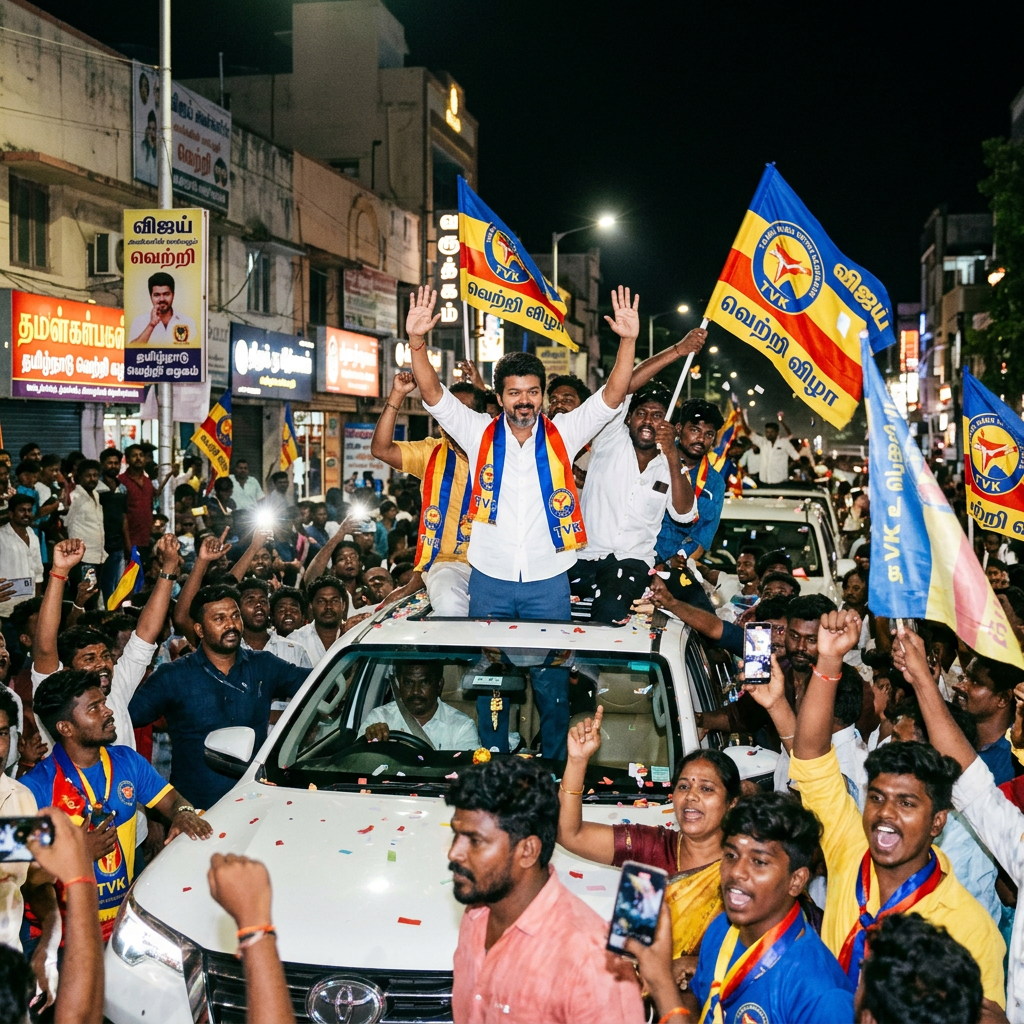
    Man standing on a car waving to crowd with supporters holding flags in a night rally
    Supporters cheer enthusiastically around a leader standing on a car during a lively political rally at night.

    In Andhra Pradesh, there was a political leader who used to send various kinds of gifts door to door in his constituency. On every occasion, he distributed sweets and snacks; during festivals, Raymond clothes for men and silk sarees for women. Every newly married couple received a gold mangalsutra pendant, silk clothes, and silver anklets as gifts. During elections, things went even further. Reports said that a separate truck was used exclusively for distributing cash lavishly. Even then, he lost the last election by a margin of more than 43,000 votes.

    This single example is enough to show that if people truly decide, no amount of inducement can make them surrender their conscience. Even though political parties and leaders are aware of this, they continue making every possible attempt to lure people and buy votes. This does nothing except create disgust among the public toward political leaders. When leaders try to purchase votes, people naturally begin to wonder how much these politicians are earning in politics and how much public money they are looting. Many people feel that all this money being distributed is nothing but wealth stolen from the public itself.

    Recently in Tamil Nadu, the DMK and AIADMK distributed money on a massive scale. Estimates suggest that between ₹20 crore and ₹50 crore was spent in each constituency. Videos showing these parties distributing cash in envelopes ranging from ₹3,000 to ₹10,000 circulated widely on social media, yet the Election Commission hardly paid attention. An NGO called “Arappor Iyakkam” even lodged a complaint with the Election Commission regarding the large-scale cash distribution. Surprisingly, the TVK party of actor Vijay, which reportedly did not distribute money at all, succeeded in getting the highest number of its candidates elected. Along with Chief Minister Stalin, 15 DMK ministers were defeated. In one constituency, a four-time DMK minister lost to an auto driver. Elsewhere, the son of a car driver won. In many constituencies, TVK candidates won with huge majorities, while in at least 20 seats they lost by extremely narrow margins. These developments prove that if elections had been conducted without the influence of money power, a massive Vijay wave would likely have swept Tamil Nadu.

    In recent democratic history, Vijay earned the distinction of winning elections in a state without purchasing votes from people. In fact, Vijay did not campaign extensively across the state. In many places, his party relied on cutouts, holograms, and duplicates for campaigning. Keeping in mind the stampede incident at Karur, he cancelled many rallies. TVK candidates themselves did not campaign aggressively in several constituencies. There were even reports that in some places DMK and AIADMK candidates offered money to TVK candidates and told them to stay home and rest. In many constituencies, TVK candidates did not even go to the counting centres. They were surprised to learn from television broadcasts that they had won.

    Although huge crowds attended Vijay’s meetings, many believed TVK could not succeed because the party lacked organizational machinery, proper local coordination, sufficient funds, and experienced candidates. In many constituencies, campaigns were carried out with nothing more than a small van, two auto-rickshaws, and a few children blowing whistles while walking ahead of the candidates. In several places, students and women voluntarily went door to door campaigning. Small donations were collected for campaign expenses. In some constituencies, there were not even TVK posters. Often, people could not even recognize TVK candidates when they walked on the roads.

    The Tamil Nadu elections should serve as a lesson to parties that rely on money power, muscle power, and manipulation of systems to come to power. It should open the eyes of those who collect funds from corporate companies in the name of electoral bonds, allot Rajya Sabha seats to donors, and even launch companies for them. Illegal funding from corporations forces governments to return favors through project allocations, ignore irregularities in those projects, and encourages politicians who buy votes to indulge in further corruption to recover their election expenses. Through such corrupt practices, entire systems have become rotten. Electoral corruption plays a major role in India’s political and administrative system. Legislatures are increasingly filled with corrupt individuals, corporates, and wealthy elites. Ordinary people are finding it impossible to contest elections. There is little doubt that black money amounting to 20–50 percent of the country’s GDP has become part of the electoral system.

    Officially, the Election Commission says that an MP candidate can spend up to ₹95 lakh and an MLA candidate up to ₹28 lakh. But politicians themselves say that in reality, this amount is not sufficient even for a single day of campaigning. Although the Election Commission officially seized black money worth ₹10,000 crore during the 2024 general elections, estimates suggest that around ₹1.35 lakh crore actually circulated during the elections—far exceeding the expenditure in the 2020 U.S. elections. The Centre for Media Studies had earlier estimated that an average of ₹1,500 is paid as bribes to every voter in the country. It would not be an exaggeration to say that election observers appointed by the Election Commission have become clowns in this entire drama. Instead of preventing electoral malpractice, they appear more focused on deciding which party should win.

    It appears that the people of Tamil Nadu responded against this vicious cycle of corruption and illegality. Out of the 107 MLAs elected from Vijay’s party, 93 were first-time entrants into politics. Half of them were between 40 and 45 years old. This helps explain the direction in which Tamil Nadu’s youth and Dalits are thinking. It also suggests that they are no longer interested in hollow identity slogans and ideological rhetoric. What they really want is simple: systems that function properly. They want efficient public services in return for the taxes they pay. They want government offices—especially revenue departments—to function properly, without power cuts and delays. Instead of political parties constantly raising emotional slogans and provoking caste, religious, or regional divisions to divert public attention, the country can become modern and ideal only when systems are reformed according to the aspirations of the youth.

    Although India ranks 91st among 182 countries in the corruption index, no government appears to be sincerely working to eliminate corruption within systems. Political parties focused solely on winning elections show little interest in institutional reforms. A recent example is the NEET question paper leak scandal. Over the last four years, question paper leaks have occurred in one form or another. Reports stated that question papers for the May 3 entrance examination were sold under the guise of “guess papers” for amounts ranging from ₹10 lakh to ₹25 lakh, and that a mafia network stretching from Rajasthan, Haryana, Maharashtra, and Uttarakhand to Kerala was responsible for the leak.

    Even after it was discovered last year that students who selected the same examination centre in Godhra, Gujarat scored unusually high marks, the examinations were not fully cancelled. Although a committee headed by former ISRO chairman Radhakrishnan was appointed to investigate the 2024 irregularities, its report merely gathered dust and was never implemented. Even after the CBI investigated 144 people who had purchased leaked question papers and submitted its findings to the Supreme Court, the Court concluded that there was no evidence of a nationwide systemic failure.

    Medical education in India costs crores of rupees. Affordable medical colleges are very few. This is one of the reasons behind examination paper leaks. What is the use of leaders delivering moral sermons when they cannot make education and healthcare accessible to ordinary citizens? After all, are these not the very sectors where people could save the most money?

    Meaningful change will not come unless the kind of political awareness shown by the generation that voted for Vijay in Tamil Nadu spreads across the country. Only when a new political consciousness emerges among the youth nationwide, as seen in Tamil Nadu, can real transformation become possible.

  • BJP’s Southern Challenge: Can the Saffron Wave Cross the Vindhyas?

    Crowd of BJP supporters holding Indian flags and BJP lotus flags at a political rally with party leaders on stage

    When will the BJP’s triumphant march reach the South?

    For several decades, red waves used to surge every year at Kolkata’s Brigade Parade Ground. But on May 9 this year, saffron waves swept across it instead. In the presence of Prime Minister Modi and thousands of people, Suvendu Adhikari took oath as the BJP’s first Chief Minister in West Bengal. Exactly a day later, on Sunday, in Chennai’s Jawaharlal Nehru Stadium, film actor Chandrasekaran Joseph Vijay took oath as the 9th Chief Minister of Tamil Nadu in the presence of national opposition leader Rahul Gandhi. Vijay’s coronation too witnessed an equally massive public turnout. This development clearly indicates that while the Bharatiya Janata Party has firmly rooted itself in Hindi-speaking states, expanded in western states like Gujarat and Maharashtra, in northeastern states such as Assam, Arunachal Pradesh, Manipur, and Tripura, and in the eastern coastal region first through Odisha and now Bengal, entering the South is not going to be easy. On one side stands Suvendu Adhikari, and on the other Joseph Vijay — both appearing as reflections of these changing political realities. Do these two events represent two distinct dimensions in the thinking of the Indian people?

    While Narendra Modi, standing beside Suvendu Adhikari in Bengal, is now eager to expand into the South, Rahul Gandhi, who stood beside Joseph Vijay after achieving success in Kerala, has been unable to regain lost ground in North India despite repeated efforts. The southern states that once resisted Congress have not particularly welcomed the BJP either. In Andhra Pradesh, Telangana, and Tamil Nadu, there has been no experiment or attempt left untried by the BJP to gain entry.

    In Andhra Pradesh, the BJP accepted the dominance of the Telugu Desam Party. In Karnataka, after losing power, it is making every possible effort to regain it. In Tamil Nadu, after realizing that strengthening independently is difficult, it had no choice but to once again ally with the AIADMK. In Kerala, although the BJP won 3 seats for the first time in this Assembly election, its vote share did not increase significantly compared to the past. If Kerala and Tamil Nadu remain distant dreams for the BJP, the only promising states appear to be Karnataka and Telangana. That is why Prime Minister Narendra Modi toured these two states immediately after the results of the five-state elections were announced. However, his tours in Karnataka and Telangana were markedly different. In Karnataka, Modi declared that people were inclining towards nationalist politics and that a saffron wave would soon sweep the state. But in Telangana, he did not express the same confidence.

    In 1984, among the only two seats won by the BJP nationwide, one was Mehsana in Gujarat and the other was Hanamkonda in Telangana. Today, while the BJP has come to power in many states including Gujarat, it has still not expanded in Telangana to the extent expected. Modi himself reportedly mentioned this to state leaders and criticized them. During Bandi Sanjay’s tenure as state president, some enthusiasm had developed within the BJP cadre, but later that momentum gradually faded. The Sangh Parivar organizations may be able to steer people toward Hindutva ideologically, but it is BJP leaders who must create political momentum among the people. During Modi’s latest visit, he did not publicly provide any direct guidance to BJP leaders. He knows that the strategies adopted in North India and Bengal may not work in the South. However, his words and meetings regarding Telangana suggest that he may have some strategy in mind. Time alone will reveal what it is.

    With the BJP’s victory in Bengal, it appears that after Mamata Banerjee, every force capable of challenging the saffron party is gradually disappearing. At the same time, questions are arising whether even the national party Congress is capable of taking on the BJP. Leaders who tried to unite opposition parties against the BJP have all collapsed one by one. Nitish Kumar, Mamata Banerjee, M.K. Stalin, KCR, Sharad Pawar, Kejriwal, and Uddhav Thackeray all once sought to unite the opposition against Modi. Nitish Kumar, who made intense efforts in 2023 to unify the opposition, later shifted towards the BJP for power and has now effectively handed over power to the BJP itself. Modi used every possible political strategy to sideline leaders capable of offering alternative politics nationally. None of them are now in a position to challenge Modi at the national level; instead, they are struggling for survival at the state level. In Maharashtra, after splitting the Shiv Sena and NCP to establish dominance, the BJP also encouraged rebellion within the Aam Aadmi Party. Although a new force has emerged in Tamil Nadu, it is too early to determine how much strength it can gather before the Lok Sabha elections. The Left parties’ only government is now under Congress influence. The Left’s presence in Parliament is also steadily declining.

    As regional parties and Left parties weaken, a situation is emerging where Congress alone must face the BJP. Perhaps the BJP desires exactly that. Anti-BJP politics appears to be either weakening or losing relevance altogether. This is evident both at the leadership level and at the ideological level. Consequently, even in the South, parties are no longer hesitant to join hands with the BJP or accept its political ideology. It is difficult to say how long it will take for anti-BJP sentiment to spread beyond the “paper tigers” of social media into the broader public.

    Congress ruled the country for decades after Independence, but gradually weakened over time. The condition Congress finds itself in today resembles the condition the Jana Sangh and later the BJP once faced. Within just two years, the BJP managed to come to power in Odisha, Bihar, and West Bengal in the East. It secured power for a third consecutive term in Assam. In the West, BJP has its own Chief Ministers in Rajasthan, Gujarat, and Maharashtra. In Gujarat, it has been in power continuously for 30 years. Except for Jharkhand and Himachal Pradesh, BJP Chief Ministers govern almost the entire Hindi belt. Even in Punjab, the BJP has already begun plans to gradually establish itself. If the BJP could establish dominance in the North, East, and West, is entering the South truly impossible?

    However, in electoral politics, the BJP has become so strategically sophisticated that defeating the party now seems nearly impossible. No one has been able to crack the BJP’s winning formula in elections. The BJP leaves no instrument unused in its pursuit of victory; whether those methods are ethical or unethical is irrelevant to the party. Since Trinamool Congress leaders themselves admitted that the BJP won 31 seats because of “Sir,” it is likely that the BJP deployed additional strategies to win the remaining seats.

    No political party can remain at its peak forever. If the BJP is to lose that position, it must become the cause of its own downfall. An alternative political force capable of dethroning the BJP must emerge. Conditions must arise where people begin resisting the party at every step. None of these three possibilities seem likely in the near future. Ordinarily, anti-incumbency sentiment against governments becomes visible, but the BJP has managed to overcome even that. BJP leaders are experts at neutralizing anti-government sentiment. In Assam, despite ruling twice, not only did Congress fail to defeat the BJP, but even Gaurav Gogoi — a three-time MP and Congress’s Chief Ministerial face — lost by a margin of 23,000 votes. What more needs to be said?

    It is impossible to predict how much strength the opposition can build before the 2029 general elections to challenge the BJP. It is uncertain how many parties will align nationally with a Congress that defeated the Left in Kerala while simultaneously trying to weaken Trinamool in Bengal with Left support. Even if all opposition parties unite again, creating an ideological foundation and leadership capable of defeating the BJP will not be easy. Leaders like Jayaprakash Narayan and V.P. Singh are unlikely to emerge again. In reality, many votes now won by regional parties once belonged to Congress. If regional parties weaken, Congress should theoretically regain those votes. But Congress has not been able to rebuild that strength. In Hindutva politics, the BJP has no competition. Organizationally too, Congress cannot match the BJP. Congress has failed to inspire confidence that it can defeat the BJP in a direct contest. What message will the elections in Uttar Pradesh, Madhya Pradesh, Rajasthan, Karnataka, Telangana, and other states over the next two years deliver? Will Karnataka and Telangana preserve their distinctiveness like Tamil Nadu? Only time will tell.

  • The Great Women’s Reservation Show: Reform or Electoral Strategy?

    Illustration of a woman ascending steps labeled Reservation, Quota, and Reservation in a legislative chamber with supporters holding signs for empowerment and equality and opponents debating.
    “Will this bill pass? My boss is asking me again and again,” a friendly-party MP asked Parliamentary Affairs Minister Kiren Rijiju last week. “Why do you have that doubt? As long as Narendra Modi is Prime Minister, whatever he decides will be achieved under any circumstances. A lot of efforts are happening behind the scenes. Many people will lean towards us. Just wait and watch,” he told that leader. “Not only that, I myself will speak to your boss,” he said, personally calling him and assuring, “There are no obstacles for the bill to pass.” Following this, arrangements were made in that state to gather large numbers of women and celebrate.

    In fact, it did not appear that even the Prime Minister had any apprehension that the bill might not be approved. From the second week of April, women from across the country were being brought to Delhi. BJP national president Nitin Nabin called state presidents and key leaders and instructed them to organize women’s conferences in the states and hold press meets on women’s reservation. A large conference with women was held at Vigyan Bhavan, where Prime Minister Narendra Modi spoke. Key women leaders from the party were brought to the central office and trained to go among the public and speak to the media. Documents were prepared and distributed showing how many seats would increase in which states. Eventually, the Lok Sabha galleries were filled with women representatives. The national capital and Parliament premises were vibrant with women. Many women dreamed that they too would soon enter the House; some even identified their prospective seats.
    However, on the very first day of the Parliament session on April 16, it became clear that the opposition was united. Behind-the-scenes efforts intensified to win over or ensure the absence of opposition members. Modi even had to warn, “If this bill fails, women will not forgive the opposition.” Doubts were raised about whether opposition MPs from states going through elections would attend the session. In West Bengal, Trinamool Congress chief Mamata Banerjee is facing unusually tough competition this time, and her party MPs were deeply engaged in campaigning. Despite efforts to stay united, seven Trinamool MPs had to be absent during voting. Even so, since there was a significant gap between the two-thirds majority required in the Lok Sabha and the NDA’s strength, the constitutional amendment inevitably failed.

    Just as there are many reasons behind Karna’s death, there are many reasons behind the failure of this bill. Why did what was considered a historic moment ultimately turn into a farce? When all parties unanimously approved the constitutional amendment bill for women’s reservation in 2023, why was it opposed now? Why was there a need to modify that bill? If it had to be changed, why were efforts not made to build consensus on it as well? If women’s reservation is to be implemented in 2029, there is still three years’ time—then why extend budget sessions and hold special sessions during ongoing assembly elections? In the Bengal elections, which Modi has taken very prestigiously, was the women’s reservation issue used as a move to attract women voters? If so, why link reservation with an increase in seats through a constitutional amendment? Since an increase in seats would also benefit the Samajwadi Party in Uttar Pradesh, was this strategy aimed at drawing that party closer? Did the government not anticipate that basing delimitation on population, the absence of a proposal for a 50% seat increase, and rising concerns about North–South disparities would lead to suspicion? Even though Home Minister Amit Shah said at the last minute that the bill would be modified, the opposition did not agree—this shows the deep mistrust between the ruling party and the opposition. It also did not appear that the government anticipated criticism that using the 2011 census as a basis would ignore OBCs.
    In our country, politics driven by short-term gains and excessive publicity sometimes pushes back even necessary decisions like women’s representation.

    The job of an MP or MLA is to enact new legislation. They have to perform legislative functions. An MP may represent a single Lok Sabha constituency, but when they sit in the Lok Sabha, they are responsible for the 1.4 billion people of the country. They are part of the law-making process. The laws made by their votes apply to every citizen of the country. They determine each citizen’s fate. The Constitution provides for the executive to handle citizens’ daily needs. The executive is responsible for implementing laws made by the legislature. If Parliament or the Legislative Assemblies make good laws and the executive implements them effectively, citizens’ problems will be resolved.

    Therefore, there is a need to work on improving the quality of laws made in Parliament and the state legislatures. There is a need to work on improving the quality of debate and discussion in Parliament or the Legislative Assemblies. Then, arrangements must be made for better implementation of those laws. Increasing the number of MPs or MLAs will not change anything.

    If there is a water, electricity, or sewage problem in an MP’s constituency, the local administration must resolve it. If there is a law and order problem, the police will address it, not the MP. Therefore, it is essential that the number of police stations be increased in proportion to the population growth, the number of police personnel be increased and they be better trained, and the number of civil service staff and officers be increased so that citizens’ problems can be resolved.

    As the population grows, the number of schools and teachers should be increased. As the population grows, the number of hospitals and doctors should be increased. As the population grows, civic amenities should be developed. As the population grows, infrastructure should be developed. While this is not to say that work is not being done in this direction, it is not being done in proportion to the population growth. No one can deny the fact that the quality of civil services is continuously deteriorating.

    Therefore, the entire delimitation debate is a ‘misplaced priority’. It could also be called ‘barking on the wrong tree’. It will not bring any qualitative change to the country’s current legislative or executive system. On the contrary, it will deepen the division between North and South India.
    If, as Modi hopes, women in large numbers shift toward the BJP in the Bengal elections, the party is bound to achieve a major victory. This time, 200,000 more women voters have been added in Bengal. Out of 67.5 million voters, 34.4 million are women. Moreover, in the last elections, more women than men voted—88% of women cast their vote. Not only in Bengal but across the country, women’s voting percentages are rising faster than men’s. In many states, schemes targeting women have benefited ruling parties in elections. Therefore, there is little doubt that Modi used women’s reservation as a strategic move to attract women voters away from Mamata Banerjee. In fact, compared to all parties, Mamata Banerjee has provided greater representation to women—about 33% in her party. Of 29 Trinamool MPs, 11 are women; 20% of her cabinet are women. This time, the party has given tickets to 52 women, more than any other party. Welfare schemes like Kanyashree and Lakshmi Bhandar have also gained popularity. So whether the BJP can attract women voters through the reservation bill remains debatable—but if the BJP wins, it will have the opportunity to claim that women made the difference.
    More than women, the BJP has focused this time on Hindu-majority seats. In West Bengal’s 294 seats, only 234 have less than 40% Muslim population. The BJP had won 77 of these seats in the last election. Before 1977, Muslims supported Congress; until 2006, the Left; and since then, the Trinamool Congress. They have been a key factor in Mamata’s success.

    The BJP, which had virtually no presence in West Bengal until 2014, secured 17% votes in the 2014 Lok Sabha elections and increased it to 40% in 2019. This percentage hasn’t changed much in the last seven years. The gap between Trinamool and BJP is about five percent. To bridge this, consolidation of Hindu votes is necessary—and within that, Hindu women’s votes are crucial.
    Ultimately, increasing the number of MPs and MLAs may create more political positions and even increase women’s representation numerically, but without deeper institutional reforms, it is unlikely to bring meaningful change on the ground.
     
  • “Beyond the Uproar: Elections Will Decide All”

    Elections have been announced in a Union Territory. Now everyone’s attention is on the developments taking place in the election-bound states. For the past two days, parliamentary proceedings have been running smoothly. The government and the Speaker agreeing to lift the suspension of eight MPs who were suspended in previous sessions is an indication that some understanding has been reached between both sides. However, no matter how much uproar is created in Parliament, or how stubbornly the government behaves, ultimately both the ruling party and the opposition must prove their strength before the people, right? Unless public anger against the government erupts and is reflected in election results, there is no benefit in stalling Parliament. After Parliament discussed and rejected the no-confidence motion brought against him over two days, Speaker Om Birla, upon resuming his seat, remarked, “These two days of the House’s time have been wasted.”

    It is surprising that the opposition was not even ready for voting on the no-confidence motion they themselves introduced. Wouldn’t it have been better if a message had gone out that 233 opposition members in the House opposed Om Birla? Perhaps the opposition feared that it would give an impression to the public that they are not united. It is noteworthy that MPs from the Samajwadi Party and Trinamool Congress did not sign the no-confidence motion. Even so, adhering to opposition dharma, they spoke in favor of it. While a discussion was supposed to take place on the no-confidence motion against Om Birla, insisting on discussing West Asia and stalling the House suggests that Congress was not serious about its own motion and had its reasons. Yet, their opposition is directed more at Modi than at Birla, isn’t it?

    In fact, Parliament provides an excellent platform for the opposition to clearly present their views and attract public attention. In the past, leaders like Hiren Mukherjee, Indrajit Gupta, Piloo Mody, Atal Bihari Vajpayee, George Fernandes, Sushma Swaraj, Arun Jaitley, and Venkaiah Naidu made remarkable speeches while in opposition, which established them as national leaders. Compared to them, it must be said that Rahul Gandhi has not yet emerged as a powerful orator in Parliament. It cannot be said that Congress lacks good speakers, but since Rahul Gandhi is the Leader of the Opposition, politics revolves around him. He seems to have developed a style of creating commotion by bringing up topics like Nirav or Epstein just moments after beginning to speak. Perhaps he is missing the opportunity to present the same issues in a powerful, flowing speech that could captivate not only members but the entire nation. On the other hand, Priyanka Gandhi Vadra, though she has delivered only a few speeches so far, has made them widely discussed. After she challenged, “Make all your criticisms against Nehru at once… let’s discuss them,” the ruling party’s criticism of Nehru in Parliament subsided. During the debate on the no-confidence motion against Om Birla, Trinamool MP and 33-year-old actress Sayoni Ghosh spoke so effectively and exposed the BJP’s stance in a way that no one had expected.

    The fortune of the Bharatiya Janata Party, especially Prime Minister Narendra Modi, lies in the fact that the opposition has not only failed to stand strong in elections but is also not effectively using Parliament as a platform. Even though there are many issues to criticize Modi on, Congress’s attacks are not reaching the public strongly. Interestingly, even in states where the BJP is not very strong, there are intellectuals who argue that Modi is extremely powerful. For example, in Karnataka, Tamil Nadu, Kerala, Andhra Pradesh, and Telangana, the BJP is not very strong. Yet, if two people from these regions talk for ten minutes, Modi’s name repeatedly comes up in their conversation. There are more people overestimating Modi’s strength than perhaps necessary. It is said that a German leader once remarked, “Even criticizing me is a crime, and ignoring me is also a crime!” This situation is perhaps pushing Modi to consider simultaneous elections.

    Coming to the southern states, after losing in Karnataka in 2023, the BJP has not yet recovered and is struggling with internal conflicts. B. S. Yediyurappa has completed 50 years in politics but has made it clear that he is not ready to retire. Just as there is uncertainty at the national level about who will succeed Modi, in Karnataka too it is unclear who will lead after Yediyurappa. Even BJP leaders themselves cannot say whether the party will strengthen in Karnataka by the next elections. In Telangana, everyone knows the BJP is struggling to rise above the third position. In Kerala, which is heading into assembly elections, it is not easy to predict whether the BJP will increase its vote share or win even ten seats. In Tamil Nadu, the confusion within the BJP is evident from its own actions. Despite attempts to split the AIADMK or promote Annamalai, the BJP has not gained strength. Ultimately, it has had to ally again with the AIADMK and depend on the seats given by it, even resorting to moves like offering the Deputy Chief Minister post to actor Vijay, who is new to politics. No matter how much the BJP expands in northern India, the people of the southern states have not yet embraced it. It is leaders who are welcoming it with shawls, not the people!

    At the national level, the BJP’s strategy broadly includes consolidating Hindu votes, pursuing politics in the name of nationalism, and projecting Modi as a strong leader. However, in states like West Bengal, Assam, Tamil Nadu, Kerala, and Puducherry, where elections are being held, Hindutva politics is not as strong as in the north and west. A form of sub-nationalism exists in these states, similar to Andhra Pradesh and Telangana. Therefore, making BJP-style politics succeed in these states is a real test for the party and for Modi. The BJP knows that fighting regional parties is not as easy as fighting Congress. Moreover, in states where the BJP has won, even relatively unknown leaders have been accepted as Chief Ministers. But such a situation does not exist in the current election-bound states. When L. K. Advani was BJP president, strong leadership was built in every state, including leaders like Modi. Today, Modi does not have leaders at either the national or regional level who can stand beside him and draw public applause. This is both his strength and his weakness.

    In the southern states, apart from marginally increasing vote share and maintaining alliances, there is little the BJP can achieve. Winning West Bengal is a major challenge for Modi. Modi and Amit Shah are making every possible effort to defeat Mamata Banerjee this time. They are well aware that Hindutva politics alone cannot secure victory in Bengal. Efforts such as revising voter lists and allegedly removing over six million voters, replacing the governor with IPS officer R. N. Ravi, making administrative changes, conducting ED raids, and consolidating Hindu votes are all being undertaken. Addressing a rally at Kolkata’s Parade Ground a day before the election announcement, Modi expressed concern that Hindus might become a minority in Bengal. The BJP’s strength in Bengal is gradually increasing. However, Modi and Amit Shah failed to defeat Mamata Banerjee in 2016 and 2021. Now they are facing her for the third time. Although they could not defeat Arvind Kejriwal in Delhi in 2015 and 2020, they managed to secure victory in 2025 on the third attempt. Will they be able to repeat that success in Bengal this time? Can Bengal be compared with Delhi? In any case, past elections are one thing, and the upcoming elections are another. These elections can be seen as a trial by fire for the strategies Modi has pursued over the past twelve years. Will Modi be able to withstand the challenges emerging at both national and international levels, counter questions about his policies, and outmaneuver opposition strategies to stand tall like a formidable leader?

  • What does Nitish’s exit indicate?

    This is a story from two decades ago. In January 2006, an unprecedented Congress Party plenary was held at the Balayogi Auditorium in Hyderabad. Chief Minister Y. S. Rajasekhara Reddy and his associate K. V. P. Ramachandra Rao worked day and night to make the plenary a grand success. Congress president Sonia Gandhi was delighted after seeing the arrangements made in Hyderabad. After that, speculation arose that KVP would surely get a Rajya Sabha seat in the upcoming elections. When the time for selecting candidates approached, one day I asked AICC general secretary Digvijaya Singh, and he said that KVP had a good chance of getting the Rajya Sabha seat. I wrote that as a news report.

    The next day, when the media met Digvijaya Singh, a colleague asked him, “A report has come that KVP will be given a Rajya Sabha seat. Is he the one getting it?” Digvijaya Singh laughed and asked, “Who told you that? By the way, who is KVP?” Within a single day the mood of the Congress high command had changed. Some of YSR’s rivals in Delhi had told Sonia all sorts of things and changed her mind. In those days the Congress was in power in about 16 states. For every small matter YSR had to explain himself to Delhi. He had to wait another two years before his close confidant could get a Rajya Sabha seat.

    Compared with YSR’s situation then, the present Telangana Chief Minister Revanth Reddy can be described as extremely powerful. YSR could not get a Rajya Sabha seat immediately for his right-hand man even after asking, but Revanth succeeded in securing one for Vem Narender Reddy. Though YSR had been a loyal Congress leader for decades, even when he wanted his brother Y. S. Vivekananda Reddy to resign so that his son Y. S. Jagan Mohan Reddy could get the Kadapa seat, the high command did not agree. It took YSR many years to win over the Congress leadership. After his death, the high command did not hesitate to file cases against his son.

    But what is the secret behind Revanth Reddy’s success? Within four years of joining the Congress he became PCC president, and within another four years he became Chief Minister. Not only in the Rajya Sabha seat issue but in many matters he has been able to make the high command accept his word.

    Just as the unanimous election of Vem Narender Reddy to the Rajya Sabha from Telangana carries political significance, the decision of Bihar Chief Minister Nitish Kumar to contest for the Rajya Sabha also has equal importance. One development reflects the changed culture of power within the Congress, while the other reflects the expanding political dominance of the Bharatiya Janata Party across the country.

    Even leaders within his party are still shocked that Nitish Kumar, who served as Chief Minister of Bihar for nearly two decades and played a key role in the NDA’s victories, gave up the post. In internal meetings of the Janata Dal (United), several leaders questioned his decision. Party workers vandalized the JD(U) office outside Nitish Kumar’s residence at 1 Anne Marg. They raised slogans saying unknown conspirators were behind his resignation. Until recently no one imagined that Nitish’s son Nishant would enter politics. Moreover, Nitish himself had strongly criticized dynastic politics on several occasions. Even though he says he is voluntarily going to the Rajya Sabha, anyone observing the present course of national politics understands that his resignation as Chief Minister was not a natural development.

    In fact, it is believed that the BJP had long been writing the script for Nitish to leave Patna and move to Delhi. Reports say that after Union Home Minister Amit Shah’s three-day tour of the Seemanchal region in the last week of February and his discussions with party leaders, the decision was finalized. Through intermediaries Nitish was reportedly told that he had no option but to step aside. The BJP, which has already consolidated its hold over the Hindi belt, has long been strategizing to completely capture Bihar as well. Many political observers believe that this development happened because the BJP has begun moving its pieces to ideologically take control of Bihar, thereby tightening its grip over power politics across northern India.

    With about 18 percent Muslims and a border with Bangladesh, it would not be surprising if the BJP wanted to turn Bihar into a laboratory for Hindutva and nationalism. Some have even described this development as a bloodless coup. The social forces unleashed in Bihar through Mandal politics had brought leaders like Lalu Prasad Yadav and Nitish Kumar—disciples of socialist leader Karpoori Thakur—to prominence. They had given a sense of dignity to backward classes and emerged as forces that could not be ignored.

    There is historical significance in the BJP coming to power in the same Bihar where Lalu Prasad Yadav had once stopped L. K. Advani’s Ram Rath Yatra. Analysts say that Nitish Kumar—who created the conditions that eventually allowed the BJP to come to power there—now giving up his position for the party could herald major political developments across the country.

    The Janata Dal, which emerged in 1988 under the leadership of V. P. Singh against the Congress, has a long history. In 1989 it played a key role in the National Front government in which the Telugu Desam Party was a partner. In 1991 it emerged as the third largest party. In the United Front government that came to power in Delhi after P. V. Narasimha Rao, the Janata Dal was again a crucial participant. Later it split into several factions but survived in the form of parties such as Biju Janata Dal in Odisha, Janata Dal (Secular) in Karnataka, Rashtriya Janata Dal in Bihar, and Janata Dal (United).

    But now, with JD(U) handing over power in Bihar to the BJP, political observers believe this marks the final chapter in the history of the Janata Dal. The political strategies used by the BJP to weaken Janata Dal factions in Odisha and Karnataka are already recorded in history. Lalu Prasad Yadav, who was once part of the old Janata Dal, has retired from active politics after getting entangled in corruption cases. Ram Vilas Paswan has passed away. The final phase of the Janata Dal (United) under Nitish’s leadership has now begun.

    The Bihar elections held last year were fought entirely under Nitish’s leadership. Though the BJP initially hesitated to project him as the chief ministerial candidate, it later had to compromise. They entered the election with the slogan “Pachchis se Tees (from 2025 to 2030), once again Nitish.” Yet, even with four years remaining in the term, Nitish’s rule has ended within just four months. Amit Shah himself stood beside him when he filed his nomination for the Rajya Sabha.

    In fact, though the BJP won more seats than JD(U) in both the 2020 and 2025 elections, it continued to keep Nitish as Chief Minister out of political necessity. If it has now decided to assume power itself, it means Nitish must have been completely neutralized. His attempts to touch Narendra Modi’s feet during the NDA meeting in 2024 and again at the Patna airport after his swearing-in are cited as examples. His ill health also added to his weakness.

    Nitish Kumar, who broke away from Lalu Prasad and built his own party, is not an ordinary politician. In the early days he conducted “Janata Darbars” and personally resolved people’s grievances. Brick by brick he brought extremely backward non-Yadav groups closer to him. He earned the title “Sushasan Babu.” He also gained strong support from women. During his 20-year rule he brought at least some change to Bihar. Although in the last elections the JD(U) won only four seats fewer than the BJP, the latter seems to have gained confidence that it can take control of the party and run politics in Bihar on its own, and also attract all the social groups that Nitish had mobilized.

    After the NDA’s victory in Maharashtra in 2024, the BJP sidelined Eknath Shinde, the leader of the Shiv Sena breakaway faction who had been Chief Minister until then, and installed its own leader as Chief Minister. Though a similar formula was applied in Bihar, Nitish Kumar was allowed to continue as Chief Minister for four months. In the BJP, touching feet or excessive praise does not change the party’s assessment of individuals.

    Above all, the BJP’s determination to establish a two-party system in the country has now materialized in Bihar. Just as the BJP is confronting the Samajwadi Party in Uttar Pradesh and the Trinamool Congress in West Bengal, it is moving in the same direction across the country. Preparing for the simultaneous elections expected in 2029 in a presidential-style contest, Narendra Modi is positioning himself as an unbeatable leader on one side.

    But whom are the opposition parties preparing to face him? And in this battle, what will be the future of other regional party leaders?

  • Telangana Checkmates BJP

    It was reported in the media that on December 11, 2025, Prime Minister Narendra Modi, in a review meeting with his party leaders, expressed dissatisfaction with the performance of BJP MPs from Telangana. The meeting appears to have conveyed a clear message to Telangana BJP leaders: set aside internal differences, work as a united team, strengthen grassroots outreach, and make better use of social media to improve the party’s prospects in the state. Modi is said to have remarked that although the party has strong potential in Telangana, leadership weaknesses and internal factionalism are weakening it. Despite having eight MPs and two Union Ministers, the party has not effectively played the role of a strong opposition, he reportedly observed.

    But what happened in the recent municipal elections held for seven corporations and 116 municipalities in Telangana? The BJP, which emerged as the single largest party in neighbouring Maharashtra elections, secured third place in Telangana with just 15.68 percent of the votes. With eight MPs — half of the total Lok Sabha seats from the state — and an equal number of MLAs, the party won only 259 wards and not even a single municipality. The saffron party’s performance in other municipalities falling under the Lok Sabha constituencies represented by its MPs has been dismal. Though the BJP has the potential to grow in Telangana, especially after its good Lok Sabha results, it has not fully capitalized on the opportunities. However, strong local leaders have made some difference in places like Karimnagar and Nizamabad, but this will not be sufficient to give a tough fight in the next Lok Sabha elections.

    The municipal results followed strong performances in recent Panchayat elections, where Congress-supported candidates secured approximately 66 percent of Gram Panchayats statewide. In an Assembly segment-wise analysis, Congress secured majorities in 68 out of 81 constituencies where municipal elections were held. After forming the government on December 7, 2023, Congress also won the Cantonment by-election and the Jubilee Hills by-election. This indicates that both urban and rural voters are increasingly supporting Congress.

    The credit goes to Mr. Revanth Reddy, the Chief Minister of Telangana, who has been able to stop the juggernaut of the BJP in the state, despite the Prime Minister himself showing keen interest in Telangana. Under his leadership, the Congress party has demonstrated its strength convincingly. These elections were held at a time when there was widespread speculation in political circles that public dissatisfaction with the Revanth Reddy government was growing. The principal opposition, BRS, had been strongly criticizing the government and claiming that its end was near. Given that the government had completed two years, interest in the municipal results was high, and doubts were raised about Congress’ prospects.

    However, contrary to predictions, Congress performed well. Though leaders like KTR may not acknowledge the importance of the results, it is significant for a party like Congress, which is often known for internal dissent, to achieve this level of success. Revanth Reddy’s strategy ensured favorable outcomes across both North and South Telangana. Districts like Nizamabad, Adilabad, and Karimnagar, previously considered strongholds of BJP and BRS, saw gains for Congress. Even in his home district of Mahabubnagar, where BRS appeared strong, Congress made inroads.

    The Congress party attributes its success to development and welfare initiatives under Chief Minister Revanth Reddy, such as ₹17,000 crore spent on urban development, 200 units of free electricity for poor families, free RTC bus travel for women, issuance of 30 lakh ration cards, expansion of Rajiv Aarogyasri coverage from ₹5 lakh to ₹10 lakh, construction of 3,500 houses per constituency, and the Young India Integrated Schools initiative.

    Apart from its socio-economic agenda, it seems that Revanth Reddy adopted a clever strategy of not completely annihilating the BRS. He understands that if the BRS is finished, it would create space for the BJP to rise. He instead put the BRS on the defensive by exposing alleged corrupt practices such as the Kaleswaram project and the telephone tapping controversy. It is a strategy similar to the one adopted by KCR a few years ago, when he allowed the BJP to rise after sensing that Revanth Reddy was gaining momentum in the state as a Congress leader.

    The Telangana setback for the BJP has come at a time when the party is facing pressure from opposition parties at the national level over issues such as General Naravane’s book, Indo-US trade matters, and elections in five states. The political graph of Narendra Modi appears to be facing challenging weather, and the Modi-Shah duo are trying their best to prevent it from declining.

    Revanth Reddy has shown the Congress party a path forward. The Congress should not confine itself to parliamentary tactics alone; it must reach out to the people on issues such as farmers’ concerns, price rise, and unemployment, and strengthen the party at the grassroots level.

  • In Search of Lost Standards

    “Lok Sabha’s first Speaker G.V. Mavalankar, the second Speaker Ananthasayanam Ayyangar, and the first Chairman of the Rajya Sabha and Vice President Dr. Sarvepalli Radhakrishnan had a profound influence on the functioning of parliamentary institutions. They conducted themselves with dignity and impartiality while framing rules, procedures, conventions, and practices. Even though the Jana Sangh had no representation in the Rajya Sabha, I used to watch the proceedings from the visitors’ gallery. It was because of them that I had the opportunity to learn about Question Hour, adjournment motions, bills and resolutions, standing committees, calling attention notices, members’ privileges, and many other aspects. Eminent leaders sitting on the opposition benches spoke with as much eloquence as those on the treasury benches. The Speaker acted as an honest guardian of the rights of the opposition. It was because of these noble traditions that Indian democracy withstood many tests and maintained its international reputation.”

    These words were written by none other than Lal Krishna Advani, one of the founders of the Bharatiya Janata Party, in his autobiography My Country–My Life, describing the parliamentary standards of earlier times.

    Standards endure only when individuals uphold them. If individuals sacrifice standards for personal interests, no standards remain worth citing as examples. If declining social standards enter Parliament, the current functioning of legislatures is proof of what happens. “Guide us. If we go astray, correct us if necessary. Advise us. Scrutinize our conduct,” India’s first Prime Minister Jawaharlal Nehru requested the first Lok Sabha Speaker G.V. Mavalankar. Mavalankar acted accordingly. Whenever serious differences arose, the Prime Minister and the Speaker would consult and resolve them. On one occasion, there was an argument between Nehru and Mavalankar in the House. Nehru wanted to make a second statement the same day, but Mavalankar clarified that it was against the rules. Nehru accepted and withdrew.

    Mavalankar strongly opposed the frequent promulgation of ordinances. He insisted they should be issued only in rare emergencies and that laws must be made in Parliament. He even wrote to the Prime Minister on this matter. If any legal doubt arose, he personally consulted the Attorney General, asserting that the Speaker must function like a judge. Nehru accorded him equal respect. When officials complained to Nehru that parliamentary committees were subjecting their decisions to excessive scrutiny, Nehru replied that it was not within his domain and advised them to approach the Speaker. Many rules framed by Mavalankar remain in force even today. The first Lok Sabha Secretary-General Shakdher described him as a Speaker who maintained balance between the ruling and opposition parties, conducted the House efficiently, and safeguarded public interest. It is noteworthy that Mavalankar, who insisted that Parliament must remain independent of government control, was elected from Gujarat.

    After Mavalankar’s death, Ananthasayanam Ayyangar followed the same path. Born into a Vaishnava Brahmin family in Tiruchanur near Tirupati, he conducted the Lok Sabha impartially. He once stated: “Under a dictatorship or absolute monarchy, citizens’ lives and freedoms have no protection. If the dictator is benevolent, people may live well. But even in a democracy, there is a danger that dominant groups may behave dictatorially and suppress those in smaller numbers. The only person who can firmly control such tendencies and protect minority interests in the House is the Speaker.” He remarked that there were no greater orators than Hiren Mukherjee (CPI) in English and Atal Bihari Vajpayee (Jana Sangh) in Hindi. Even without formal recognition of an Opposition Leader due to inadequate numbers, Ayyangar gave full respect and opportunity to opposition members. In the second Lok Sabha, both ruling and opposition members unanimously proposed his re-election as Speaker — a testimony to the standards he upheld. In 1972, when a Dalit Christian candidate contested from Tirupati, Ayyangar campaigned to support him at Congress’s request, responding to critics by saying, “Secularism is embedded within Vishishtadvaita.” This was later revealed by former Prime Minister P.V. Narasimha Rao.

    After Mavalankar, Speaker Sardar Hukam Singh admitted no-confidence motions against Nehru’s government, declaring that Parliament held supremacy over the government. His successor Neelam Sanjiva Reddy allowed a discussion on a no-confidence motion on the very day the President addressed both Houses. During his tenure, the first parliamentary committee on the welfare of Scheduled Castes and Scheduled Tribes was formed.

    Gradually, parliamentary standards began to decline from 4th Lok Sabha. During the Emergency, parliamentary proceedings were censored in unprecedented ways, yet the presiding officers remained silent. Indira Gandhi forced G.S. Dhillon to resign as Speaker and appointed him Shipping Minister the same day. After the Emergency, Speakers such as K.S. Hegde, Balram Jakhar, Rabi Ray, Shivraj Patil, P.A. Sangma, Balayogi, Manohar Joshi, and Somnath Chatterjee each tried in their own way to uphold the dignity of the office. Balayogi, the first Dalit and first Speaker from a regional party, maintained such neutrality that during his tenure the Vajpayee government fell by just one vote. Later, during the tenures of women Speakers Meira Kumar and Sumitra Mahajan, frequent disruptions occurred. The Telangana movement made Meira Kumar’s tenure extremely difficult, while increasing confrontation between ruling and opposition parties during Narendra Modi’s premiership placed Sumitra Mahajan in a challenging position. Since then, tensions have intensified, and Speaker Om Birla too has found himself in a helpless situation over the past six years, with parliamentary standards steadily declining.

    Recently, opposition parties moved a no-confidence motion against Om Birla for not allowing Congress leader Rahul Gandhi to speak — a sign of the deteriorating condition of Indian democracy. If a discussion had been allowed on former Army General Naravane’s book on the India–China conflict, and if the government had responded, people would have had the opportunity to assess the facts. Instead, opposition parties stalled Parliament. Sessions ended without full discussions on the President’s Address or the Budget, and without the Prime Minister speaking in the Lok Sabha. Furthermore, the Speaker himself claimed he had information that women MPs were planning to attack Modi — an unusual development. In reality, both government and opposition are responsible for failing to show flexibility and for using Parliament as a political arena. In an atmosphere where mutual respect is absent, no one expects the Speaker to remain impartial. As a result, the office of the Speaker too appears to be losing its dignity.

    “The Speaker represents the entire House. He reflects its dignity and freedom. Since the House represents the nation, the Speaker becomes a symbol of freedom in the country. It is therefore a position of great honor. Only individuals of the highest competence and impartiality should occupy it,” said Nehru. But it is impossible to compare those days with the present. Those in power then sought to set standards themselves and serve as role models for future generations. At a time when the country aspires toward a ‘Viksit Bharat’ (Developed India), leaders must internally deliberate on preserving parliamentary democratic standards within a defined timeframe.