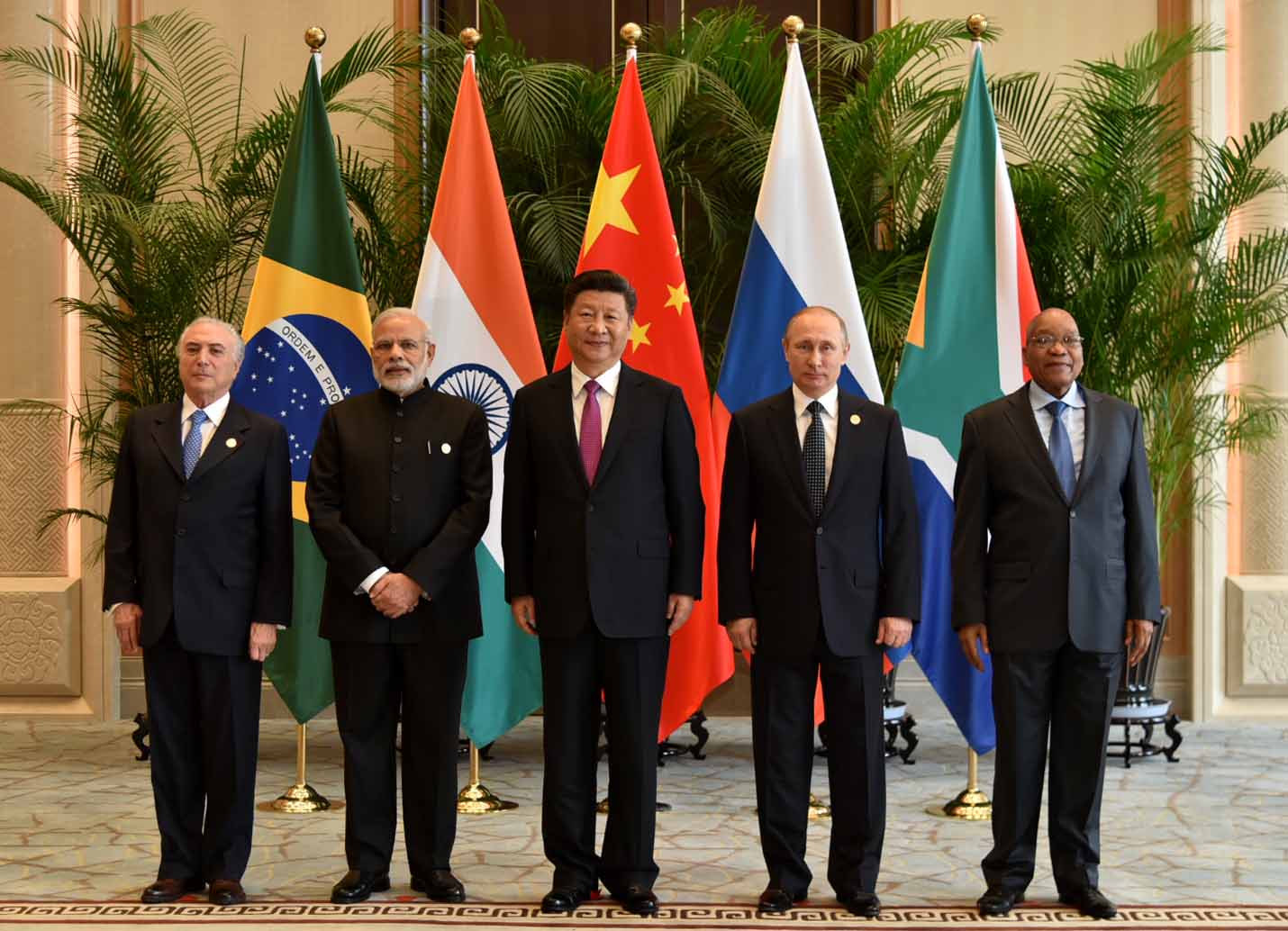
What will ‘Vishwaguru’ achieve in BRICS?
“I am also from the American South, and you are also from the Indian South,” U.S. President Bill Clinton personally called and told then Indian Prime Minister P.V. Narasimha Rao in 1994. This conversation took place after initiating sweeping economic reforms in the country and turning the attention of American corporate powers toward India. Following this, P.V. Narasimha Rao himself went to America and held extensive discussions with Clinton. In a sense of whether America pressured India on anything, reporters asked PV, “Whether your arm was twisted?” Showing his arm, PV replied, “It is intact. Your President didn’t even touch it…” Clinton immediately remarked, “I am very grateful to you, Prime Minister, for saying that.” PV, who opened a new chapter in India-U.S. relations, strengthened relations with Russia, China, Iran, and Arab countries quietly and effectively without much hulla gulla or blabla, while limiting relations with America strictly to investments and technology. Adopting strategic autonomy and multi-directional diplomacy, PV continued to pave the way for India’s missile program and nuclear tests. Vajpayee, who became Prime Minister after him, conducted nuclear tests undeterred by U.S. sanctions. Eventually, he created conditions where America itself extended a hand of friendship to India once again. The fact that U.S. President Clinton visited India for the first time in 22 years is evidence of this.
What do these developments prove? They make it clear that no one can dictate to India in global politics, and if circumstances arise where anyone tries to dictate, India will follow its own path. “India has the natural strength to play a key role in international politics. India’s history, civilization, and geographical conditions are the reasons for this,” India’s first Prime Minister Jawaharlal Nehru declared back in 1949. As early as 6 million years ago, the spinal structure necessary for our ancestors to stand upright on two legs was formed. Today, we are facing a similar evolutionary crisis in international diplomacy.
Even during the Cold War between the United States and the Soviet Union, India organized the Non-Aligned Movement as a guide for the countries of the world. Having played a prominent role in designing systems on numerous key international platforms thereafter, India played a crucial role in the emergence of BRICS (comprising Brazil, Russia, India, China, and South Africa) a decade and a half ago in 2009 under the tenure of Manmohan Singh. True to his characteristic demeanor, Manmohan Singh never boasted of his achievements or made a big fuss about them. “We are facing many kinds of challenges. In these circumstances, we have got a meaningful opportunity to take collective action,” I had the opportunity to hear when Manmohan Singh declared this at the BRICS summit held in Durban, South Africa, in 2013. That same year, I also participated in a rare event on the outskirts of Beijing where the Chinese government had members of the Central Party School of their Communist Party take lessons through Manmohan Singh. It is a rare milestone for a foreign head of state to deliver lectures at this school that prepares future leaders of their country.
Following the conditions of the World Bank and the IMF, the proposal to establish the New Development Bank at the BRICS summit held in 2012 under the aegis of BRICS was also made by Manmohan Singh. Without any conditions, massive funding continues to be available from the New Development Bank for numerous infrastructure projects in India such as metros, RRTS, and rural water sanitation.
It is in this context that we need to understand the BRICS meetings being held in New Delhi between September 11 and 14. Although criticisms arose that after Narendra Modi became Prime Minister in 2014, he embraced America more excessively, departing from the multi-alignment direction established during the tenures of PV and Manmohan Singh, today India appears to have realized the need to correct its course. Today, BRICS has expanded to 11 countries, including Iran, Saudi Arabia, the UAE, and Egypt. Another 10 countries have been inducted as partner countries. Not only does this represent over 50 percent of the population in the world, but these countries also account for nearly 40 percent of global GDP. At a time when U.S. President Trump is upending the economic interests of almost all countries in the world through extreme policies in the name of tariffs, attacks on Iran, and America First, there is no doubt that BRICS is shaping up as a strong system. Today, neighboring countries like Canada as well as nations like North Korea are also resisting America’s aggressive stance.
As a precursor to the BRICS meetings taking place in Delhi, the Shanghai Cooperation Organisation (SCO) summit was held in Kyrgyzstan at the end of last month. In fact, the SCO summit was scheduled to be held in Delhi in 2023, but since India was not in a position to clash with America, it had to strategically hold an online meeting. However, it must be said that India taking the initiative to pass a unanimous resolution in the latest meeting—condemning military attacks on Iranian territory and supporting West Asian stability—is a highly crucial development. It is not something to be ignored that India proposed in Kyrgyzstan that all countries in the world should have equal representation, developed countries should be given higher priority, and a multi-polar system along with economic self-reliance should be established.
However, it remains to be seen to what extent India can influence Russia, China, and other countries alongside them at the BRICS summit in New Delhi. Persuading China and Russia at the BRICS meeting on its stance—that it should not be against the West, but at the same time, the West alone should not dictate to the countries of the world—is like walking a tightrope for India. India is also not in a position to accept the proposal to establish a BRICS currency to compete with the U.S. dollar. Since trade is already taking place among BRICS countries through local currencies, India is proposing to introduce seamless digital payments between countries through the integration of systems like UPI. India believes that there neither is the condition nor the necessity to strongly counter the dominance of the dollar. As usual, India is seeking reforms in the United Nations Security Council, the IMF, and the World Bank. There is a need to build consensus on these.
Most importantly for India is balancing Chinese hegemony. There is no doubt that India will try to the maximum extent possible to prevent BRICS from completely falling under China’s influence. Moreover, through relations forged with China on the BRICS platform, India is trying to prevent tensions between the two countries and create peaceful conditions. The fact that Indian military officials have already held talks with Chinese military officials at the borders is evidence of this. The participation of countries like Iran and the UAE in BRICS will bring many benefits to India. It provides an opportunity to strengthen crude oil and energy security, maritime trade routes, and economic relations with Gulf countries. Furthermore, BRICS is likely to provide mutual cooperation on critical mineral resources such as lithium, rare earths, and nickel. This will contribute to the building of electric vehicles, batteries, semiconductors, and solar and renewable energy systems.
By announcing a 7.8 percent growth rate himself just days before the meetings, it is clear that Narendra Modi wants to solidify his standing among developed countries. Having to face recent student agitations, inflation, employment issues, and other political headwinds in the country, successfully hosting a global-level summit like BRICS is extremely imperative for Narendra Modi. There is no exaggeration in saying that by hosting this summit in India, he will try to claim victory both at home and abroad. In this context, the BRICS summit cannot be viewed as a routine diplomatic platform by India. It is going to be a platform to test how far India can establish its independent position in global politics. Therefore, the New Delhi Declaration to be adopted at this summit is of utmost importance to India. Only when it grows into a force capable of playing a key role in shaping new values for the global system through our civilization, history, and moral values—not just achieving a balance between global powers—must India’s status as a Vishwaguru be deemed attained.

