“If the judiciary loses its credibility, nothing else will remain. An independent judiciary is the lifeblood of the Constitution. Without it, judges will exist, courts will exist, and judgments will exist—but their heart and soul will disappear,” said Supreme Court Judge Ujjal Bhuyan in a recent memorial lecture in Pune.
He referred to a stark reality: the collegium itself recorded in its minutes that a High Court judge was being transferred in accordance with the wishes of the Central Government. This serves as a clear example of how a judiciary constitutionally expected to function independently can find itself working under government pressure.
“The judiciary must remain distant from party politics and function firmly. Changes in government should have absolutely no connection with the judiciary. It should act with goodwill and sympathy towards everyone, but should not side with anyone,” said the first Chief Justice of India, H. J. Kania, at the inaugural sitting of the Supreme Court. Yet, reviewing the situation more than 75 years after the Constitution came into force, deep doubts arise as to whether standards in the higher judiciary have improved or deteriorated.
The Historical Shield and the Ultimate Downfall
For nearly twenty-five years after the Constitution came into force, the judiciary largely fulfilled its responsibility of preserving its own existence, protecting the fundamental rights of citizens, and defining the limits of government authority. The Supreme Court progressively interpreted Articles 14, 15, 19, and 31. In the 1967 Golaknath case, it clarified that fundamental rights could not be diluted, and in the landmark 1973 Kesavananda Bharati case, it solidified that Parliament had no authority to alter the basic structure of the Constitution.
However, after coming to power with an overwhelming majority in 1971, Indira Gandhi’s administration began to toy with judicial independence. The absolute peak of the judiciary’s downfall in capitulating to executive overreach was the infamous ADM Jabalpur case during the Emergency.
When thousands of political opponents and journalists were jailed without trial, and citizens sought the intervention of the courts to protect their fundamental liberties, a five-judge Constitution Bench delivered one of the most disgraceful judgments in Indian history. By a 4:1 majority, the bench ruled that during an Emergency, citizens do not even possess the right to life under Article 21.
The majority consisted of Chief Justice A. N. Ray, Justice P. N. Bhagwati, Justice M. H. Beg, and Justice Y. V. Chandrachud (father of former Chief Justice D. Y. Chandrachud). When Justice H. R. Khanna—the sole courageous dissenter—asked during the hearings, “Does that mean people cannot question even if they are shot dead in the name of Emergency?”, the then-Attorney General chillingly replied, “My Lord, that is what the law says.”
A Era of Introspection and Activism
Following the Emergency—one of the darkest chapters in judicial history—the Supreme Court undertook deep introspection and initiated significant corrective measures. Moving past its catastrophic failure, the court aggressively declared that the Constitution, not the executive, was supreme.
It opened its doors to the masses through Public Interest Litigations (PILs), ordered the release of thousands of undertrial prisoners languishing in jails, liberated bonded laborers, and eventually introduced the collegium system to insulate judicial appointments from political interference.
Most importantly, it expanded the scope of personal liberties, protected the environment, championed the interests of working women, and curbed the arbitrary dismissal of state governments by ruling that political majorities must be proven on the floor of the legislature. At that stage, judicial activism was a remarkable shield for the vulnerable.
Modern Shadows and Internal Fractures
If the Supreme Court denied protection to human life twenty-five years after Independence, today, five decades after that judgment, the core functioning of the institution faces renewed skepticism. We may not be living in a formal Emergency, but public faith in the judiciary is noticeably shrinking.
The fact that sitting judges themselves feel compelled to speak out demands serious reflection:
- Justice Ujjal Bhuyan publicly emphasized that no external forces should be allowed to intrude upon judicial independence, asserting that personal political or ideological views must not influence decisions on the bench.
- Justice B. V. Nagarathna warned that judges must not succumb to external pressures, noting that those who cannot live contentedly on their legitimate income should be eliminated from the system entirely. “A tainted judge is a stain on the entire system,” she remarked.
- Justice S. Muralidhar, former Chief Justice of the Orissa High Court, once noted: “Impartiality is the soul of the judiciary, and independence is the blood flowing through its veins.” Notably, during his tenure at the Delhi High Court, he was transferred overnight after questioning police inaction during civil unrest in the capital.
In her book Constitution Is My Home, senior advocate Indira Jaising recalled a harrowing 2022 case involving sexual harassment allegations made by a female Additional District Judge against a Madhya Pradesh High Court judge. Not only did the victim fail to find immediate recourse, but she was also swiftly transferred and forced to resign.
Through Jaising’s persistent legal battles, a Supreme Court bench headed by Justice L. Nageswara Rao eventually restored her position and questioned why the then-Chief Justice of the High Court had refused to even grant her an interview. Disturbingly, just days later, that very Chief Justice was elevated to the Supreme Court.
Growing Questions and the “Cockroach” Backlash
Why has it become necessary for judges to comment so defensively on their own institution? Critics increasingly argue that the higher judiciary—originally designed to protect the common citizen—is becoming overwhelmingly responsive to the wealthy, the state, and political elites.
Calculated bench allocations and predictable judgments in politically sensitive cases have sparked intense debate. Former Supreme Court Bar Association President Dushyant Dave openly criticized the court for failing to check the erosion of vital institutions like the Election Commission, pointing out that judges routinely scramble for lucrative post-retirement positions.
Simultaneously, ethical questions have mounted. Organizations like the Campaign for Judicial Accountability and Reforms (CJAR) heavily criticized several judges and their families for utilizing private aircraft provided by state governments, arguing it severely compromises judicial ethics. Furthermore, instances like the discovery of massive cash bundles at the residence of a former Delhi High Court judge—followed by an apparent lack of accountability—have deepened public cynicism.
Perhaps because the public, especially the younger demographic, is closely watching these lapses, an explosive reaction occurred following recent remarks made by Supreme Court Judge Surya Kant.
During a judicial hearing, Justice Surya Kant criticized unemployed youth, comparing them to “cockroaches” who populate social media, media outlets, and RTI activism to attack institutions. Though he later clarified that the comment was contextualized within a specific petition regarding a lawyer’s designation and was not aimed at the youth at large, the damage was done.
Justice Surya Kant has faced widening backlash for a series of oral remarks. On May 11, 2026, during a hearing on the Pipavav Port expansion project in Gujarat, his comments drew sharp rebukes from environmentalists and legal experts. Former civil servants under the Constitutional Conduct Group warned that these remarks showed a disturbing pro-corporate bias from the bench, creating an atmosphere of fear that silences dissent. Over 70 lawyers noted that treating citizens who enforce environmental laws as “obstructionists” marks a dangerous jurisprudential shift.
Similarly, on January 29, 2026, during a PIL hearing on domestic workers’ rights, Justice Surya Kant blamed trade unions for stifling industrial growth and shutting down traditional industries. Labor bodies, including the AITUC, strongly condemned the court for misreading economic realities, arguing that industrial stagnation is driven by corporate monopoly and pro-corporate state policies, not by workers asserting their legal rights.
The Danger of Erased Boundaries
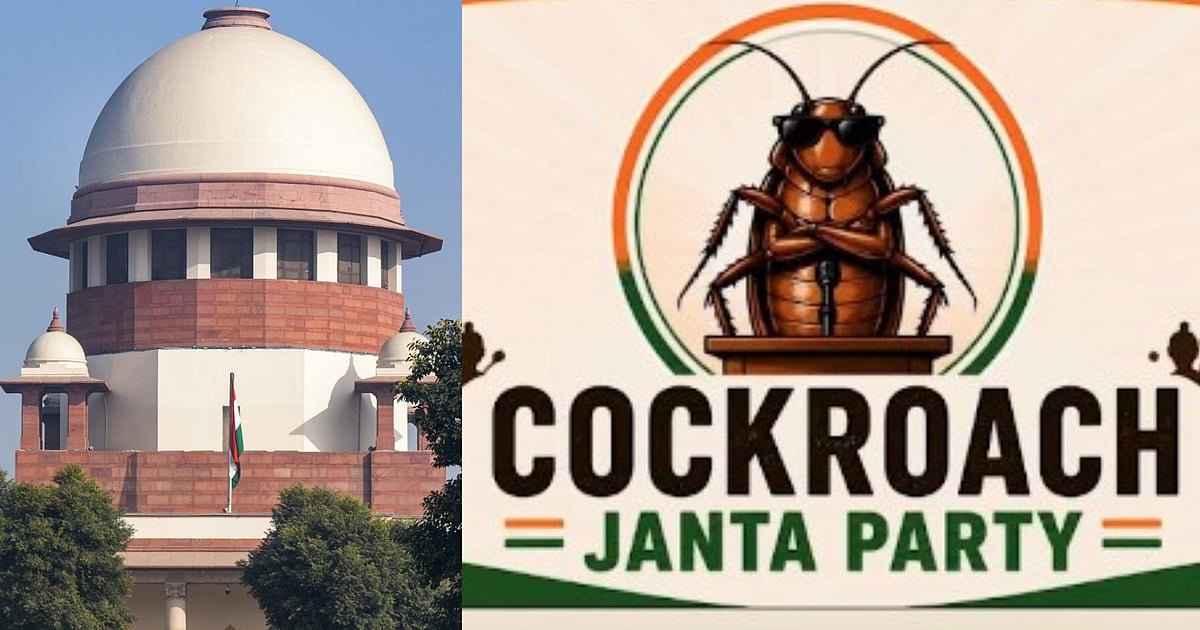
Following the “cockroach” commentary, a young citizen created a social media movement under the banner of the “Cockroach Janata Party.” Millions responded. Instead of merely deflecting the insult, the youth weaponized it, using the platform to furiously criticize the government over unemployment, inflation, corruption, and systemic scams, proclaiming: “Yes, we are cockroaches.”
This reaction highlights a profound systemic crisis. The derogatory comments were made by a member of the judiciary, yet the public directed its anger squarely at the executive government.
This reveals a terrifying reality: the public no longer views the government and the judiciary as separate entities.
In a constitutional democracy, nothing is more dangerous than the total erasure of the boundary between the ruling executive and the independent judiciary. The judiciary must aggressively reform and rescue itself from this crisis. If it fails, the day may soon arrive when the “cockroaches” themselves feel forced to become the arbiters of justice.

