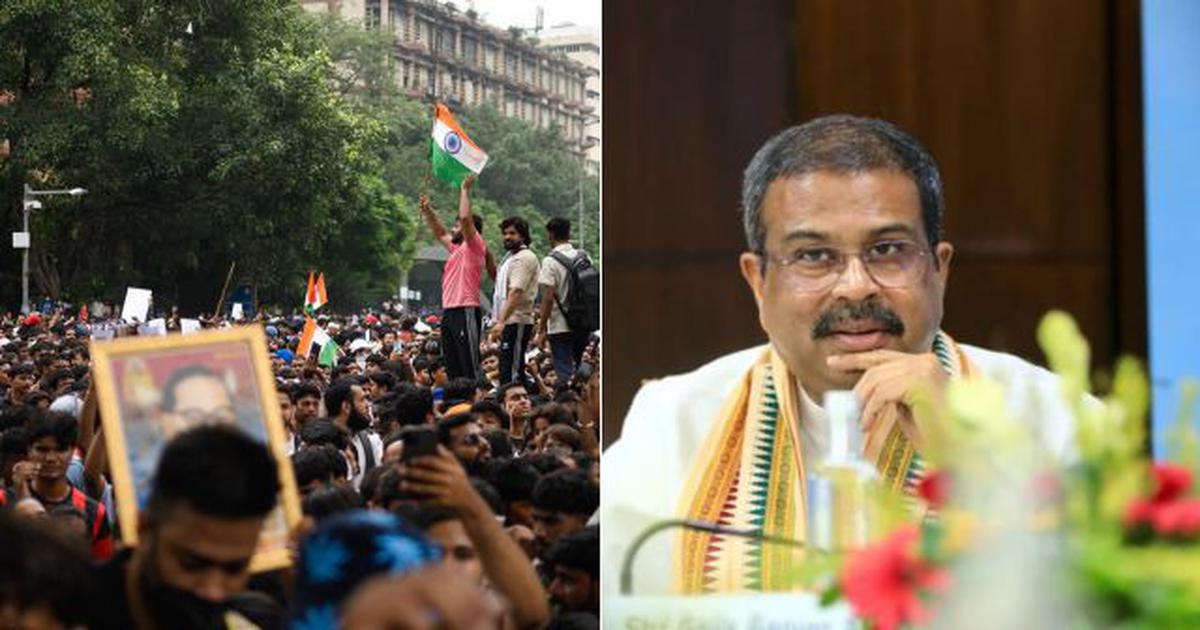
Tag: Dharmendra Pradhan

  • Mid-Course Correction: Why Dharmendra Pradhan’s Exit is a Wake-Up Call

    ‘Today’s youth have not strayed from the right path. They are not acting without direction. One should engage in discussion with them, but not control them. They ask for reasons, not rules. They seek explanations. Curiosity is their trait. Rebellion is their nature’.. These words were spoken not by some Communist leader, but by Rashtriya Swayamsevak Sangh chief Mohan Bhagwat. On July 24, as he was speaking these words at the Vishwa Mangalya Sabha held at the Ambedkar International Centre.. just one kilometer away at Jantar Mantar, an aggrieved group of youth was expressing intense anger. Exactly 24 hours later, Union Education Minister Dharmendra Pradhan resigned from his post. ‘Though delayed, a good thing was done in the end..’ commented 92-year-old Murli Manohar Joshi. A day before Bhagwat made his statement, that veteran grandee commented that the lathicharge on students was atrocious. Joshi also justified that the students’ anxiety regarding the examination system was legitimate.

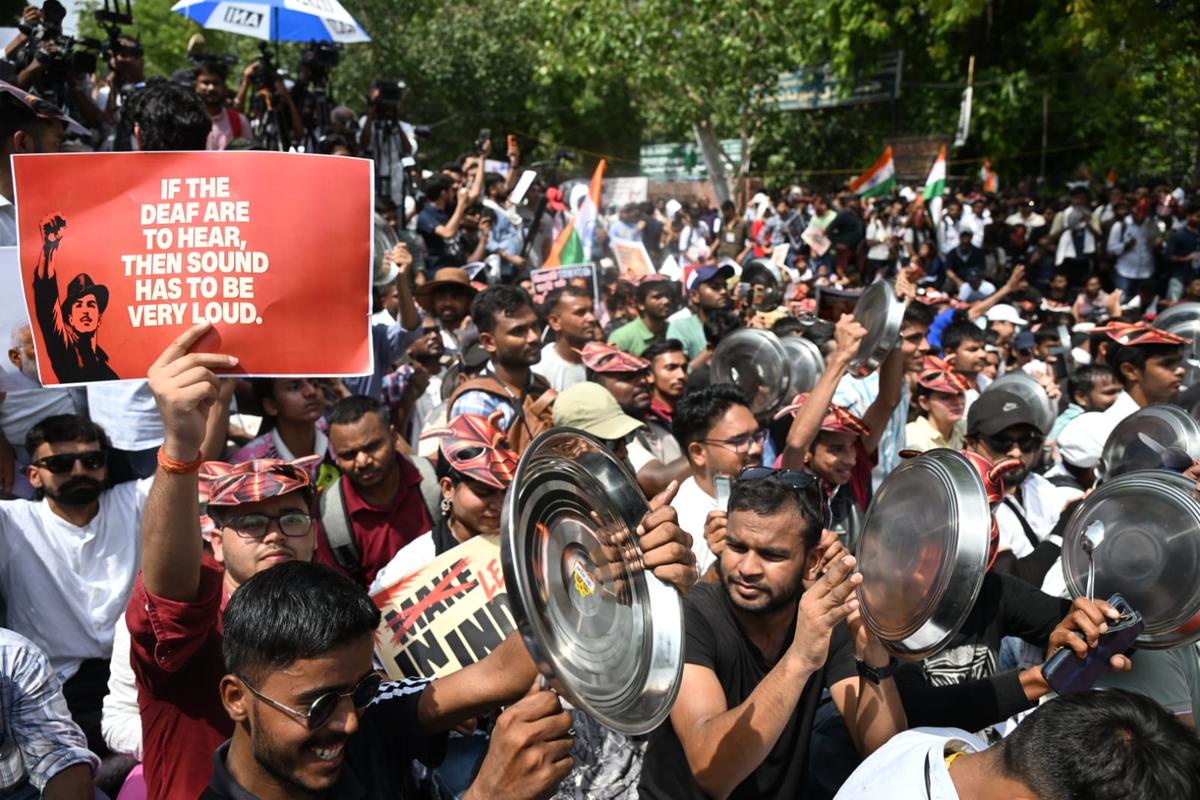
    Examining these developments closely reveals that it was not only the pressure from the youth, but also the pressure from internal forces within the BJP and the Sangh that led to Dharmendra Pradhan’s resignation. It also becomes clear how much internal disquiet the intensity of the Cockroach Janata Party’s protest demonstration at Jantar Mantar created within the BJP, albeit belatedly. Sonam Wangchuk, an educator and environmental activist from Ladakh who strengthened the Cockroach Janata Party’s protest through his hunger strike unto death, was once a supporter of Modi. When Article 370 was revoked and Ladakh was separated from Jammu and Kashmir, he overflowed with joy. When the BJP promised to include Ladakh in the Sixth Schedule, he campaigned in favor of the BJP during elections. Wangchuk even turned down Rahul Gandhi’s invitation to participate in the Bharat Jodo Yatra. The BJP turned such a person against itself. Not just him, among the young men and women who came to Jantar Mantar, there were many who once admired Modi and the BJP and later turned against them. ‘I too voted for Modi along with my parents. When I was coming to the Jantar Mantar demonstration in Delhi, they did not raise any objection at all,’ said a young woman. BJP leaders themselves say that even in the houses of several Union Ministers and MPs, their children expressed solidarity with the CJP demonstration. In the Jantar Mantar demonstration, many engineers, fashion designers, MBA and law students, and children of farmer families were seen from several states along with Punjab, Mumbai, Haryana, and Telangana. Wearing loose jeans, t-shirts, various kinds of attire, and bands tied around their heads, these youth cannot be linked to any political party.

    It is surprising that these very students are deciding the Parliament’s agenda today. After the commencement of the monsoon session of Parliament, the Lok Sabha functioned smoothly for the first time on Tuesday afternoon after seven days. The students were the reason for that. They were responsible not only for Dharmendra Pradhan’s resignation, but also for the government hastily bringing a bill to prevent irregularities in exams, for the Prime Minister announcing this bill late at night, and for the opposition finally agreeing to a debate. From Smriti Irani to Dharmendra Pradhan, four education ministers have changed during Modi’s tenure. During every education minister’s tenure, there was some controversy or the other. But the situation of having to resign due to student pressure arose only for Dharmendra Pradhan. When Dharmendra stepped into the Parliament premises after resigning, BJP MPs gave him a grand welcome chanting ‘Zindabad’ to him. They crowned him. For what? On whose orders and why did they honor him? It is clear that this was done to claim that even when knocked down, their upper hand remains. Who suffers the loss due to this? Is it not them?

    Many people across the country connected with the young men and women who conducted a peaceful protest demonstration for over a month, demanding that the Education Minister take moral responsibility for the exam paper leak. When they marched towards Parliament and their heads were fractured by lathicharges, and pellet fragments penetrated the bodies of those youths, many felt deep anguish. If those in the CJP were anti-social elements, why did Union Ministers hold three rounds of discussions with their representatives? Why did they promise to discuss reforms in the education system with them as well?

    In reality, in every movement, some amount of violence and destruction keeps taking place. Even in the Sampoorna Kranti movement led by Jayaprakash Narayan, there were allegations that a conspiracy was hatched to blow up railway bridges with dynamite. Violence broke out during the anti-reservation movement as well. Many times, after police brutality occurs, this angle of anti-social elements is brought forward to justify it. That alone does not take away credibility from the entire movement. Portraying every protest as a crime might work for a while, but it will not work at all times. Those in the ruling system must learn to respect the anger of protesters. Otherwise, a permanent hostility towards governance systems will be formed. This wisdom is evident in the comments made by Mohan Bhagwat, even if belatedly.

    Actually, had Congress acted properly, the need for students to take to the streets would not have arisen. Congress did not raise its voice strongly until after seeing the response to the formation of CJP on June 6. After the paper leak occurred in the first week of May and the exam was cancelled on May 12, Congress did not make enough efforts to respond strongly and hold the government accountable. Rahul Gandhi, who organized a student rally named ‘Chatron Ki Goonj’ in Kota, Rajasthan on June 17, disappeared for the next 23 days and spent time in Germany. Rahul showed signs of movement again only after the founder of CJP entered Delhi and intensified their protest, with just three days left for the Parliament session to begin. It was proven that if there is no continuity and daily active presence in politics, the situation goes into someone else’s hands. Congress must realize that theatrically organizing dharnas and getting arrested as in the past will not gain public sympathy. Since 2014, Congress has been stalling Parliament and holding protests. What change has come in electoral politics or in the government’s stance? With just a month-long protest, the Cockroach Party was able to make the government back down. Why did Congress and the opposition lack such moral strength?

    Just because bills are introduced in Parliament, it cannot be said that changes will come in the education system. Just by opening new IITs and medical colleges, the quality in higher education cannot be improved. To this day, not a single Indian university finds a place among the top hundred universities in the world. Even though the size of the Union Budget increases enormously every year, the share allotted to education in the Union Budget over the last 12 years has decreased significantly. In 2013–14, 4.65 percent of the total Union Budget was allocated to education, whereas by 2025–26, that share has fallen to 2.5 percent. Priority in the country is decreasing not just for education, but also for research. Going into the pages of history reveals that during the Congress regime, BJP leaders like Murli Manohar Joshi, Arun Jaitley, Sushma Swaraj, Narendra Modi, and others heavily criticized educational standards, facilities in educational institutions, and the lack of connection between higher education and employment. So to what extent has the situation changed now? Despite test papers leaking multiple times, why did the idea of setting up fast-track courts not arise earlier until students came onto the streets? In 2024, re-examinations were not conducted in certain test centers until the Supreme Court intervened. Now, the entire examinations had to be cancelled. Moreover, they are promoting it as a grand achievement that they are organizing exams properly on a war footing without loopholes. Days might even come when they claim in election manifestos that they conducted exams properly without paper leaks!

    PM Modi described the intervening period until achieving Viksit Bharat by 2047 as Amrit Kaal. The protest by the swarm of cockroaches during this Amrit Kaal should be considered, in a way, an auspicious development that served as an eye-opener for the government. Dharmendra Pradhan’s resignation need not be considered a humiliation. It should be regarded as an opportunity to engage in self-introspection over the developments that occurred and take appropriate measures. Perhaps realizing this very fact, Infosys co-founder Nandan Nilekani was entrusted with the responsibility of Chairman of the Task Force on NTA exam reforms. It was under his leadership during the UPA tenure that the Aadhaar project, which stood as the largest biometric identification system, took shape. He played a key role in the digital transformation currently visible in the country. Technical experts and intellectuals have no affiliation with parties. That is why Modi entrusted him with key responsibilities. If the government moves forward in this same direction and takes steps to bring key changes in the governance system rather than always focusing on politics, there is no one who would not appreciate it. There is an opportunity to take such mid-course correction measures in another three years. If that does not happen, the ruling party itself stands to lose!
  • The Uncontainable Anger of India’s Disillusioned Youth

    “A small body of determined spirits fired by an unquenchable faith in their mission can alter the course of history,” said Mahatma Gandhi. India now seems to be moving toward an indefinable change. The siege of Parliament on the first day of the Monsoon Session in the national capital on Monday by activists of the Cockroach Janata Party (CJP)—who have been protesting for a month demanding the resignation of Union Education Minister Dharmendra Pradhan, holding him responsible for the NEET question paper leak—must be called a monumental development in recent times. Despite setting up four-tier barricades, deploying large-scale forces of the Rapid Action Force, CRPF, Delhi, and Tripura Police, closing metro stations, and shutting down the internet, the Cockroach army, thousands strong, charged up to the gates of Parliament. Even as the police beat them severely, the young men and women displayed sheer daring. The young people lying with injuries at Ram Manohar Lohia Hospital are direct witnesses to Monday’s brutality.

    It is clear that the Modi government, which remained unmoved despite a decade of attacks and criticism from the opposition, has been put on the defensive by this incident of the cockroach rebellion. A BJP MP said that it is not important how many people participated in the movement launched by the Cockroach Party, but how much impact it had. “My father is a very important leader in the BJP. However, the unfolding developments are not very healthy…” said a youth who participated in the Jantar Mantar protest. “Where politicians fail, children will question,” said a student.

    In reality, the Cockroach Janata Party is not an organization. It is a crowd of directionless young men and women in the country’s contemporary history. Those who came to the protest at Jantar Mantar or participated in the procession did not come because someone paid them. No one arranged buses or trains for their arrival. The discussion happening merely on social media made them set out for Delhi. They did not come raging only over the NEET question paper leak. The young men and women who came were simply fed up with the problems faced by youth—especially unemployment, meager salaries, systemic flaws, and the machinations of political parties. Those who came to the Jantar Mantar protest site did not have a specific goal. Youth aged between 14–28 cannot be fitted into the mold of Left or Right ideologies. The Emergency is not part of their experience. They do not know about Loknayak Jayaprakash Narayan, who once united the opposition. They lack even the experience of the Mandal and Kamandal movements. They have no memories of events that happened three decades ago. Struggling with contemporary issues, unable to decide what to do, with an uncertain future, and arriving with various questions… they are not bound by any traditional rules. Over the past four weeks, this protest platform served as a space where they asked their own questions and provided their own answers. That protest was widely publicized on social media. Examining alternative media sources makes one understand how concerned the youth were about the health condition of environmental activist Sonam Wangchuk, who has been on a hunger strike for more than three weeks.

    Believing that the opposition lacked credibility, that there was no alternative to them, and that whatever they did would pass, the Modi government seems to have underestimated the emergence of the Cockroach Janata Party. The Modi government was easily able to deal with the long-drawn protests by farmers over farm laws and Muslims over the Citizenship Amendment Act. It did not listen even to the cries of female wrestlers who questioned the assaults committed against them. Whichever movement occurred in the country, it adopted various means to damage its credibility. It berated the protesters with various names. The Modi government thought it would be enough to treat the surge of youth protest as a law-and-order issue and suppress it. As the Cockroach Party protest was reaching its peak, Delhi Police Commissioner Satish Golcha was removed and replaced by Anurag Kumar, who until then served as Special Director (Intelligence). As the in-charge of the Jammu & Kashmir desk, he played a key role in dismantling terrorist activities in Kashmir. There is no surprise in such a person attempting to suppress the youth protest with the same mindset.

    During the UPA government’s tenure as well, young men and women flooded the streets against the Nirbhaya rape incident. However, back then, social media was not as influential as it is now. There is no doubt that social media today has become an alternative media for the public. In fact, when Modi came to power, the BJP IT Cell carried out various campaigns to mobilize people, especially to inflame the emotions of Hindus. In particular, it made extensive use of WhatsApp groups. Today, those IT Cell campaigns seem to fade before the social media in the hands of the Gen Z generation. This development proves that if any campaign is not aligned with the sentiments of the people, it will not last long.

    The current generation has not failed to notice that the promises with which Modi came before the people have vanished into the background, and emotional issues have become the main agenda. Leave aside the failure to create jobs; they are closely observing the inability to conduct even exams properly, the failure to provide quality education, and the resorting to numerous machinations and unrighteous wars solely for the sake of power. Nevertheless, there is no evidence to say that the current generation is placing the opposition, especially the Congress, on a pedestal. It is an undeniable fact that for a decade, the Congress and other parties have failed to ignite public anger against Modi. However, no one expected that youth would step up where the opposition failed. If the Congress party had acted as a strong opposition and reflected the aspirations of the youth, the Cockroach Janata Party would not have emerged. It is an interesting point that many forces that failed to confront Modi are now visible in the Cockroach army.

    Strangely, on the first day of Parliament’s Monsoon Session, people did not care about the bills the government intended to introduce or the issues the opposition wanted to raise. The ‘Chalo Sansad’ call given by the Cockroach Janata Party received immense publicity. In a way, this development questioned not only the existence of the government but also the existence of the opposition. Congress leaders, who had been silent all this while on the Cockroach Janata Party protest, making a hue and cry about the lathi charge on the youth, or Rahul Gandhi protesting in front of the Prime Minister’s residence, are all part of Congress trying to prove its own existence. Time alone will tell whether Congress will resurrect itself as a strong opposition learning from the experience of the Cockroach Janata Party. Even for Modi, it is fortunate for the opposition to exist at least to some extent. Otherwise, there are chances of more entities like the Cockroach Janata Party being born.

    Moral responsibility has become an unacceptable taboo in present times. Today, there are no leaders like NTR, who made the entire cabinet resign because the budget was leaked, nor are there ministers who take responsibility and resign for train and plane accidents. When Dharmendra Pradhan is constantly utilized to win elections for the party, how can he focus on his ministerial responsibilities? It is true that Dharmendra Pradhan, who efficiently strategized for the BJP’s victories in Bihar, Haryana, and Bengal, did not manage his ministry efficiently. However, that mistake is not entirely his. Treating their party’s victory in elections as a matter of life and death and diverting all energy and skill in that direction is the cause of the failure of leaders like Dharmendra Pradhan. Will the Modi government act with sincerity at least now to take responsibility for the mistakes committed and build public trust in system institutions?

  • If the Judiciary Is Bleeding, Who Fired the First Shot?

    Screenshot

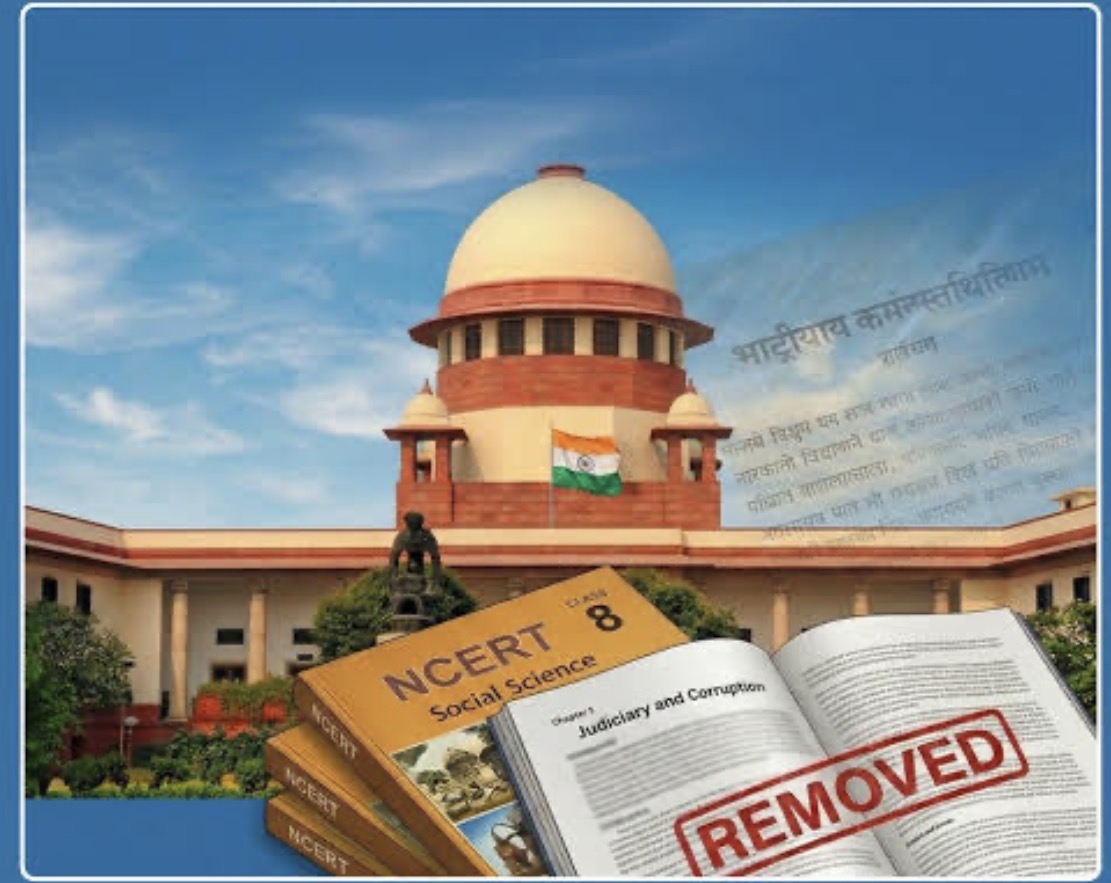
    There are systematic attempts underway to undermine the institutional authority of the Supreme Court and to damage the reputation of the judiciary. If these attempts are not stopped, the sanctity of the judiciary in the eyes of the people will erode. It will influence the tender minds of the youth. “Shots have been fired at us… the judiciary is bleeding,” expressed Justice Suryakant of the Supreme Court of India in anguish. For describing corruption in the judiciary in an 8th-grade textbook published by the National Council of Educational Research and Training, he went so far as to announce a ban on that very book. He ordered that the book should not be available even in digital form. Following these prohibitory orders, NCERT withdrew several lakh copies of the textbook. It was also reported that a bookstore owner was arrested by the police for selling photocopies of the textbook. “I will not tolerate anyone on this earth attempting to defame the judiciary,” said the Chief Justice.

    When he expressed his anger over the textbook, Prime Minister Narendra Modi was in Israel. Official sources told the media that Modi too was distressed that the judiciary’s sentiments had been hurt and remarked, “Who is overseeing all this?” After returning to the country, Modi reportedly raised the issue in a Cabinet meeting as well. News reports said he remarked, “How can we tell 8th-grade children ourselves that there is corruption in our judiciary?” Education Minister Dharmendra Pradhan also expressed regret over including the controversial chapter on corruption in the judiciary in the 8th-grade textbook. “We have immense respect for the judiciary. We did not intend to insult it deliberately,” he said. The Supreme Court sent notices to NCERT Chairman Professor Dinesh Prasad Saklani.

    With the Chief Justice expressing concern, is there really a conspiracy behind this entire episode to defame the judiciary? Are there systematic efforts underway to reduce public respect for the judiciary? In fact, the Congress attempted to create the impression that it was the Modi government itself that engineered this conspiracy. “For a decade, the BJP government has been trying to spread its ideological virus through textbooks. The inclusion of details about corruption in the judiciary was not accidental. It was a systematic attempt to corrupt the minds of students,” said Congress spokesperson Jairam Ramesh. He made indirect remarks suggesting there was evidence that Modi himself guided this process and that the RSS was behind it. Lawyers Kapil Sibal and Abhishek Singhvi, who argue opposition cases in the Supreme Court, made submissions that led Justice Suryakant to treat the matter more seriously. They succeeded in creating the impression that a major conspiracy had taken place.

    It is because people believe that they will ultimately receive justice through the judiciary that lakhs of them approach the courts. If they did not believe courts would deliver justice, there is a possibility that they might resort to vigilante justice instead of going to court. It cannot be said that Justice Suryakant’s view — “We cannot allow students to develop the impression that justice is not available in this country” — is entirely wrong. The textbook mentioned a judgment that described slum dwellers as encroachers. However, by highlighting such instances, it would be inappropriate to portray the entire judiciary as anti-poor.

    Quoting Martin Luther King Jr.’s words, “Injustice anywhere is a threat to justice everywhere,” CBI Special Judge Justice Jitendra Singh, in his recent judgment on the Delhi liquor case, detailed across nearly 600 pages how the CBI allegedly tailored facts to suit its narrative in order to implicate political opponents of the ruling party. He asked, “If even policy decisions taken to strengthen the economy are treated as crimes, how can any government take decisions?” He pointed out the injustice of keeping accused persons imprisoned for months based solely on the statements of approvers and accomplice witnesses. He observed that the right to life and personal liberty did not come from the government’s grace but from the Constitution, and that unless a balance is maintained between the Constitution and statutory law, public trust in the criminal justice system would erode. It is noteworthy that even constitutional benches which had refused stays in several instances in the Delhi liquor cases did not reflect at such depth as the lower court did. Regardless of how much this judgment is challenged in higher courts, the significance of the questions it raises will not diminish.

    By banning a textbook that mentioned corruption in the judiciary, students may lose the opportunity to learn in the classroom about what is happening within the judicial system. The very act of banning it has created greater discussion and drawn more attention to the issue. Do students learn about the world only through textbooks? Just because something is not mentioned in a textbook, will they automatically form a favorable opinion of the judiciary? It is no secret that today social media has far greater influence than any textbook. Do 8th-grade students not watch television or read newspapers? Moreover, as mentioned in the textbook, the government itself has repeatedly informed Parliament that crores of cases are pending across the Supreme Court, High Courts, district and subordinate courts. The textbook also cited remarks made in 2025 by then Chief Justice Justice Gavai that corruption and misconduct in the judiciary erode public trust. Therefore, merely banning the textbook will not increase public respect for the judiciary. It is impossible to conceal such matters from students simply by excluding them from textbooks.

    Secondly, it has become a matter of debate whether the Supreme Court has the constitutional authority to ban a book or a speech. In a democratic society, censoring a book falls under curtailing freedom of expression guaranteed by Article 19. Legal experts are raising questions about whether judicial orders fall within the permissible restrictions under Article 19 and whether the Constitution grants such authority to the judiciary. When their fundamental rights are violated, citizens can approach the courts. But when courts themselves infringe upon fundamental rights, what is to be done? they ask.

    After the strict stance taken by the Supreme Court, NCERT has fallen in line—and so has the government. Everyone is offering clarifications and apologies. NCERT apologized in court and assured that the books would be withdrawn, but the court is not satisfied with that. The Chief Justice has put a stay on the book. But is this really an issue related to corruption in the judiciary, or is there some other story behind it?

    In reality, the chapter titled ‘Corruption in Judiciary’ included in NCERT’s Class 8 book was not an attempt to inform students about corruption existing at any level within the judiciary. It appears to be an effort to raise questions about the credibility of the judiciary and influence public perception. It should be noted that NCERT books are not prepared randomly, as if someone wrote something arbitrarily and it got printed. There is a long process behind it. Every subject has two committees that oversee the entire process—from preparing the content to its publication.

    This chapter appears in the Class 8 Social Science book. It is perhaps just a coincidence that the head of the Curricular Area Group that prepared the Social Science book is a guest professor at IIT Gandhinagar, Michel Danino. This committee oversees the selection and writing of content for social science textbooks. After this comes the National Syllabus and Teaching Learning Materials Committee, a high-level committee that gave the book its final shape. The chairman of this committee is MC Pant, Chancellor of the National School of Planning and Administration. Professor Manjul Bhargava of Princeton University is its co-chair. Apart from them, there are 19 members including Sudha Murty and Sanjeev Sanyal, a member of the Prime Minister’s Economic Advisory Council. Think about it—if all these people have truly fulfilled their responsibilities, it would mean that the book’s content passed through all their scrutiny and none of them found anything objectionable in it. It is worth noting that around the same time, remarks previously made by Sanjeev Sanyal that “the judiciary is the main obstacle to rapid development in this country,” were also brought up.

    So the question is whether a committee that prepares textbook content in line with the prevailing social and political narrative in the country would inadvertently decide to teach eighth-grade students about alleged corruption in the judiciary. It is hard to believe that this happened accidentally.

    Then the question arises: why did the government not defend it in court? If so many people collectively played a role in preparing the book, then either action should be taken against all of them, or the government should defend the book in court. If one closely observes the narrative that has emerged on social media regarding this entire episode, it seems that the objective behind including this chapter in the book has already been achieved. A discussion on corruption in the judiciary has begun, and a debate has also erupted over the Supreme Court’s move to stop this discussion. There is a large group arguing that corruption exists in the judiciary and that it should be investigated and openly discussed. The same group is also saying that the judiciary becomes immediately sensitive about matters concerning itself and does not want its issues to come before the public.

    Senior Supreme Court lawyer and public interest litigator Prashant Bhushan has also objected to certain remarks made by the Supreme Court and some senior lawyers. He wrote on social media that in 2007, Transparency International had said that in public perception, the judiciary was the second most corrupt institution. He wrote that if discussion on this issue is suppressed, it will only strengthen public perception. Later, former NCERT Director JS Rajput also questioned the Supreme Court’s stance and said that stopping discussion on corruption in the judiciary is not appropriate.

    Why should the court react only when corruption in the judiciary is mentioned? Why remain silent when other institutions are criticized? This entire episode has also brought the case of Yashwant Varma back into discussion. Burnt currency notes were reportedly recovered from his residence when he was a judge of the Delhi High Court. The incident took place around Holi last year, and now another Holi has arrived. Nothing has happened in one year. There is an impeachment motion in Parliament that is to be investigated. People are asking what happened after sacks of cash were allegedly recovered from a judge’s residence. If action had been taken and an example set, it would have positively influenced public perception. But no action has been taken on such a major issue of corruption.

    There are those who argue that there is nothing wrong with textbooks discussing the ailments present in the country and that only by discussing them can they be resolved. For example, irregularities in the electoral system have also been discussed in textbooks, including an image of currency notes found in a candidate’s car. Do such incidents not occur? Over time, several allegations have been made against High Court and Supreme Court judges. There are no records of any judge being convicted or impeached over corruption allegations; at most, transfers have taken place. While ordinary citizens and political leaders face CBI raids and ED investigations, why does the same not happen to judges? The very higher judiciary that banned the 8th-grade textbook must answer these questions.