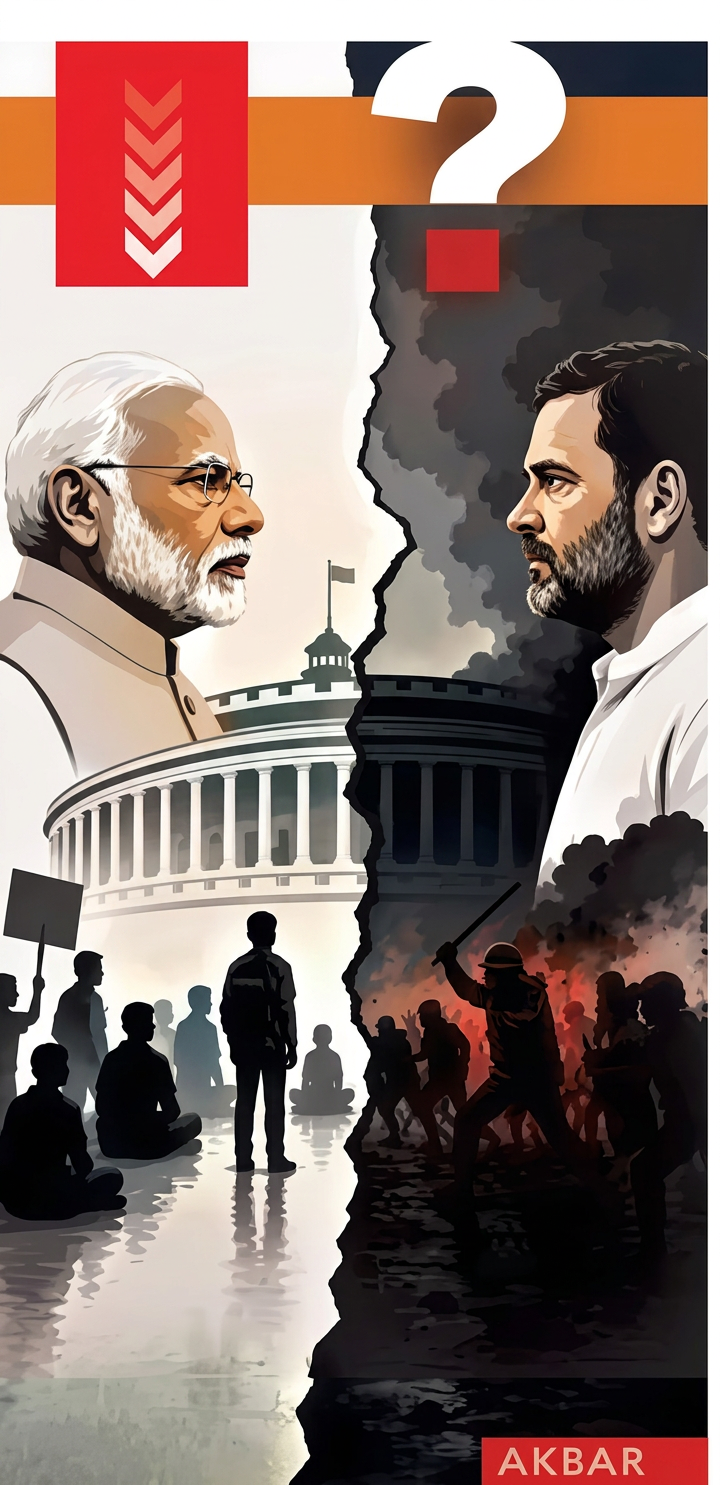
Once a wound is formed, it may heal in a few days. But politics does not let those wounds heal easily. If possible, leaders stand ready to create new wounds. Many people may have recovered from the injuries inflicted on July 20 by the police using various weapons against students in the national capital. But since then, parliamentary proceedings have been almost paralyzed. The Monsoon session in both houses was practically washed out as Congress leader Rahul Gandhi demanded that Union Home Minister Amit Shah personally clarify who incited the attacks on the students.
On one hand, relentless rains over the past few days in the national capital disrupted normal life; on the other, political slogans froze the atmosphere inside Parliament. Opposition parties, who until yesterday chanted “Paper Chor, Gaddi Chhod” (Paper thief, step down), are now chanting “Amit Shah Jawab Do, Chanda Chor, Gaddi Chhod” (Amit Shah answer us, donation thief, step down). Surprisingly, ruling party members also stood near the Makardwar on Tuesday confronting the opposition, shouting “Rahul Gandhi Jawab Do…” The lathi charge against students in Jharkhand—ruled by JMM, a partner in the INDIA bloc—provided an opportunity for the ruling party members. Parliament security personnel had to stand like a wall between the shouting members of the ruling and opposition parties. Amidst the clamor of these ruling and opposition members, news related to the “Cockroach Janata Party” also seems to have been swept away.
Those who expected miracles during the Monsoon session—believing the Modi government could pass the Delimitation Bill, Women’s Reservation Bill, FCRA Bill, and Viksit Bharat Shiksha Anusandhan Bill as planned—must be disappointed now. Narendra Modi’s team had set the stage to pass these bills. Exuberant after their victory in Bengal, they engineered a split of 20 MPs from the Trinamool Congress to join an obscure party. They poached Uddhav Thackeray’s Shiv Sena MPs to their side. Seven Rajya Sabha members from the Aam Aadmi Party were turned toward the BJP. In Tamil Nadu, after Congress supported Vijay’s party, negotiations took place with the DMK, which had backed out of the INDIA bloc. Talks were also held with Sharad Pawar’s NCP. Modi’s admirers swelled with pride, believing that Narendra Modi—who could split any party at any time and damage anyone—could achieve anything. Surrendered to Modi and terrified of his actions, several political parties concluded that he was unstoppable in this country and that there was no choice but to follow in his footsteps.
With only two working days remaining in the Monsoon Session—and effectively only one full working day left for substantive business before the traditional sine die adjournment on the final day around noon—that sense of unstoppable momentum has hit a wall. The quality of parliamentary debate came under severe scrutiny; apart from the anti-paper leak legislation, almost no major bill saw sustained discussion as Lok Sabha proceedings repeatedly collapsed within an hour of opening at 11 am due to incessant sloganeering and protests.
In reality, while Trump’s international actions had put Modi on the defensive regarding foreign policy for the past two years, several domestic developments over the last two months shattered the atmosphere of fear he had built. In particular, the emergence of the Cockroach Janata Party, the student agitation, children mocking Modi, and their questioning of his every action damaged Modi’s invincibility for the first time in the country. As a result of this agitation and sustained pressure from opposition parties following the police action against student protests at Jantar Mantar, Union Education Minister Dharmendra Pradhan was forced to resign in the very first week of the session. This forced a shift in a government mindset that previously dismissed everything.
Following Pradhan’s resignation, the opposition intensified its confrontation. Rahul Gandhi alleged that the police action was carried out at Shah’s behest—an allegation the government categorically and repeatedly rejected—and the focus shifted entirely to demanding a statement from the Home Minister. Although the government offered to facilitate a statement by Shah along with a comprehensive debate on the student movement, the opposition remained unconvinced, leaving Shah’s statement as a central sticking point through the final stretch of the session.
The student protest in Delhi created ripples across many cities, undoubtedly forcing the BJP and the Sangh into reflection. Those who thought this movement could be suppressed and quieted down like the farmers’ movement were left bewildered. The Chief Justice of the Supreme Court, who had characterized them as parasites and cockroaches, began hearing the students’ cases. Although RSS leaders like Atul Limaye initially described the student protest as treason, Mohan Bhagwat later entered the scene himself, albeit late, attempting to properly understand the situation. “Even birds have the right to peck,” he recently stated. “We must listen to them. We must talk to them. That is why they protested,” he said. Prime Minister Narendra Modi also started creating Instagram content and Reels to appeal to the youth. Ministers began speaking in student slang, using terms like “delulu” and “fomo.” For the first time in six years, Narendra Modi attended the Delhi IIT convocation on August 8, calling on students to question thoughtless decisions and demonstrate courage for real solutions. Isn’t that precisely what students in the country did? If they hadn’t dared to question, a bill setting up fast-track courts for question paper leaks would not have been rushed through. If there was anything noteworthy in Parliament during this month-long session, it was only the passage of this bill.
There is no need to remind BJP ideologues that questioning holds the most honored place in Bharatiya Sanatana Dharma. Upanishads like the Bhagavad Gita and Prashnopanishad assigned a pivotal role to questioning. Nothing in our culture is valued more than the freedom to question and search in the pursuit of truth. Yet until now, questioning wrong decisions, unethical acts, dismantled institutions, and corrupt activities brought fear. However, that situation now appears to be changing slightly.
Whether the student movement calms down, erupts in new regions, or inspires other forces remains to be seen, but it has reinvigorated an opposition crushed by Modi’s surge. Dismayed by the BJP’s major victory in West Bengal and divisions within the INDIA bloc, the student agitation offered the opposition room to breathe. Shielding the students in the final stages of the protest, the opposition stepped in to expand the movement into Parliament and onto the streets. The massive student turnout at Rahul Gandhi’s “Chatron Ki Goonj” in Prayagraj can be considered a key development. The opposition will undoubtedly make intense efforts to leverage the anti-Modi sentiment generated by students in the upcoming elections. That is why they maintained heat in Parliament from start to finish, and now that heat is likely to spill onto the streets.
Any gain above zero is good for Congress. But for the BJP at its peak, staying on top requires immense effort. For Narendra Modi, hitherto an unquestioned leader, the students and the opposition are not the only issues; he also faces internal challenges within the party and the Sangh. The party losing the seat vacated by Nitin Nabin, whom Modi appointed as BJP National President, is no small matter. In fact, discontent has been simmering within the party regarding several leaders Modi placed in key positions. Appointing Rekha Gupta as Chief Minister—who used to roam the party office in Delhi and wait hours just to meet a party secretary-level leader—caused severe dissatisfaction within the ranks. The world only realized someone was serving as Chief Minister of Madhya Pradesh after the Ujjain land scam came to light. Except for chief ministers who switched from other parties in Assam and West Bengal, one would struggle to name the leaders heading BJP-ruled states. Aside from Chief Ministers, two Union Ministers recently became controversial. While Dharmendra Pradhan had to resign over the NEET paper leak, the PMO abruptly removed several people from Environment Minister Bhupender Yadav’s office without notice, with no official reason given regarding what corrupt activities prompted it. Although party leaders have claimed for six months that a Cabinet expansion would occur and Nitin Nabin would announce his team, these changes keep getting postponed. It is said these shifts stalled due to internal resistance within the party. Either way, anyone navigating Delhi’s official corridors realizes things inside the BJP are not as smooth as assumed. Additionally, the theft of donations at the Ayodhya Ram Temple has undeniably damaged the BJP’s moral foundation.
Ultimately, when will the Modi government introduce the high-stakes Delimitation Bill and Women’s Reservation Bill? The push for Delimitation hit a complete roadblock during the session. Parliamentary Affairs Minister Kiren Rijiju held three rounds of talks with Rahul Gandhi on the matter; Gandhi insisted on an all-party meeting first, while Rijiju maintained that such a meeting would only happen if Congress committed to supporting the bill. With neither side yielding, the talks failed to break the deadlock.
Similarly, will they manage to pass the FCRA Bill that emerged after the Kerala and Tamil Nadu elections? The bill became one of the central flashpoints of the entire session. Following objections by various groups, Amit Shah held consultations inside Parliament with representatives of the Christian community, assuring them the government would proceed only after consulting all stakeholders. Yet opposition concerns remained unresolved. With two days left, Congress and Trinamool Congress MPs demanded the bill’s complete withdrawal in the Rajya Sabha Business Advisory Committee, while others suggested sending it to a Joint Parliamentary Committee (JPC). Government sources indicate the Centre is considering referring it to a JPC, leaving its legislative fate shrouded in uncertainty.
Is there any connection between US Vice President James David Vance’s phone call to Modi two days ago and the non-introduction of this bill? These questions remain to be answered. The issue is not merely failing to pass bills; pushing forward unilaterally without democratic efforts and dismissing those expressing concern over issues creates new problems. Modi’s style of functioning may be his natural disposition, but changing times show that such a temperament will not always guarantee victory.

