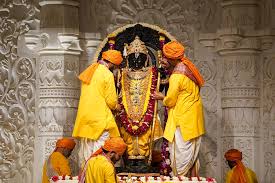
On the night before the demolition of the Babri Masjid structure on December 6, 1992, I met Rama Shankar Agnihotri in Ayodhya, a senior RSS member, journalist, and someone who oversaw media affairs during the Ram Janmabhoomi movement. Sitting right next to him, Vinay Katiyar, the MP of Faizabad (Ayodhya), gave me information about the Karseva. As the founding president of the Bajrang Dal, he was one of those who intensified the Ram Janmabhoomi movement. Without leaders like Ashok Singhal, Vinay Katiyar, Kalyan Singh, Mahant Vaidyanath—the guru of UP Chief Minister Yogi Adityanath—Uma Bharti, and Sadhvi Rithambhara, there would be no Ram Janmabhoomi movement at all. Advani, who went among the people in the name of the Ram Rath Yatra, gave a political shape to this movement, but the forces that actually organized the movement, like the VHP and Bajrang Dal, were different. Vinay Katiyar, who won three times from Ayodhya, gained popularity with slogans like ‘Mandir Wahi Banayenge’.
Such a Vinay Katiyar is taking the developments happening in Ayodhya today very seriously. He expressed deep anguish over the large-scale looting of cash and valuables from the donation boxes (Hundis) in the temple. The severity of the situation can be understood by the very fact that he said, “Everyone who is currently there is a thief.” Not only Vinay Katiyar, but many saints also condemned this plunder. “Those who looted the funds are Ravanas,” said Dhirendra Krishna Shastri, the head of Bageshwar Dham. Swami Avimukteshvarananda Saraswati, preacher Devakinandan Thakur, and Mahant Kamal Nayan Das like many other saints alleged that powerful people are behind this plunder. Shri Ram Janmabhoomi Teerth Kshetra Trust member Mahant Dinendra Das Maharaj on Sunday backed the administration’s action in the alleged Ram Mandir donation embezzlement case, saying the steps taken were appropriate and demanding strict punishment for those found guilty. Speaking to news agency ANI, he said the ongoing investigation and arrests were justified and credited the state leadership for swift action. “If I tell the truth in this matter, I will get into trouble,” said a former BJP MP.
Mahipal Singh, the former CEO of the trust, alleged that these funds have been plundered ever since the Centre formed the Shri Ram Janmabhoomi Teerth Kshetra Trust in 2020 to manage the temple construction, properties, and public donations, and that no one properly accounted for the gold, silver, and jewelry offered by the devotees. Instead of conducting an investigation after he pointed out the mismatch between vouchers, cash, and jewelry, he was removed from his job. The matter leaked out only after Akhilesh Yadav, the leader of the Samajwadi Party, raised this issue on June 7, 2026 and demanded a judicial inquiry. BJP leader Rajnish Singh wrote a letter directly to Prime Minister Narendra Modi, demanding that bank accounts and trust accounts be shown to the public and disclosed transparently. Finally, on June 13, the Yogi government appointed a Special Investigation Team (SIT).
There is no count of how large an amount of donations, ornaments, gold, and silver bricks the devotees offered for the Ram Janmabhoomi in Ayodhya. One can gauge the extent of the issue across religious institutions as The Indian Express reported that the Shri Badrinath Kedarnath Temple Committee on Friday ordered an inquiry into allegations of misappropriation of donations at the Badrinath shrine in Uttarakhand. All employees and officials involved in counting donations have been issued show-cause notices, ANI quoted the temple committee chairperson, Hemant Dwivedi, as saying.
Meanwhile, in Ayodhya, many devotees responded with deep devotion to the programs conducted in the name of distributing Akshatalu (sacred rice) and the ‘Ram Ram Gram Abhiyan’. Visuals of cash being taken away and bags being carried were exposed at least 70 times on CCTV cameras. The SIT concluded that some staff members intentionally stood in front of the cameras to prevent the scenes of stealing cash from the donation boxes from being recorded. Information was also obtained that large-scale lands were purchased with the looted money. Among those arrested by the SIT are some officials who count notes, the General Secretary of the Trust and International Vice President of the VHP, Champat Rai Bansal, and his personal driver Rama Shankar Yadav alias Tinnu Yadav, among others. But Champat Rai Bansal and Trustee Anil Mishra, who should have taken responsibility, merely resigned. Reports emerged that Anil Mishra built a magnificent three-story bungalow with ultra-modern amenities in Ayodhya. In fact, Alok Bansal, his wife Shivani Bansal, Chandan Rai Bansal, Manish Bansal, and others who ran real estate businesses worth crores of rupees in Ayodhya, are relatives of Champat Rai. Several land purchase documents seized by the SIT reached the media. Gopal Rao, a Pracharak of the Karnataka region belonging to Maharashtra and the Central Joint Secretary of the VHP, was appointed as the administrative officer. It is also reported that Gopal Rao, who is the most powerful person after Champat Rai, is the creator of many Udupi hotels in Ayodhya.
It is not entirely far from the truth to say that if there were no Ram Mandir movement, there would be no Bharatiya Janata Party. Lal Krishna Advani himself explained in his autobiography that the Ram Janmabhoomi had a role in the rise of the BJP. He described the Ram Janmabhoomi movement as the largest mass movement in the history of independent India. Only after he conducted the Rath Yatra from Somnath did the BJP win 120 seats in the 1991 elections. After promising about the Ram Mandir in the BJP’s election manifesto in 1998, the first non-Congress coalition government led by the BJP under the leadership of Atal Bihari Vajpayee was formed at the Centre in the subsequent elections. He declared that they proved that if the people’s identification with religion is directed in a positive path, it can be shaped into an wonderful force, and that the collective expression of the people resonated in unison with the expression of a nation’s soul. Advani, who wished to awaken the dormant Hindutva through his movement, described Rama as a distinctive symbol of India’s national personality, unity, and integrity. Many people lost their lives due to this movement. Thousands of people died in the firing ordered by the then UP Chief Minister Mulayam Singh Yadav’s government in Ayodhya in October and November 1990, and in the riots that took place across the country after the demolition of the Babri Masjid structure. Many people were jailed. Today, it appears that the ultimate purpose of the many sacrifices made for the Ram Janmabhoomi has been lost.
People like Advani believed that the Ramayana has influenced the high moral value system in this country for several decades. Pamidighantam Kodandaramaiah, a former High Court judge who established the Arsha Vijnana Trust, wrote that the Ramayana transcends religion and religious systems. He stated in his book ‘Ramayana Prabha’ that the Ramayana has endured forever in India because Rama is dharma personified, as in ‘Ramo Vigrahavan Dharmah’. Scholars like Ilapavuluri Panduranga Rao said that Valmiki’s Ramayana mentions Sri Rama’s truthfulness at every step, and that very adherence to the spoken truth has sustained Indian society through the ages. Valmiki made Maricha describe Rama as the personification of the Deity of Dharma. Valmiki praised Rama as a saintly person, one of true valor, devoted to truth and righteousness, true to his word, of truthful character, and one whose soul is truth itself. “Truth is the only God; truth is the foundation of devotion in the world. The root of everything lies in truth alone. There is no higher goal beyond truth,” Valmiki said. He formulated that “Dharma is born out of strength (Balo pratishtaho dharmah dharanyamiva jangamam). If righteousness and strength are coupled with truth, they can protect against any great calamity.” He said that even the world can be conquered through truth. Valmiki makes Rama himself say, “I have no infatuation for wealth, gold, objects, or vehicles; what I want is not the kingdom, but the nation (Na hahamartha paro devi lokamavastu mutsahe).”
But what is happening now? Ramayana means the path walked by Rama. Are we walking in that path? Are the strong standing by truth and righteousness today? Do they think the nation is more important than the kingdom? Is it enough to construct a Ram temple and install the idol of Rama? The ongoing developments prove that there is absolutely no value for truth and righteousness anywhere in the country, and that self-interest, wealth accumulation, desire for power, and tyrannical rule have become the sole goals. Leaders of the BJP, along with other parties, are proving the maxim: “Power corrupts. Absolute power corrupts absolutely.” It has turned out that some within the Sangh Parivar are also not exceptions to this. Today, one has to search for virtuous people in the BJP and the Sangh like Nanaji Deshmukh, Kushabhau Thakre, J.P. Mathur, Bhairon Singh Shekhawat, and Lakshmanrao Inamdar. There is also a rumor going around that the plunder in Ayodhya took place either to take the management of the temple away from the Sangh into the control of the government, or to put Yogi Adityanath in a tight spot. At a time when the BJP’s grip on national politics was thought to be tightening completely, the occurrence of plunder in Ayodhya—the very place responsible for the party’s progress—is a bad development. This development is causing distress among the people. Today, even lawyers in Ayodhya are collectively refusing to argue on behalf of the plunderers. This is not a stain that has come upon just a political party or an organization like the RSS, which claims to be committed to Hindu Dharma. It is a wound inflicted on the minds of the people who worship Sri Rama and the Ramayana in the country. The responsibility lies on the leaders of that party to ensure that the very arrow of Rama that caused the rise of the BJP does not become the cause of the BJP’s downfall.

