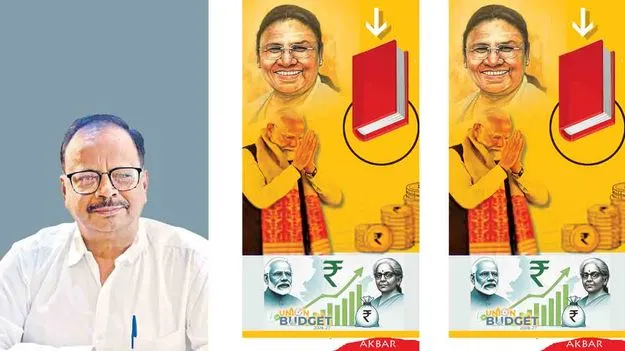
On the second day after the Union Budget was presented, immediately following the President’s address, Parliament plunged into severe chaos. This raises a fundamental question: do either the opposition or the government genuinely intend for Parliament to function smoothly? Conventionally, after the Budget is presented, discussion takes place on the motion of thanks to the President’s address, and only thereafter do debates on budget proposals begin. The President’s address to both Houses of Parliament is, in effect, a policy document of the government.
The President’s address detailed the various welfare schemes being implemented by the Modi government, its programmes, and the priority being accorded to infrastructure development. Rising above political differences, the President called upon all national representatives to work collectively in the national interest in line with the goal of Viksit Bharat (Developed India). Ironically, the very next day after the Budget presentation, parliamentary proceedings became impossible due to intense confrontations between the ruling and opposition parties. Who is responsible for this situation?
During the discussion on the President’s address that began on Monday, BJP MP Tejasvi Surya launched sharp attacks on the Congress. His remarks accusing the Congress of being opposed to Indian civilisation, culture, nationalism, and patriotism provoked the party. Would a Congress already seething with multiple wounds remain silent?
Immediately thereafter, Leader of the Opposition Rahul Gandhi entered the fray, strongly objecting to questioning Congress’s patriotism and nationalism. He began by saying, “Since the BJP’s young MP has made remarks about our patriotism and Indian culture, I would like to read out a few sentences.” He proceeded to read excerpts published by The Caravan magazine from Four Stars of Destiny, a book written by former Army Chief General M.M. Naravane on the 2020 border clash with China.
As soon as Rahul Gandhi began reading passages written by Naravane about Prime Minister Narendra Modi and Defence Minister Rajnath Singh, BJP MPs created an uproar. Defence Minister Rajnath Singh, Home Minister Amit Shah, and Parliamentary Affairs Minister Kiren Rijiju raised strong objections, questioning how excerpts from an unpublished book could be read in Parliament. Speaker Om Birla clarified that doing so was not permissible under Rule 342. Heated arguments ensued not only between ruling and opposition members but also between the Speaker and opposition MPs.
The same situation continued on Tuesday. Rahul Gandhi submitted a written note to the Speaker asserting that the contents of Naravane’s book were authentic and resumed his speech. However, ruling party members obstructed him as usual. Every time the word “Prime Minister” was uttered, the Speaker intervened. Amid the chaos over Rahul Gandhi being repeatedly stopped, eight Congress MPs were suspended. Eventually, after several adjournments, the House was adjourned till Wednesday.
Why did the situation deteriorate to this extent? Were Tejasvi Surya’s attacks solely responsible for provoking Congress? Why is the BJP preventing any reference to the contents of General Naravane’s book? In reality, the Centre has been blocking the book’s publication for the past two years. The Ministries of Defence and External Affairs have not yet granted permission to the publisher. Naravane himself stated, “I have written what I had to write. It is for the publisher to decide how to release the book.” He has neither commented on the controversy surrounding the book’s contents nor responded to The Caravan excerpts—suggesting that he stands by what he wrote.
Border clashes between India and China are not new. Numerous books have documented the mistakes of the Nehru government that led to war with China. During that war, Nehru expressed anguish over possibly losing Assam, saying, “My heart goes out to the people of Assam,” a remark that caused a sensation. The Congress never attempted to conceal the failures, defeats, and mistakes that occurred during its rule. Those very failures are partly why Congress today finds itself on the defensive on issues of national security and unable to recover from electoral defeats.
But under Modi’s tenure, even discussion of such matters appears impossible. Why is there a refusal to debate issues of national importance, even while minor successes are exaggerated and celebrated with excessive propaganda? Had Naravane’s book been released, it would have been debated for a few days and the matter would have settled.
Naravane wrote that during China’s intrusion into the Galwan Valley, the Defence Minister conveyed that the Prime Minister told him, “Do whatever you deem appropriate.” What exactly happened at that time, how many discussions were held, with whom, and after how much deliberation the Prime Minister decided to leave the matter to the Army—these details cannot be explained transparently on the floor of Parliament. At the same time, completely suppressing the issue and preventing any voice from being raised in Parliament only fuels suspicion.
In reality, budget sessions are meant for discussion on the Budget. A positive environment should have been created for debate on the so-called “mother of all agreements” signed with the European Union just days before the Budget. Instead, discussion on the Budget presented by Nirmala Sitharaman collapsed on the second day itself.
This is the third Budget presented by the Modi government since returning to power for a third term. With revenues estimated at ₹36.5 lakh crore and expenditures at ₹53.5 lakh crore, the government plans to borrow nearly ₹12 lakh crore and raise the remaining funds from the public and through disinvestment. Allocating ₹12.20 lakh crore for capital expenditure, nearly half of it to roads and rail networks, supporting the manufacturing sector, announcing industrial corridors, attempting to curb food inflation, and preparing the country for free trade agreements with global markets—all these may appear impressive. However, none of this may be sufficient to dramatically revive the Indian economy. While the Economic Survey suggested structural reforms, the government appears to have limited itself to announcements suited to current conditions, avoiding tough policy decisions.
Markets behave like flowing rivers. When blocked in one place, they find another route. The world was not intimidated by Trump’s tariffs. The U.S. was isolated as even its partner countries entered into their own trade agreements. The EU’s agreement with India introduced zero tariffs on many goods. China and Canada struck their own agreements as well. Consequently, Trump was compelled to revise his stance and reduce tariffs on India to 18% to stay competitive.
However, Trump’s declaration that India would stop buying Russian oil and instead purchase $500 billion worth of agricultural products, energy, technology, coal, and other goods from the U.S. triggered debate over the agreement’s implications. Rahul Gandhi alleged that Modi compromised with the U.S. and that Indian farmers would suffer, while Commerce Minister Piyush Goyal asserted that this historic agreement would create vast opportunities for Indian citizens.
Until the official details of the India–U.S. joint trade agreement are publicly disclosed, neither excessive optimism nor pessimism is advisable. Nevertheless, the Modi government has entered into two major international agreements at the beginning of 2026—an undeniable development. At the same time, it has become entangled in controversies such as Naravane’s book and the Epstein files. The consequences of these developments will become clear in due course.(4-2-2026)
 akrishnarao