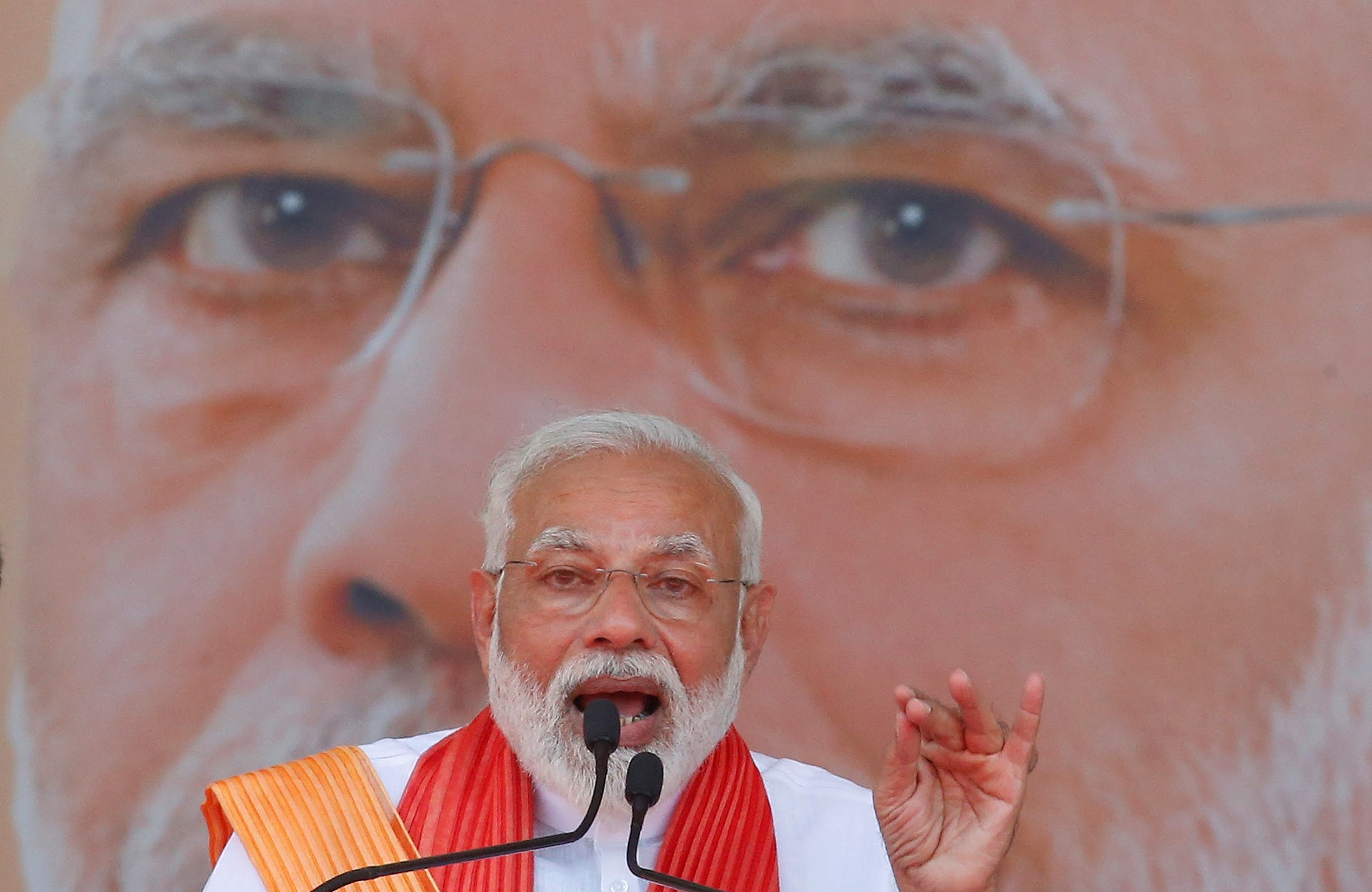
“You win only when you play. If you don’t play, how can victory come?” Prime Minister Narendra Modi recently said while speaking to young children. Since joining the Bharatiya Janata Party (BJP) in 1987, Narendra Modi has been continuously playing in politics. Completing four decades in this political game next year, he has had no notable defeat so far. In 1987, when he was handed over the responsibility of the Ahmedabad Municipal Corporation as the BJP Gujarat General Secretary, he secured this victory for his party for the first time. Since then, he has never looked back.
His journey of victory, which began in Gujarat with the corporation win, brought the party to power in the state, and later led to him personally taking over power as Chief Minister, delivering an unchallenged governance for 12 years. Without stopping there, even after taking over the responsibilities as the Prime Minister of the country in 2014, Modi has been continuously continuing in office for 12 years so far.
By 1987, when Modi entered active politics, the Congress was in power at the Centre and in 15 states. With the recent victory in West Bengal, the BJP and its allies under Modi’s leadership have achieved power in 21 states. In a way, Modi is now in the ascendant phase of his political life. While on one hand preparing for the celebratory milestones of his 12 years of governance, on the other hand, he is getting ready for massive changes in both the party and the government. He is setting the stage for his next political game.
“Victory is not just a game, it is also like riding a tiger,” political scientists often describe. Once you get down from it, it will swallow you. Baba Saheb Ambedkar said long ago that democracy is not just about victory in elections. Although Modi’s government is unchallenged in politics, India’s economic situation remains worrisome. Economists say that GDP growth is gradually declining, average inflation is doubling, and the pace of development is moving sluggishly. The monthly review prepared in May by the Ministry of Finance under the leadership of Union Finance Minister Nirmala Sitharaman made it clear that international developments are severely impacting India’s economic conditions. The value of the rupee is falling day by day. Crude oil import bills are rising. Reports are coming that petrol and diesel prices have increased four times since May 15 after the assembly election results, and there are chances of them rising again. For the second consecutive week, the decline in India’s foreign exchange reserves is clearly visible. Economists like former Economic Advisor Arvind Subramanian and representatives of the National Institute of Public Finance and Policy are warning that private investments in the country are also declining.
In May last year, NITI Aayog CEO B.V.R. Subrahmanyam announced that India had overtaken Japan to become the fourth largest economy, but according to the World Economic Outlook recently released by the International Monetary Fund, India has dropped to the sixth largest economy. Regardless of this matter, irrespective of statistical details, everyone knows that the per capita income in the country is at a very low level. Economists state that since 1991, while per capita income in China has increased 38 times, it has increased only 8 times in India.
The fact that Prime Minister Narendra Modi himself is appealing to the people to practice austerity measures indicates the severity of the situation. Economists say that the government is taking short-term measures from time to time but is not undertaking long-term measures. What are long-term measures? Discussions are ongoing whether it means further accelerating reforms or allowing foreign investments to enter more freely. No one has clarity on what steps Modi is taking in this direction. Organizations like NITI Aayog are also not transparently publishing reports on the country’s economic situation. It has been a long time since such organizations stopped trying to tell the government the actual situation, as they are instead eager to exaggerate minor developments into mountains. Will the situation improve merely by changing the heads of ministers as part of a cabinet reshuffle?
Secondly, even though the opposition parties in this country have failed to win elections, they seem to have succeeded in creating an impression among the people that institutions are being weakened. They are giving scope to raise doubts not only on the functioning of institutions like the Election Commission, CBI, ED, IT, CVC, and National Testing Agency, but also on the judgments given by the Supreme Court. The strange thing is, even when elections are conducted properly, the credibility of the Election Commission is being questioned. Due to the indiscriminate deployment of agencies like the CBI, ED, and IT against political rivals, trust in them is lost even when they work genuinely. Judges are acting in a manner that raises suspicion whether the boundaries that should exist between the Supreme Court and the government are blurring.
Ultimately, the fact that a miserable state exists in this country where even exams cannot be properly conducted for students was proven once again with the leak of NEET question papers. More recently, the controversy surrounding the CBSE’s On-Screen Marking (OSM) system has further deepened concerns about institutional competence. What began as isolated complaints soon turned into one of the biggest credibility crises faced by the country’s premier school education board. Remarkably, it was not political parties or government agencies that exposed the issue, but three young students. Vedant Shrivastava brought attention to the problem after allegedly receiving another student’s answer sheet during the verification process. Nisarga Adhikary, a young cybersecurity researcher, claimed to have uncovered serious vulnerabilities in the digital evaluation portal that could expose sensitive student data and examination records. Sarthak Sidhant raised questions regarding the tendering and procurement process behind the system’s implementation. Together, these three students forced a national debate on transparency, accountability, digital security, and administrative responsibility in the education system. Even CBSE was eventually compelled to acknowledge vulnerabilities in parts of the system after initially rejecting the allegations. The episode demonstrated how public institutions can lose credibility when legitimate concerns raised by students are not addressed promptly and transparently.
The way the youth of this country responded in an unprecedented manner to the call given on social media under the name of ‘Cockroach Janata Party’ creates a feeling that a fire is smouldering somewhere. It is naive to think that those who ask questions will decrease just by suspending social media accounts. Therefore, it must be considered that the Modi government succeeds only when it tries not just to win elections, but to increase the credibility of institutions and to solve the problems of the youth of this country.
Moreover, the political victories of the Modi government are not completed with the victory in Bengal. From next year onwards, they have to win again in BJP-ruled states. This includes the Prime Minister’s home state of Gujarat, as well as the largest state Uttar Pradesh, Madhya Pradesh, Rajasthan, and other states. The BJP’s situation in the four southern states is not very grand. In Karnataka, the BJP has no independent identity of its own outside of Yediyurappa. Even though several top RSS leaders like Dattatreya Hosabale, Santhosh, and Mukund hail from Karnataka, the BJP is unable to establish itself firmly there. As for Telangana, no party seems better than the BJP at cutting the very branch it is sitting on. In Tamil Nadu, Annamalai, who was once the party president, announced that the BJP has no future and is preparing to look out for his own path. BJP leaders do not seem to have realized that gaining acceptability in the South is more important than in Bengal.
However, whatever Modi’s weaknesses may be, how far Congress is trying to utilize them remains a matter of debate. No one can say what Congress is doing to confront the BJP head-on in UP, Gujarat, Madhya Pradesh, and Rajasthan. After Congress won in Kerala, the Congress high command took 11 days to decide the Chief Minister. It took Rahul Gandhi these many days to realize that the people, senior party leaders, and the cadre there completely admire Satheesan. He could not restrain his right-hand man KC Venugopal, even though the latter made intense efforts to become the Chief Minister himself.
Similarly, without even enjoying the happiness of winning in Kerala, the Karnataka headache started for Delhi. The Delhi elders are dragging both Siddaramaiah and DK Shivakumar along, in a helpless state where they cannot bring about a compromise between the two. Siddaramaiah, who represents the AHINDA group consisting of minorities, backward classes, and Dalits on one side, and DK, who is extremely loyal to the party and has stood by the high command in every crisis on the other side, have left the high command at a total loss. In fact, DK, who once had to move Gujarat MLAs to Bengaluru to ensure Ahmed Patel’s victory, had to get entangled in several cases. Ultimately, he even had to go to Tihar Jail. While it is justifiable to give the Chief Minister post to such a person as DK, nothing can be said right now about the future course of action of Siddaramaiah, who made it clear that he will remain active in politics and will not come to the Rajya Sabha.
A situation arose where Shivakumar had no choice but to include everyone suggested by Siddaramaiah in his cabinet. For the past 20 days, Delhi hotels and the AICC have been overcrowded, initially with Kerala leaders and now with Karnataka leaders. Although infighting exists in Congress in every state, Delhi is in a situation where it can do nothing.
That situation has never existed in the BJP. Even though there are BJP Chief Ministers in 17 states, there is no record of even a single one coming to Delhi for cabinet expansion or other changes. The BJP top brass has the grip to dictate who should be appointed without them needing to visit. That is the difference between the BJP and the Congress. That is also the secret behind their victories and defeats.

