When will the BJP’s triumphant march reach the South?
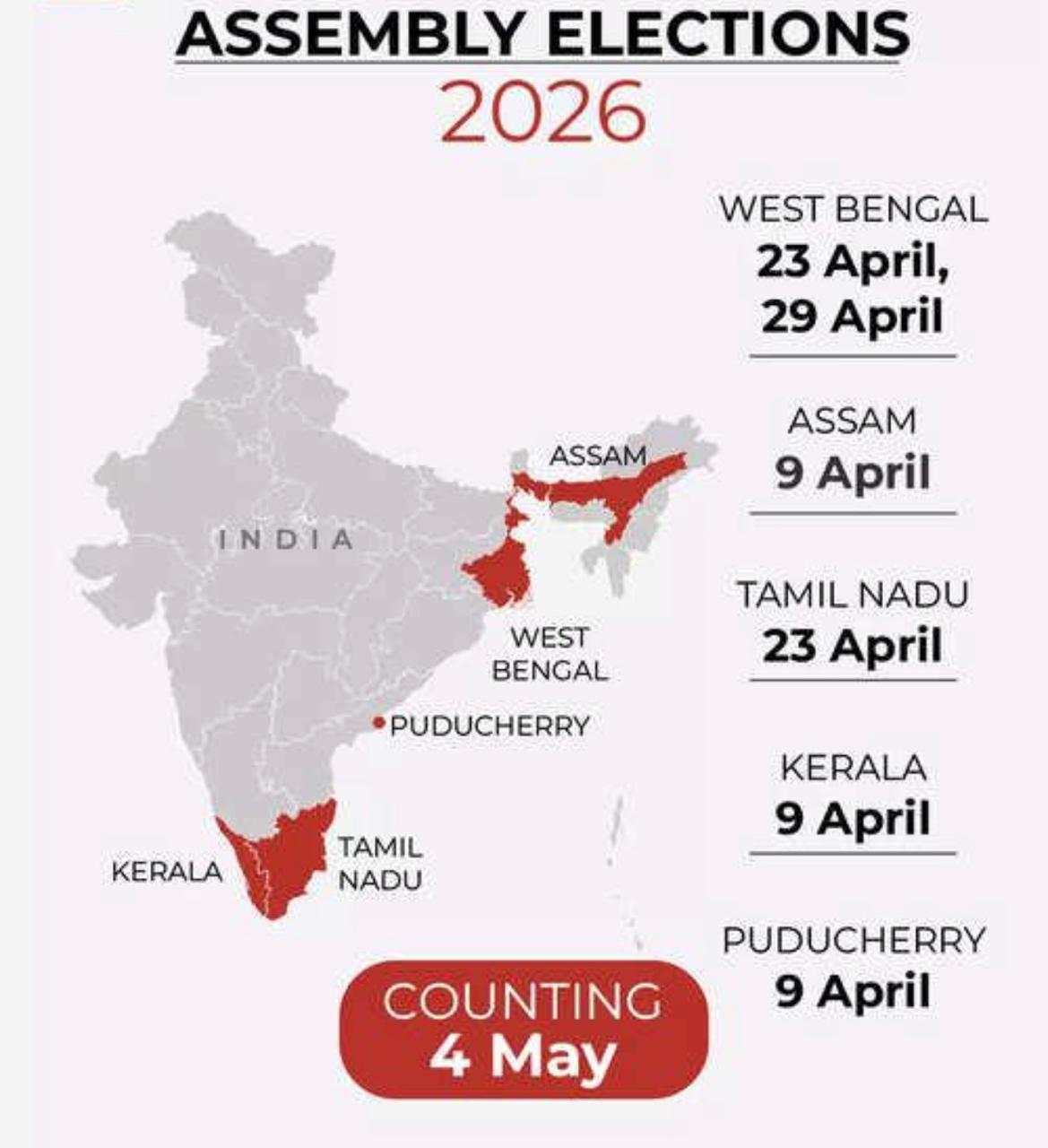
For several decades, red waves used to surge every year at Kolkata’s Brigade Parade Ground. But on May 9 this year, saffron waves swept across it instead. In the presence of Prime Minister Modi and thousands of people, Suvendu Adhikari took oath as the BJP’s first Chief Minister in West Bengal. Exactly a day later, on Sunday, in Chennai’s Jawaharlal Nehru Stadium, film actor Chandrasekaran Joseph Vijay took oath as the 9th Chief Minister of Tamil Nadu in the presence of national opposition leader Rahul Gandhi. Vijay’s coronation too witnessed an equally massive public turnout. This development clearly indicates that while the Bharatiya Janata Party has firmly rooted itself in Hindi-speaking states, expanded in western states like Gujarat and Maharashtra, in northeastern states such as Assam, Arunachal Pradesh, Manipur, and Tripura, and in the eastern coastal region first through Odisha and now Bengal, entering the South is not going to be easy. On one side stands Suvendu Adhikari, and on the other Joseph Vijay — both appearing as reflections of these changing political realities. Do these two events represent two distinct dimensions in the thinking of the Indian people?
While Narendra Modi, standing beside Suvendu Adhikari in Bengal, is now eager to expand into the South, Rahul Gandhi, who stood beside Joseph Vijay after achieving success in Kerala, has been unable to regain lost ground in North India despite repeated efforts. The southern states that once resisted Congress have not particularly welcomed the BJP either. In Andhra Pradesh, Telangana, and Tamil Nadu, there has been no experiment or attempt left untried by the BJP to gain entry.
In Andhra Pradesh, the BJP accepted the dominance of the Telugu Desam Party. In Karnataka, after losing power, it is making every possible effort to regain it. In Tamil Nadu, after realizing that strengthening independently is difficult, it had no choice but to once again ally with the AIADMK. In Kerala, although the BJP won 3 seats for the first time in this Assembly election, its vote share did not increase significantly compared to the past. If Kerala and Tamil Nadu remain distant dreams for the BJP, the only promising states appear to be Karnataka and Telangana. That is why Prime Minister Narendra Modi toured these two states immediately after the results of the five-state elections were announced. However, his tours in Karnataka and Telangana were markedly different. In Karnataka, Modi declared that people were inclining towards nationalist politics and that a saffron wave would soon sweep the state. But in Telangana, he did not express the same confidence.
In 1984, among the only two seats won by the BJP nationwide, one was Mehsana in Gujarat and the other was Hanamkonda in Telangana. Today, while the BJP has come to power in many states including Gujarat, it has still not expanded in Telangana to the extent expected. Modi himself reportedly mentioned this to state leaders and criticized them. During Bandi Sanjay’s tenure as state president, some enthusiasm had developed within the BJP cadre, but later that momentum gradually faded. The Sangh Parivar organizations may be able to steer people toward Hindutva ideologically, but it is BJP leaders who must create political momentum among the people. During Modi’s latest visit, he did not publicly provide any direct guidance to BJP leaders. He knows that the strategies adopted in North India and Bengal may not work in the South. However, his words and meetings regarding Telangana suggest that he may have some strategy in mind. Time alone will reveal what it is.
With the BJP’s victory in Bengal, it appears that after Mamata Banerjee, every force capable of challenging the saffron party is gradually disappearing. At the same time, questions are arising whether even the national party Congress is capable of taking on the BJP. Leaders who tried to unite opposition parties against the BJP have all collapsed one by one. Nitish Kumar, Mamata Banerjee, M.K. Stalin, KCR, Sharad Pawar, Kejriwal, and Uddhav Thackeray all once sought to unite the opposition against Modi. Nitish Kumar, who made intense efforts in 2023 to unify the opposition, later shifted towards the BJP for power and has now effectively handed over power to the BJP itself. Modi used every possible political strategy to sideline leaders capable of offering alternative politics nationally. None of them are now in a position to challenge Modi at the national level; instead, they are struggling for survival at the state level. In Maharashtra, after splitting the Shiv Sena and NCP to establish dominance, the BJP also encouraged rebellion within the Aam Aadmi Party. Although a new force has emerged in Tamil Nadu, it is too early to determine how much strength it can gather before the Lok Sabha elections. The Left parties’ only government is now under Congress influence. The Left’s presence in Parliament is also steadily declining.
As regional parties and Left parties weaken, a situation is emerging where Congress alone must face the BJP. Perhaps the BJP desires exactly that. Anti-BJP politics appears to be either weakening or losing relevance altogether. This is evident both at the leadership level and at the ideological level. Consequently, even in the South, parties are no longer hesitant to join hands with the BJP or accept its political ideology. It is difficult to say how long it will take for anti-BJP sentiment to spread beyond the “paper tigers” of social media into the broader public.
Congress ruled the country for decades after Independence, but gradually weakened over time. The condition Congress finds itself in today resembles the condition the Jana Sangh and later the BJP once faced. Within just two years, the BJP managed to come to power in Odisha, Bihar, and West Bengal in the East. It secured power for a third consecutive term in Assam. In the West, BJP has its own Chief Ministers in Rajasthan, Gujarat, and Maharashtra. In Gujarat, it has been in power continuously for 30 years. Except for Jharkhand and Himachal Pradesh, BJP Chief Ministers govern almost the entire Hindi belt. Even in Punjab, the BJP has already begun plans to gradually establish itself. If the BJP could establish dominance in the North, East, and West, is entering the South truly impossible?
However, in electoral politics, the BJP has become so strategically sophisticated that defeating the party now seems nearly impossible. No one has been able to crack the BJP’s winning formula in elections. The BJP leaves no instrument unused in its pursuit of victory; whether those methods are ethical or unethical is irrelevant to the party. Since Trinamool Congress leaders themselves admitted that the BJP won 31 seats because of “Sir,” it is likely that the BJP deployed additional strategies to win the remaining seats.
No political party can remain at its peak forever. If the BJP is to lose that position, it must become the cause of its own downfall. An alternative political force capable of dethroning the BJP must emerge. Conditions must arise where people begin resisting the party at every step. None of these three possibilities seem likely in the near future. Ordinarily, anti-incumbency sentiment against governments becomes visible, but the BJP has managed to overcome even that. BJP leaders are experts at neutralizing anti-government sentiment. In Assam, despite ruling twice, not only did Congress fail to defeat the BJP, but even Gaurav Gogoi — a three-time MP and Congress’s Chief Ministerial face — lost by a margin of 23,000 votes. What more needs to be said?
It is impossible to predict how much strength the opposition can build before the 2029 general elections to challenge the BJP. It is uncertain how many parties will align nationally with a Congress that defeated the Left in Kerala while simultaneously trying to weaken Trinamool in Bengal with Left support. Even if all opposition parties unite again, creating an ideological foundation and leadership capable of defeating the BJP will not be easy. Leaders like Jayaprakash Narayan and V.P. Singh are unlikely to emerge again. In reality, many votes now won by regional parties once belonged to Congress. If regional parties weaken, Congress should theoretically regain those votes. But Congress has not been able to rebuild that strength. In Hindutva politics, the BJP has no competition. Organizationally too, Congress cannot match the BJP. Congress has failed to inspire confidence that it can defeat the BJP in a direct contest. What message will the elections in Uttar Pradesh, Madhya Pradesh, Rajasthan, Karnataka, Telangana, and other states over the next two years deliver? Will Karnataka and Telangana preserve their distinctiveness like Tamil Nadu? Only time will tell.
 akrishnarao