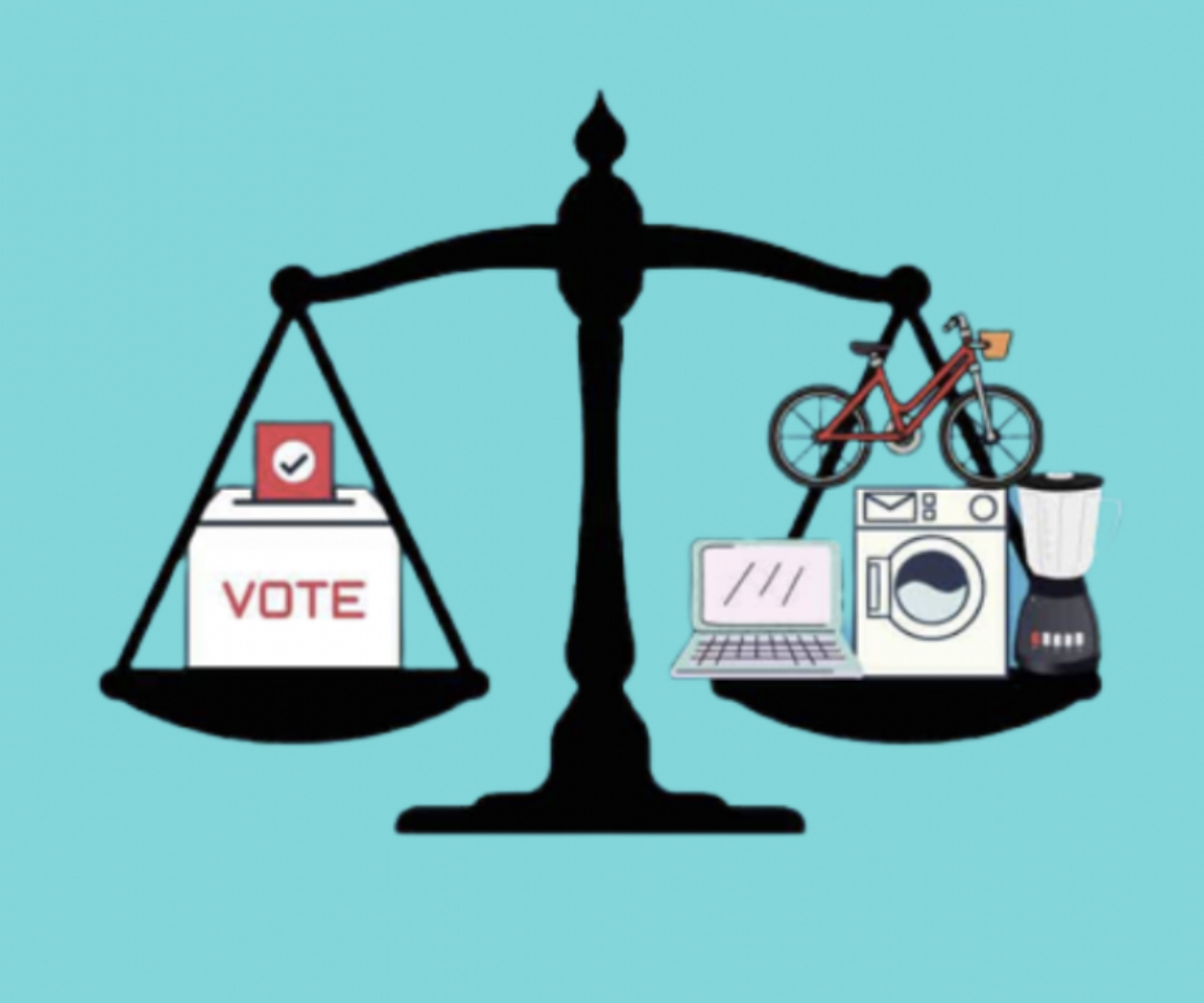
The debate over “freebies” in Indian politics has now entered the constitutional arena, with the Supreme Court of India agreeing to examine whether pre-election promises of cash transfers funded from the public exchequer amount to a “corrupt practice” under the Representation of the People Act, 1951. The Supreme Court said the petition will be heard in March. What began as a political accusation has evolved into a deeper inquiry into fiscal responsibility, democratic fairness, and the character of India’s welfare state. At stake is not merely the legality of campaign promises, but the broader balance between social justice and macroeconomic prudence in a competitive democracy.
Tamil Nadu Chief Minister M.K. Stalin’s announcement on February 13, 2026, implementing a major bonanza for women in the poll-bound state of Tamil Nadu—crediting ₹5,000 each to the bank accounts of 1.31 crore women family heads who are beneficiaries under the scheme Kalaignar Magalir Urimai Thittam (KMUT)—has added further interest to the debate.
The petition filed by BJP leader Ashwini Kumar Upadhyay raises foundational questions. Can electoral promises financed from public funds distort the level playing field? Where does legitimate welfare end and electoral inducement begin? And should courts regulate what is essentially a political and fiscal policy choice? The Representation of the People Act identifies certain forms of bribery and inducement as corrupt practices, yet it does not clearly define whether manifesto promises of welfare schemes fall within that ambit. This definitional ambiguity has allowed successive governments across party lines to expand direct benefit transfers without clear judicial boundaries.
The controversy gains urgency when viewed through the prism of fiscal sustainability. In Maharashtra, the Ladki Bahin Yojana reportedly costs approximately ₹46,000 crore annually—nearly 8 percent of the state’s total budget—at a time when the fiscal deficit exceeds ₹66,000 crore. Such recurring commitments constrain fiscal space for capital expenditure on infrastructure, education, and healthcare. The 2019 farm loan waiver of roughly ₹25,000 crore provided immediate relief but was widely criticized for restricting long-term investment capacity. Economists warn that debt-financed consumption spending can crowd out growth-oriented expenditure, raise debt-to-GSDP ratios, and increase interest burdens that future taxpayers must bear. The Reserve Bank of India has cautioned that excessive non-merit subsidies may affect macroeconomic stability, underscoring the long-term risks of fiscally expansive populism.
Yet the debate is complicated by the absence of a universally accepted definition of a “freebie.” Economist C. Rangarajan has suggested distinguishing between subsidies on merit goods such as education and health and non-merit transfers that lack productivity linkages. But even this distinction is not always clear. Is free electricity for farmers a distortionary subsidy or a growth investment? Is free education merely welfare, or a constitutional obligation under the right to education framework? Is unconditional income support empowerment for vulnerable households, or an electoral inducement timed for political gain? The boundary between welfare and populism is not merely economic; it is normative and political.
International comparisons add nuance but not easy solutions. Countries such as Germany and South Korea operate structured welfare systems in which benefits are often linked to employment search requirements, skill development, or contributory social insurance. These systems are embedded within stable fiscal architectures and high levels of formal employment. India, by contrast, confronts a large informal sector, weak employment absorption, and rising aspirations among its population. In such a setting, unconditional cash transfers are administratively simpler and politically more attractive than complex structural reforms.
Electoral timing further complicates perceptions of legitimacy. In several states, welfare schemes have been expanded, advanced, or newly announced shortly before elections. Even when legally permissible, such timing creates the impression that public finances are being leveraged for electoral advantage. The criticism is not confined to one political formation. Prime Minister Narendra Modi has warned against what he termed “revdi culture,” arguing that fiscally irresponsible promises burden future generations. Yet critics note that the Modi government is providing free food grains to over 81 crore beneficiaries under the Pradhan Mantri Garib Kalyan Anna Yojana (PMGKAY) to ensure food security and reduce financial burdens. This initiative covers Antyodaya Anna Yojana (AAY) and Priority Households (PHH) under the National Food Security Act, with a five-year budget of ₹11.80 lakh crore. Moreover, BJP-led governments in states such as Assam, Delhi, Maharashtra, and Madhya Pradesh operate substantial direct transfer schemes of their own. What emerges is less an ideological contradiction than a structural incentive within a competitive democracy.
Direct transfers produce immediate and visible benefits to identifiable voters. Infrastructure projects, by contrast, yield slower and more diffuse gains that are harder to attribute to a particular government. In an electoral environment where tangible short-term relief can decisively influence outcomes, parties across the spectrum may feel compelled to adopt similar strategies. The result is a normalization of competitive cash-transfer politics, where the debate shifts from whether to provide transfers to how large and how frequent they should be.
As the Supreme Court considers the legal framework, it faces a delicate institutional balance. An aggressive intervention could risk judicial overreach into policymaking and blur the separation of powers. A restrained approach, however, may leave fiscal populism unchecked in shaping electoral competition. The solution may not lie in absolute prohibition or blanket endorsement, but in greater transparency and accountability. Mechanisms such as mandatory fiscal impact disclosures in manifestos, adherence to medium-term fiscal responsibility frameworks, or the establishment of independent fiscal councils could introduce discipline without undermining democratic choice.
Ultimately, the freebies debate reflects a deeper tension within India’s development trajectory—between redistribution and growth, between immediate relief and long-term investment, and between electoral competition and fiscal prudence. In a democracy committed to both social justice and economic stability, the challenge is not to eliminate welfare but to design it responsibly. Whether cash transfers represent empowerment or populism depends on their timing, targeting, sustainability, and measurable outcomes. The Court may clarify legal boundaries, but the enduring balance between welfare and responsibility will remain a political question, to be negotiated through informed public debate and accountable governance.
 akrishnarao