Tag: news

  • Mid-Course Correction: Why Dharmendra Pradhan’s Exit is a Wake-Up Call

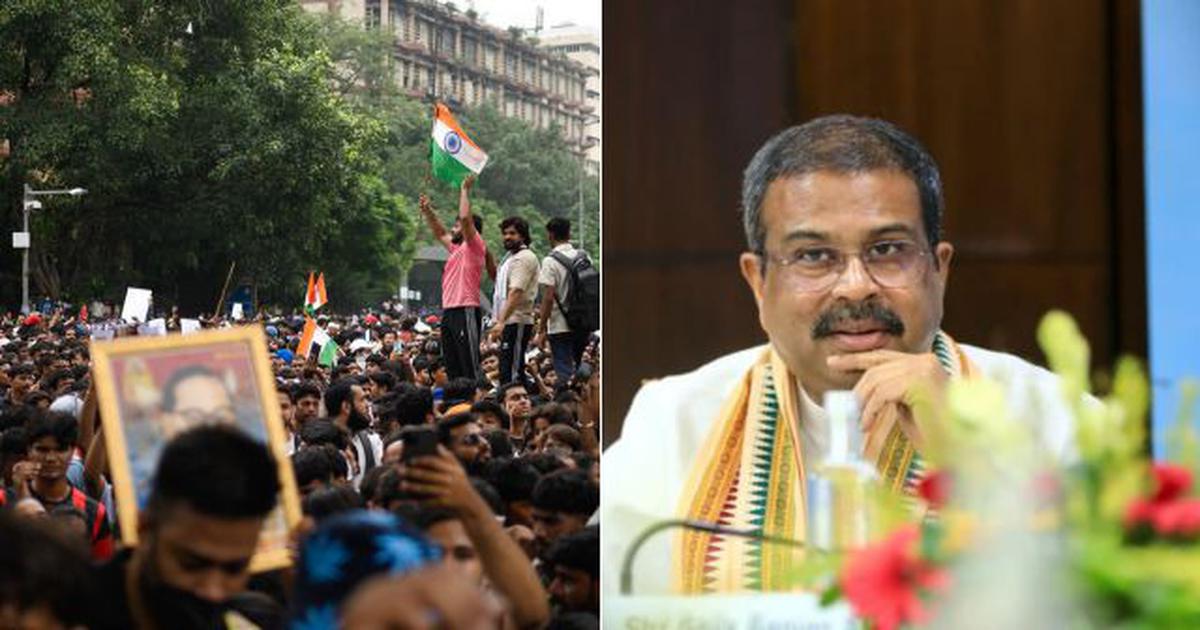
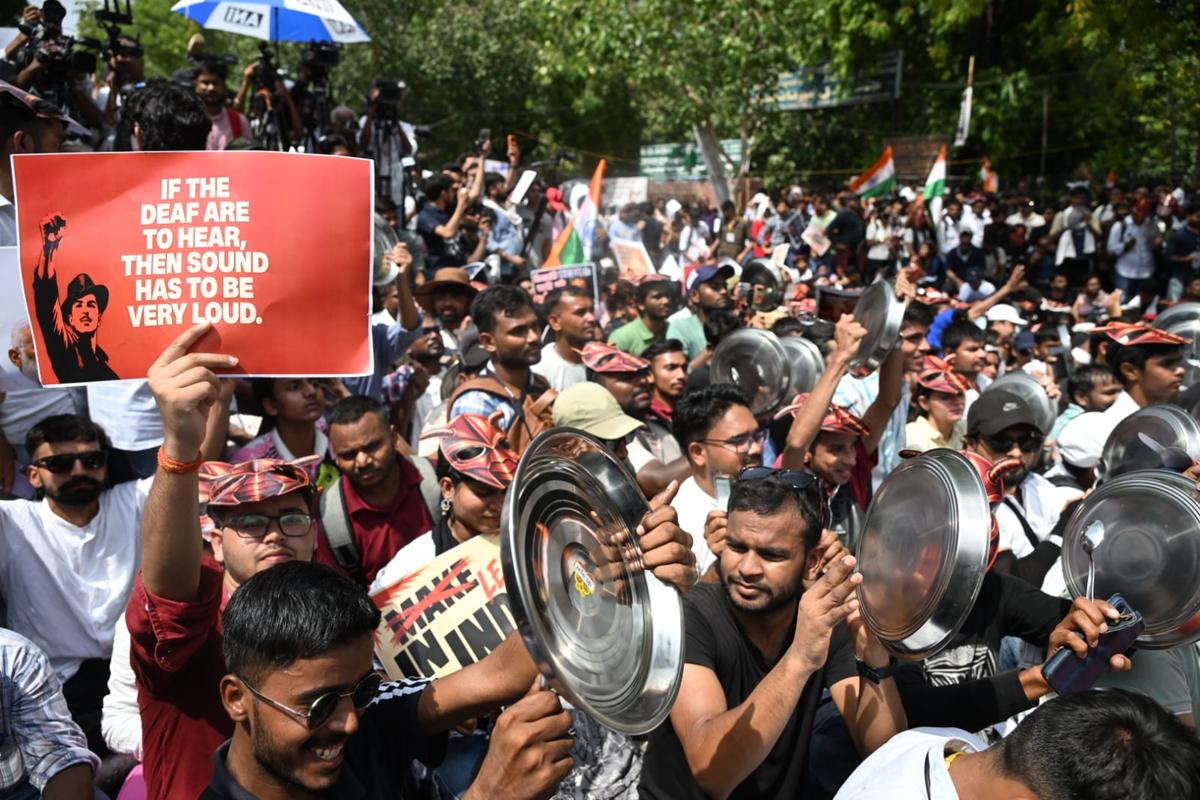
    ‘Today’s youth have not strayed from the right path. They are not acting without direction. One should engage in discussion with them, but not control them. They ask for reasons, not rules. They seek explanations. Curiosity is their trait. Rebellion is their nature’.. These words were spoken not by some Communist leader, but by Rashtriya Swayamsevak Sangh chief Mohan Bhagwat. On July 24, as he was speaking these words at the Vishwa Mangalya Sabha held at the Ambedkar International Centre.. just one kilometer away at Jantar Mantar, an aggrieved group of youth was expressing intense anger. Exactly 24 hours later, Union Education Minister Dharmendra Pradhan resigned from his post. ‘Though delayed, a good thing was done in the end..’ commented 92-year-old Murli Manohar Joshi. A day before Bhagwat made his statement, that veteran grandee commented that the lathicharge on students was atrocious. Joshi also justified that the students’ anxiety regarding the examination system was legitimate.

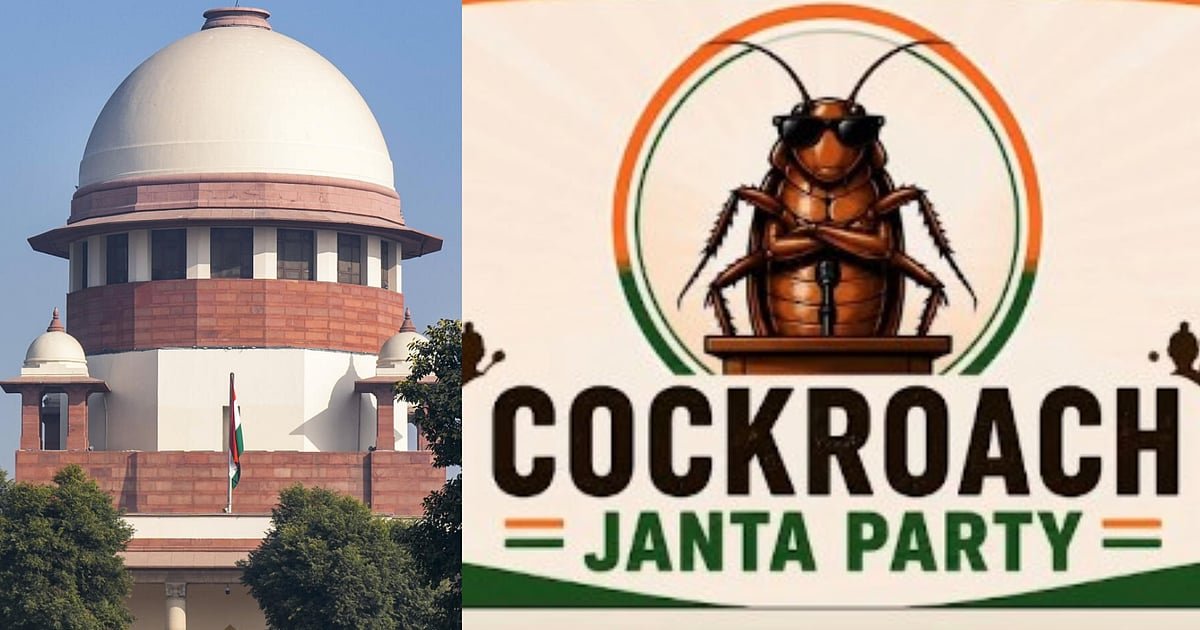
    Examining these developments closely reveals that it was not only the pressure from the youth, but also the pressure from internal forces within the BJP and the Sangh that led to Dharmendra Pradhan’s resignation. It also becomes clear how much internal disquiet the intensity of the Cockroach Janata Party’s protest demonstration at Jantar Mantar created within the BJP, albeit belatedly. Sonam Wangchuk, an educator and environmental activist from Ladakh who strengthened the Cockroach Janata Party’s protest through his hunger strike unto death, was once a supporter of Modi. When Article 370 was revoked and Ladakh was separated from Jammu and Kashmir, he overflowed with joy. When the BJP promised to include Ladakh in the Sixth Schedule, he campaigned in favor of the BJP during elections. Wangchuk even turned down Rahul Gandhi’s invitation to participate in the Bharat Jodo Yatra. The BJP turned such a person against itself. Not just him, among the young men and women who came to Jantar Mantar, there were many who once admired Modi and the BJP and later turned against them. ‘I too voted for Modi along with my parents. When I was coming to the Jantar Mantar demonstration in Delhi, they did not raise any objection at all,’ said a young woman. BJP leaders themselves say that even in the houses of several Union Ministers and MPs, their children expressed solidarity with the CJP demonstration. In the Jantar Mantar demonstration, many engineers, fashion designers, MBA and law students, and children of farmer families were seen from several states along with Punjab, Mumbai, Haryana, and Telangana. Wearing loose jeans, t-shirts, various kinds of attire, and bands tied around their heads, these youth cannot be linked to any political party.

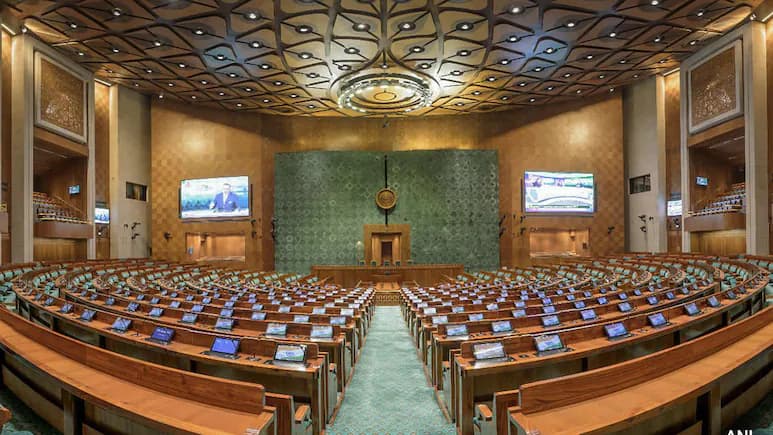
    It is surprising that these very students are deciding the Parliament’s agenda today. After the commencement of the monsoon session of Parliament, the Lok Sabha functioned smoothly for the first time on Tuesday afternoon after seven days. The students were the reason for that. They were responsible not only for Dharmendra Pradhan’s resignation, but also for the government hastily bringing a bill to prevent irregularities in exams, for the Prime Minister announcing this bill late at night, and for the opposition finally agreeing to a debate. From Smriti Irani to Dharmendra Pradhan, four education ministers have changed during Modi’s tenure. During every education minister’s tenure, there was some controversy or the other. But the situation of having to resign due to student pressure arose only for Dharmendra Pradhan. When Dharmendra stepped into the Parliament premises after resigning, BJP MPs gave him a grand welcome chanting ‘Zindabad’ to him. They crowned him. For what? On whose orders and why did they honor him? It is clear that this was done to claim that even when knocked down, their upper hand remains. Who suffers the loss due to this? Is it not them?

    Many people across the country connected with the young men and women who conducted a peaceful protest demonstration for over a month, demanding that the Education Minister take moral responsibility for the exam paper leak. When they marched towards Parliament and their heads were fractured by lathicharges, and pellet fragments penetrated the bodies of those youths, many felt deep anguish. If those in the CJP were anti-social elements, why did Union Ministers hold three rounds of discussions with their representatives? Why did they promise to discuss reforms in the education system with them as well?

    In reality, in every movement, some amount of violence and destruction keeps taking place. Even in the Sampoorna Kranti movement led by Jayaprakash Narayan, there were allegations that a conspiracy was hatched to blow up railway bridges with dynamite. Violence broke out during the anti-reservation movement as well. Many times, after police brutality occurs, this angle of anti-social elements is brought forward to justify it. That alone does not take away credibility from the entire movement. Portraying every protest as a crime might work for a while, but it will not work at all times. Those in the ruling system must learn to respect the anger of protesters. Otherwise, a permanent hostility towards governance systems will be formed. This wisdom is evident in the comments made by Mohan Bhagwat, even if belatedly.

    Actually, had Congress acted properly, the need for students to take to the streets would not have arisen. Congress did not raise its voice strongly until after seeing the response to the formation of CJP on June 6. After the paper leak occurred in the first week of May and the exam was cancelled on May 12, Congress did not make enough efforts to respond strongly and hold the government accountable. Rahul Gandhi, who organized a student rally named ‘Chatron Ki Goonj’ in Kota, Rajasthan on June 17, disappeared for the next 23 days and spent time in Germany. Rahul showed signs of movement again only after the founder of CJP entered Delhi and intensified their protest, with just three days left for the Parliament session to begin. It was proven that if there is no continuity and daily active presence in politics, the situation goes into someone else’s hands. Congress must realize that theatrically organizing dharnas and getting arrested as in the past will not gain public sympathy. Since 2014, Congress has been stalling Parliament and holding protests. What change has come in electoral politics or in the government’s stance? With just a month-long protest, the Cockroach Party was able to make the government back down. Why did Congress and the opposition lack such moral strength?

    Just because bills are introduced in Parliament, it cannot be said that changes will come in the education system. Just by opening new IITs and medical colleges, the quality in higher education cannot be improved. To this day, not a single Indian university finds a place among the top hundred universities in the world. Even though the size of the Union Budget increases enormously every year, the share allotted to education in the Union Budget over the last 12 years has decreased significantly. In 2013–14, 4.65 percent of the total Union Budget was allocated to education, whereas by 2025–26, that share has fallen to 2.5 percent. Priority in the country is decreasing not just for education, but also for research. Going into the pages of history reveals that during the Congress regime, BJP leaders like Murli Manohar Joshi, Arun Jaitley, Sushma Swaraj, Narendra Modi, and others heavily criticized educational standards, facilities in educational institutions, and the lack of connection between higher education and employment. So to what extent has the situation changed now? Despite test papers leaking multiple times, why did the idea of setting up fast-track courts not arise earlier until students came onto the streets? In 2024, re-examinations were not conducted in certain test centers until the Supreme Court intervened. Now, the entire examinations had to be cancelled. Moreover, they are promoting it as a grand achievement that they are organizing exams properly on a war footing without loopholes. Days might even come when they claim in election manifestos that they conducted exams properly without paper leaks!

    PM Modi described the intervening period until achieving Viksit Bharat by 2047 as Amrit Kaal. The protest by the swarm of cockroaches during this Amrit Kaal should be considered, in a way, an auspicious development that served as an eye-opener for the government. Dharmendra Pradhan’s resignation need not be considered a humiliation. It should be regarded as an opportunity to engage in self-introspection over the developments that occurred and take appropriate measures. Perhaps realizing this very fact, Infosys co-founder Nandan Nilekani was entrusted with the responsibility of Chairman of the Task Force on NTA exam reforms. It was under his leadership during the UPA tenure that the Aadhaar project, which stood as the largest biometric identification system, took shape. He played a key role in the digital transformation currently visible in the country. Technical experts and intellectuals have no affiliation with parties. That is why Modi entrusted him with key responsibilities. If the government moves forward in this same direction and takes steps to bring key changes in the governance system rather than always focusing on politics, there is no one who would not appreciate it. There is an opportunity to take such mid-course correction measures in another three years. If that does not happen, the ruling party itself stands to lose!
  • The Uncontainable Anger of India’s Disillusioned Youth

    “A small body of determined spirits fired by an unquenchable faith in their mission can alter the course of history,” said Mahatma Gandhi. India now seems to be moving toward an indefinable change. The siege of Parliament on the first day of the Monsoon Session in the national capital on Monday by activists of the Cockroach Janata Party (CJP)—who have been protesting for a month demanding the resignation of Union Education Minister Dharmendra Pradhan, holding him responsible for the NEET question paper leak—must be called a monumental development in recent times. Despite setting up four-tier barricades, deploying large-scale forces of the Rapid Action Force, CRPF, Delhi, and Tripura Police, closing metro stations, and shutting down the internet, the Cockroach army, thousands strong, charged up to the gates of Parliament. Even as the police beat them severely, the young men and women displayed sheer daring. The young people lying with injuries at Ram Manohar Lohia Hospital are direct witnesses to Monday’s brutality.

    It is clear that the Modi government, which remained unmoved despite a decade of attacks and criticism from the opposition, has been put on the defensive by this incident of the cockroach rebellion. A BJP MP said that it is not important how many people participated in the movement launched by the Cockroach Party, but how much impact it had. “My father is a very important leader in the BJP. However, the unfolding developments are not very healthy…” said a youth who participated in the Jantar Mantar protest. “Where politicians fail, children will question,” said a student.

    In reality, the Cockroach Janata Party is not an organization. It is a crowd of directionless young men and women in the country’s contemporary history. Those who came to the protest at Jantar Mantar or participated in the procession did not come because someone paid them. No one arranged buses or trains for their arrival. The discussion happening merely on social media made them set out for Delhi. They did not come raging only over the NEET question paper leak. The young men and women who came were simply fed up with the problems faced by youth—especially unemployment, meager salaries, systemic flaws, and the machinations of political parties. Those who came to the Jantar Mantar protest site did not have a specific goal. Youth aged between 14–28 cannot be fitted into the mold of Left or Right ideologies. The Emergency is not part of their experience. They do not know about Loknayak Jayaprakash Narayan, who once united the opposition. They lack even the experience of the Mandal and Kamandal movements. They have no memories of events that happened three decades ago. Struggling with contemporary issues, unable to decide what to do, with an uncertain future, and arriving with various questions… they are not bound by any traditional rules. Over the past four weeks, this protest platform served as a space where they asked their own questions and provided their own answers. That protest was widely publicized on social media. Examining alternative media sources makes one understand how concerned the youth were about the health condition of environmental activist Sonam Wangchuk, who has been on a hunger strike for more than three weeks.

    Believing that the opposition lacked credibility, that there was no alternative to them, and that whatever they did would pass, the Modi government seems to have underestimated the emergence of the Cockroach Janata Party. The Modi government was easily able to deal with the long-drawn protests by farmers over farm laws and Muslims over the Citizenship Amendment Act. It did not listen even to the cries of female wrestlers who questioned the assaults committed against them. Whichever movement occurred in the country, it adopted various means to damage its credibility. It berated the protesters with various names. The Modi government thought it would be enough to treat the surge of youth protest as a law-and-order issue and suppress it. As the Cockroach Party protest was reaching its peak, Delhi Police Commissioner Satish Golcha was removed and replaced by Anurag Kumar, who until then served as Special Director (Intelligence). As the in-charge of the Jammu & Kashmir desk, he played a key role in dismantling terrorist activities in Kashmir. There is no surprise in such a person attempting to suppress the youth protest with the same mindset.

    During the UPA government’s tenure as well, young men and women flooded the streets against the Nirbhaya rape incident. However, back then, social media was not as influential as it is now. There is no doubt that social media today has become an alternative media for the public. In fact, when Modi came to power, the BJP IT Cell carried out various campaigns to mobilize people, especially to inflame the emotions of Hindus. In particular, it made extensive use of WhatsApp groups. Today, those IT Cell campaigns seem to fade before the social media in the hands of the Gen Z generation. This development proves that if any campaign is not aligned with the sentiments of the people, it will not last long.

    The current generation has not failed to notice that the promises with which Modi came before the people have vanished into the background, and emotional issues have become the main agenda. Leave aside the failure to create jobs; they are closely observing the inability to conduct even exams properly, the failure to provide quality education, and the resorting to numerous machinations and unrighteous wars solely for the sake of power. Nevertheless, there is no evidence to say that the current generation is placing the opposition, especially the Congress, on a pedestal. It is an undeniable fact that for a decade, the Congress and other parties have failed to ignite public anger against Modi. However, no one expected that youth would step up where the opposition failed. If the Congress party had acted as a strong opposition and reflected the aspirations of the youth, the Cockroach Janata Party would not have emerged. It is an interesting point that many forces that failed to confront Modi are now visible in the Cockroach army.

    Strangely, on the first day of Parliament’s Monsoon Session, people did not care about the bills the government intended to introduce or the issues the opposition wanted to raise. The ‘Chalo Sansad’ call given by the Cockroach Janata Party received immense publicity. In a way, this development questioned not only the existence of the government but also the existence of the opposition. Congress leaders, who had been silent all this while on the Cockroach Janata Party protest, making a hue and cry about the lathi charge on the youth, or Rahul Gandhi protesting in front of the Prime Minister’s residence, are all part of Congress trying to prove its own existence. Time alone will tell whether Congress will resurrect itself as a strong opposition learning from the experience of the Cockroach Janata Party. Even for Modi, it is fortunate for the opposition to exist at least to some extent. Otherwise, there are chances of more entities like the Cockroach Janata Party being born.

    Moral responsibility has become an unacceptable taboo in present times. Today, there are no leaders like NTR, who made the entire cabinet resign because the budget was leaked, nor are there ministers who take responsibility and resign for train and plane accidents. When Dharmendra Pradhan is constantly utilized to win elections for the party, how can he focus on his ministerial responsibilities? It is true that Dharmendra Pradhan, who efficiently strategized for the BJP’s victories in Bihar, Haryana, and Bengal, did not manage his ministry efficiently. However, that mistake is not entirely his. Treating their party’s victory in elections as a matter of life and death and diverting all energy and skill in that direction is the cause of the failure of leaders like Dharmendra Pradhan. Will the Modi government act with sincerity at least now to take responsibility for the mistakes committed and build public trust in system institutions?

  • Is India’s Judiciary Losing Its Autonomy?

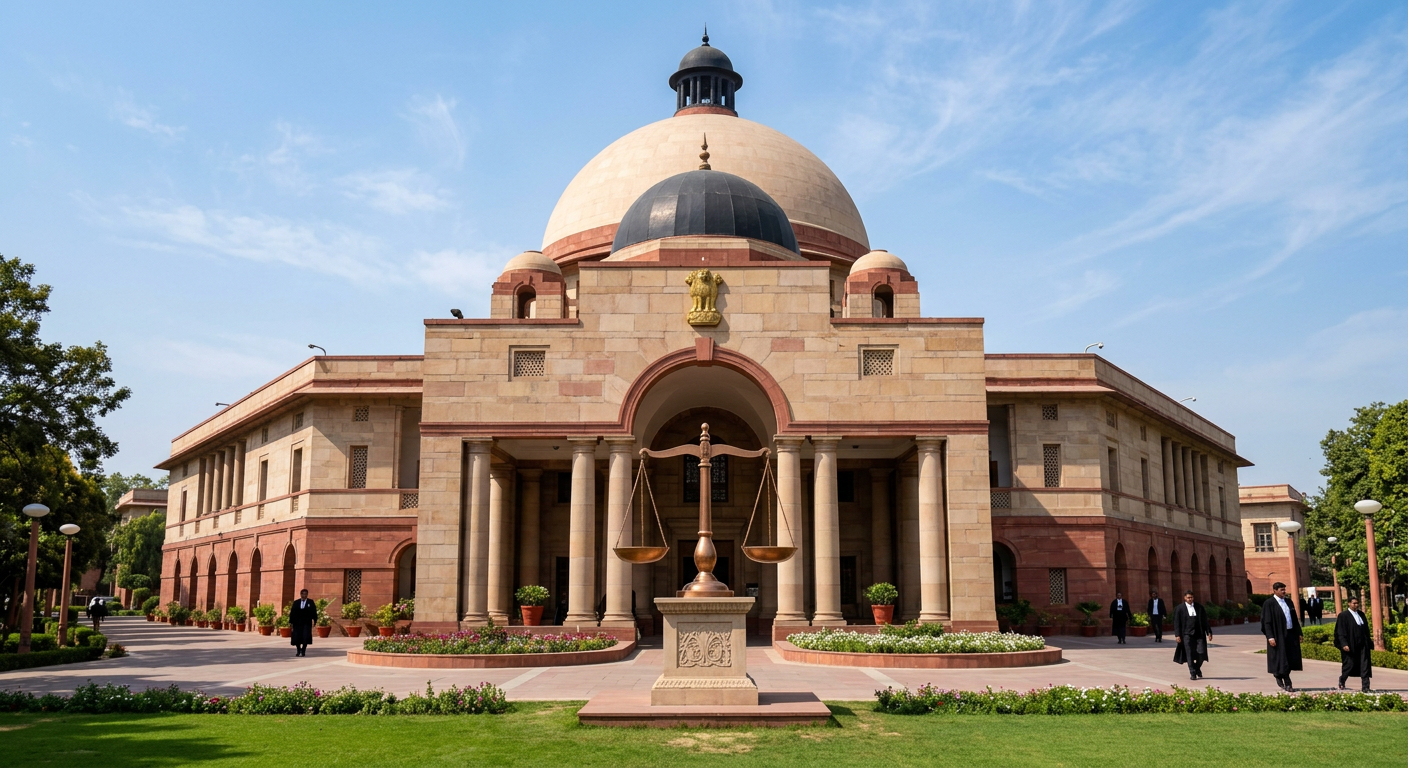
    Supreme Court of India building with dome and scales of justice statue
    The Supreme Court of India building with a prominent scales of justice statue in front

    A boy died when a tanker hit him from behind while a father was taking his five-year-old son to school. That road had neither a footpath nor crossing markings to cross the road. Such incidents keep happening in large numbers in the country, but the apex court responded to this tragic incident in a rare manner. Supreme Court Judge Justice P.S. Narasimha issued directions that walking should be recognized as a fundamental right under Article 19(1)(d) and Article 21. He said that roads should be constructed not just for vehicles but in a manner suitable for pedestrians. He also reminded that walking has cultural, religious, political, and social value in India. Justice Narasimha cited historical events like the Dandi March and the Bhoodan Movement.

    A study has revealed that in this country, where walking itself has turned into a conflict, an average of 36,500 pedestrians die every year due to the lack of proper footpaths and crossings. These incidents are occurring because 80 percent of urban roads lack safe and pedestrian-friendly infrastructure. In metro cities, 44 percent of roads do not have footpaths at all. Most of the existing footpaths do not comply with the regulations laid down by the Indian Roads Congress. To what extent are the government leaders—who talk about Viksit Bharat, a trillion-dollar economy, and global cities—aware of the plight of pedestrians in the country?

    On this occasion, Justice Narasimha questioned the failure to make laws in accordance with the fundamental rights of the people. He clarified that when the Motor Vehicles Act was made, the fundamental right of walking people was not recognized, and it appears as if this Act was made solely for vehicles. After Justice P.S. Narasimha, the second Telugu person who is set to become the Chief Justice next year, gave a judgment to recognize walking as a fundamental right, there has been an overwhelming response from the public. Reports are emerging about the lack of footpaths in many cities. The Supreme Court Bar Association responded positively to another judgment given by Justice Narasimha, stating that advocates should first know about the Rule of Law, independent stance, and standards, and build credibility. As suggested by Justice Narasimha, it has come forward to establish a National Legal Academy for advocates. Many also welcomed the judgment given by Justice Narasimha stating that merely chanting shlokas like ‘Guru Brahma, Guru Vishnu, Guru Devo Maheshwara’ is not primary, proper salaries must be given to those teachers, and ordered that the minimum wage scale be applied to teachers in Gujarat educational institutions. In the name of the Green Energy Corridor, he prevented any threat to the Great Indian Bustard birds in Rajasthan and Gujarat.

    Like pleasant raindrops in the scorching summer, we cannot ignore some good judgments given occasionally not only by Justice Narasimha, but also by Justice Ujjal Bhuyan, Justice Vikram Nath, Justice Nagarathna, Justice Viswanathan, and others. The Chief Justice of the Supreme Court, Justice Surya Kant, stayed a judgment that allowed the demolition of the Aravalli hills if they exceeded a height of one hundred meters, following concerns raised by environmentalists. Although several notable judgments are coming from the Supreme Court on and off, the debate on whether the judiciary is functioning independently continues unabated.

    The fact that the role of the apex court in the country is becoming controversial day by day is becoming a topic of discussion. Even former judges and senior advocates are commenting that the Supreme Court is losing its identity, acting as if it is under someone’s control, and ignoring fundamental rights. Before the country could forget the incident where a shoe was hurled at the Chief Justice of the Supreme Court, a petitioner made obscene remarks against the CJI in full court last week. There are those who describe such incidents as signs of growing frustration and despair toward the apex court. On the other hand, in light of the incident where a huge amount of cash was found at the residence of Delhi High Court Judge Justice Yashwant Varma, Parliament is preparing to introduce an impeachment motion against him. Why would the government let go of an opportunity to put the judiciary on the defensive?

    Chief Justice of the Supreme Court Justice Surya Kant himself expressed the view at a conference held in Stockholm that the independence of the judiciary is essential to preserve constitutional values and prevent the abuse of power. He cited cases such as Kesavananda Bharati, which protected fundamental rights, and S.R. Bommai, which protected the federal spirit. These judgments have entered the pages of history. In the past, the Supreme Court intervened multiple times to ensure that investigative agencies like the CBI and ED function freely, smoothly, and without any external pressure. So, how many such wonderful judgments have come from the Supreme Court in the last few years?

    There is no dearth of instances where good judgments have come from some High Courts as well in recent times. Justice Madhav J. Jamdar of the Bombay High Court questioned whether externment (exile from the city) can be imposed for raising slogans against the government. He declared that people are not slaves to the government, and it is their right to protest and raise slogans opposing government decisions. Justice Madhav clarified that the police are servants to the people, not to the government. Questioning the blocking of the ‘Cockroach Janata Party’ X account, the Delhi High Court ordered that the ban on that account be lifted. The Madras High Court commented, “Judges are not holy cows, there are corrupt people among them too.” It responded in this manner to a petition filed seeking a ban on a movie that depicted a judge engaging in corruption. Ironically, because it was mentioned in the NCERT textbook that corruption exists in the judiciary, the Supreme Court opened its third eye and had that paragraph changed. The details previously mentioned regarding thousands of cases pending in courts were also removed in the new chapter. The textbook stated that the judiciary functions independently, beyond the executive and the legislature. Is that really happening?

    According to the World Justice Project report, India ranks 86th in terms of the Rule of Law. According to that report, prepared by an independent organization based in the US, the Rule of Law is not that great even in the US, finding that it ranks 36th in that regard. A report by the V-Dem Institute in Sweden stated that one-fourth of the countries in the world are sliding into autocracy, and America and India are also among them. The report noted that America lost its recognition as a liberal democratic country for the first time after fifty years. It revealed that systems are systematically collapsing in India. It goes without saying that if governments become autocratic, its impact will be directly felt on the systems.

    Sitting judges like Justice Narasimha, Justice Ujjal Bhuyan, Justice Nagarathna, Justice Dipankar Datta, and others have been repeatedly warning about the independent status of the judiciary and the pressures coming from external forces. Present judge Justice Ujjal Bhuyan said that the biggest threat to the independence of the courts comes from the courts themselves… Justice Dipankar Datta said that it is not enough to say the Election Commission is independent, it must appear to be operating independently. Among former judges as well, there are those who are expressing grief over the current situation. Justice Kurian expressed concern that the federal system is in danger. While Justice Madan Lokur said that thousands of people are languishing in jails without trial, Justice Deepak Gupta criticized that the Supreme Court is acting slowly in the matter of protecting fundamental rights.

    Senior advocates are also expressing similar opinions. Former President of the Supreme Court Bar Association Dushyant Dave said that the judiciary is unable to protect the people from the excesses of the government. He alleged that the leadership of the Supreme Court has failed the country and the judiciary over the last few years. Kapil Sibal, Prashant Bhushan, Indira Jaising, Sanjay Hegde, and others also frequently highlight the plight of the judicial system. In this country, it appears that governments are suffering from more insecurity and experiencing more intolerance than the people. There is no exaggeration in saying that disastrous consequences occur precisely when governments, which ought to focus on governance, project their intolerance and sense of insecurity onto the people and systems.

  • India at a Political Crossroads

    “Be extremely cautious while speaking about the theft of money from the donation boxes (hundis) at the Ram Temple in Ayodhya. This incident has hurt the entire Hindu community and the BJP. It happened because of a few wrong individuals. The government will not spare the culprits,” BJP National President Nitin Nabin said two days ago at a meeting of key party leaders in Uttar Pradesh. His remarks themselves reveal how deeply the incident has shaken the BJP.

    In fact, the thefts in Ayodhya came to light just as Prime Minister Narendra Modi was preparing for a major reshuffle in both the BJP organization and the Union government, including appointments of office-bearers and changes in the Cabinet. Before the upcoming Parliament session, Modi had intended to give both the party and the government a fresh shape. Several rounds of high-level discussions had already taken place.

    The very fact that the Prime Minister was planning a large-scale Cabinet reshuffle suggests that he was not fully satisfied with the performance of several ministries. He held lengthy review meetings with Cabinet ministers and Ministers of State, both individually and collectively, signaling that changes were inevitable. Reports suggesting that key ministers—including the Finance Minister and the Education Minister—might be shifted indicate dissatisfaction with the functioning of their departments.

    It is also noteworthy that Morning Consult, which has consistently reported rising approval ratings for the Prime Minister, has now indicated a decline from around 75–78% to 68–70%. It is therefore understandable that Modi would want to proceed cautiously. However, whether because he felt the timing was not right or due to internal challenges, the proposed reshuffle now appears to have been postponed. According to official sources, several ministers who feared removal have, for the time being, breathed a sigh of relief.

    Ayodhya is not the only issue. One controversy after another continues to emerge across the country.

    A dispute has arisen over the University Grants Commission’s equity regulations. The prestigious NEET-UG medical entrance examination has been rocked by allegations of irregularities and repeated paper leaks. Supporting protesting students, a prominent educationist and environmental activist from Ladakh has been on a hunger strike at Jantar Mantar for the past eight days.

    The government’s E20 ethanol blending policy has also come under severe criticism. Opponents argue that the policy threatens food security and allege that certain ministers have vested interests influencing policy decisions.

    Meanwhile, the ₹90,000-crore Great Nicobar Mega Infrastructure Project in the Andaman and Nicobar Islands has become the subject of intense controversy between the Centre, environmentalists, and opposition parties. Critics claim that the project would require cutting down nearly 15 million rare rainforest trees, damage fragile coral reefs and marine ecosystems, and threaten the survival of indigenous tribal communities. Against this backdrop, the recent removal of several officials from the Union Environment Ministry has also attracted considerable attention.

    The opposition is likely to use all these issues to create disruptions during the upcoming Monsoon Session of Parliament. But the question is: where is the opposition?

    Major constituents of the INDIA alliance—including the Trinamool Congress, Shiv Sena, and Aam Aadmi Party—have been weakened by large-scale defections, raising concerns about their political survival. In Tamil Nadu, after Congress aligned with TVK, the DMK has reportedly distanced itself from Congress. Sharad Pawar’s NCP is also facing an internal crisis. The Jharkhand Mukti Morcha’s position has become uncertain after it supported the BJP-backed independent candidate in recent Rajya Sabha elections. The Aam Aadmi Party has already declared that it is no longer part of the INDIA alliance.

    In these circumstances, even if Congress and a few other parties manage to disrupt Parliament for a day or two, the BJP may face little resistance in advancing its legislative agenda afterward.

    Against this backdrop, the weakening of the opposition ahead of the Monsoon Session and the changing composition of Parliament represent significant developments in Indian politics.

    Even more important is the government’s reported intention to reintroduce the 130th and 131st Constitutional Amendment Bills. The opposition had successfully blocked these bills in April and again during a subsequent special session. But the situation is different now.

    If these two bills are passed, they are expected to bring significant changes to India’s political and constitutional framework. Alongside the Constitutional Amendment Bill providing women’s reservation, the government is also preparing to secure the required two-thirds majority for a delimitation bill.

    If passed, the delimitation exercise would proceed based on the previous Census rather than waiting for the ongoing Census. The bill may also specify the exact increase in the number of parliamentary seats. Furthermore, many observers believe that the Delimitation Commission constituted by the government could redraw constituency boundaries in ways that benefit the ruling BJP.

    The proposed 130th Constitutional Amendment Bill is equally significant. It would reportedly provide for the immediate removal of a Prime Minister, Chief Minister, Union Minister, or State Minister from office if they are arrested in a serious criminal case and remain in jail for 30 days. Many believe this provision is primarily aimed at opposition chief ministers and ministers.

    If the government succeeds in establishing dominance in Parliament and securing passage of these constitutional amendment bills during the Monsoon Session, there may be few obstacles left to passing other major legislation. Most notably, it would pave the way for legislation enabling simultaneous elections under the “One Nation, One Election” proposal.

    BJP chief ministers across the country have already declared their readiness for simultaneous elections. Party strategists reportedly believe that implementing women’s reservation alongside simultaneous elections would significantly strengthen the BJP’s prospects of returning to power once again.

    If that happens, it would mark a major transformation in Indian democracy. BJP circles also reportedly view this as an opportunity to postpone the Assembly elections due in Telangana, Madhya Pradesh, Chhattisgarh, and Rajasthan in 2028 until the next general election.

    This raises an important question: what will elections look like by 2029?

    The Congress does not appear to be taking seriously the possibility that the BJP could further consolidate its dominance in Parliament as several regional parties split or decline. Congress leaders seem to believe that if regional parties disappear, Congress itself will fill the vacuum.

    If that were to happen, India could gradually evolve into a two-party system. Whether the BJP or Congress, other parties could steadily weaken. Is such a development healthy for democracy? Would regional aspirations lose their place in Indian politics? These are questions that deserve discussion.

    The decline of Odia, Bengali, and Dravidian regional identity politics in electoral politics has contributed to these concerns. At the same time, another question must also be asked: have regional parties genuinely safeguarded regional aspirations? Or have parties willing to compromise anything for the survival of their leaders lost their credibility in the eyes of the people?

    It should not be forgotten that India has always functioned as a pluralistic democracy. Even when the Congress was the dominant political force, it was never the only one. During Jawaharlal Nehru’s tenure as Prime Minister, Congress won 364 seats with about 46% of the vote, but opposition parties together secured 54% of the vote and won 125 seats. They represented a wide variety of social groups.

    From the second general election onward, the number of regional parties steadily increased. Even Congress recognizes that this happened largely because of its own arrogance and overconfidence during its years of dominance. As a result, Dravidian parties, socialist parties, and various regional and identity-based political movements emerged, becoming symbols of India’s diversity.

    At one stage, coalition governments at the national level appeared to be the country’s permanent political reality. Leaders like Atal Bihari Vajpayee viewed regional aspirations as an essential expression of India’s pluralism and federal spirit.

    Today, however, history appears to be moving in the opposite direction.

    Whether this trend is dangerous or healthy is not the central question. More troubling is the fact that the number of voices willing to ask difficult questions is steadily diminishing.

  • Winning Without Contest: The New Politics of Power

    In the 2017 Legislative Council elections, some leaders from Rayalaseema exerted intense pressure on the Returning Officer, Satyanarayana Rao, who was then serving as the Assembly Secretary, to reject the nomination of a candidate. They also tried to influence him with inducements. Frightened and disturbed, that Returning Officer reportedly approached Chief Minister Chandrababu Naidu. It is said that he told the officer, “Do not yield to any pressures. Act fearlessly according to the rules.”

    In 2009, during the YSR era, Telugu Desam Party candidate Kadiri Baburao, who contested for the Legislative Assembly from Kanigiri, forgot to sign in one place in his affidavit. The Returning Officer, who maintained strategic silence without saying anything until 5 p.m., later rejected Baburao’s nomination papers on the grounds that the signature was missing. Baburao was known to be a close associate of the prominent film actor Nandamuri Balakrishna. These are merely examples to illustrate how crucial a role Returning Officers play in determining the fate of candidates. Just as Jayadratha in the Mahabharata possessed the power to prevent the Pandavas from entering the battlefield even for a single day, Returning Officers too occasionally play the role of Jayadratha in the electoral battle. Their power is that formidable.

    Recently, in Madhya Pradesh, Returning Officer Arvind Sharma played a key role in rejecting the nomination papers of Congress candidate and party General Secretary Meenakshi Natarajan. Arvind Sharma, who is a Principal Secretary in the Madhya Pradesh government, had previously served as a Director in the Lok Sabha. The very fact that he came to Madhya Pradesh with the assistance of Narendra Singh Tomar, who was the Agriculture Minister during the period when farmers were protesting against the farm laws, indicates the strength of his connections with the BJP. Tomar is now the Speaker of the Madhya Pradesh Assembly.

    Perhaps BJP circles were aware of the complaint filed in Hyderabad against Meenakshi Natarajan even before they received official notification of it. Otherwise, they would not have fielded a third candidate despite lacking the necessary strength. Meenakshi filing her nomination, the BJP immediately reminding the Returning Officer about the case against her, the officer promptly rejecting her nomination, and then announcing the BJP candidate as elected unopposed—all of this happened in rapid succession. It appears that whatever the BJP does is executed with meticulous planning and considerable advance preparation.

    Although the Modi government convened special sessions of Parliament for three days last April, it failed to secure passage of the Delimitation and Women’s Reservation Bills, which it had introduced with great prestige. This was the first time since Modi came to power that the opposition succeeded in preventing the passage of such bills. Following the BJP’s first-ever sweeping victory with an overwhelming majority in West Bengal, the party’s confidence increased. It sought to employ all possible methods to increase its strength in both Houses of Parliament.

    As part of that effort, twenty Lok Sabha members belonging to the Trinamool Congress reportedly broke away from the party, joined an obscure party called the Nationalist Citizens Party, and declared support for the NDA. Three Rajya Sabha members belonging to that party resigned. Negotiations are reportedly underway with others as well. Leaders who until recently criticized Modi during the Bengal elections are now said to regard him as their leader. In Jharkhand, efforts are underway to field Parimal Nathwani, considered Ambani’s right-hand man, as an independent candidate and thereby attract legislators from the ruling party to their side. By strategically ensuring the rejection of Meenakshi Natarajan’s nomination, three BJP candidates from Madhya Pradesh were elected unopposed. Not only that, across the country nineteen BJP MPs won without any contest. These developments make it clear that the Modi government is preparing the ground to ensure that it faces no obstacles in either House and can pass the bills it desires. Although the NDA has not yet reached a two-thirds majority in both Houses, discussions are taking place in the national capital about how many more people the BJP might bring into its fold by the time the monsoon session begins in July.

    After the rejection of Meenakshi Natarajan’s nomination and the surrender of Trinamool Congress members to the NDA, a sense of anxiety regarding political survival has reportedly emerged in every party across the country. Reports suggest that even the Shiv Sena led by Uddhav Thackeray and the NCP led by Pawar are facing an existential test. In this context, it is becoming clear that the Modi government has prepared the ground to secure passage during the monsoon session of several important bills, including the Delimitation and Women’s Reservation Bills.

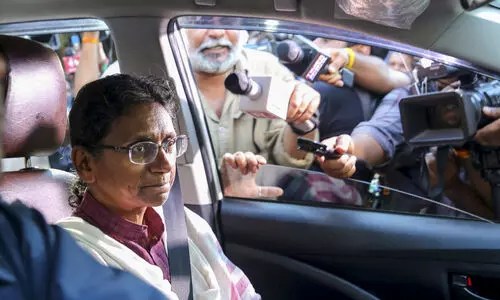
    The surprising thing is that although Returning Officers have behaved controversially in the past, no one has received as much sympathy as Meenakshi Natarajan. That may be because she is a Gandhian who leads a very simple life, making her a rare kind of political leader. There is little point in criticizing the Returning Officer here. “What can we do if orders come from above?” said one official from Madhya Pradesh.

    Rejecting her nomination on the basis of a case filed on the basis of a private complaint entirely unrelated to her appears completely unreasonable. Many individuals who have served as Returning Officers in legislative bodies say that under Section 33A of the Representation of the People Act, only cases in which a charge sheet has been filed, charges have been framed, and which are punishable with imprisonment of more than two years need to be disclosed. Even if the Returning Officer believed that the affidavit had not been fully completed, they say that a nomination should not be rejected solely for that reason and that the candidate should be given another opportunity to correct the error.

    On the very day Meenakshi Natarajan’s nomination was rejected in Madhya Pradesh, a BJP candidate in Jharkhand was given 24 hours to correct an error in his affidavit. There have been many such instances across the country where Returning Officers have acted fairly. Officials should facilitate a candidate’s democratic election, not create obstacles preventing that candidate from being elected. When officials act in accordance with the political interests of the ruling party, it becomes clear that democracy in our country is not in a healthy condition.

    Another surprising aspect is that courts also do not make efforts to dispose of election petitions quickly and thereby give wronged candidates an opportunity to be re-elected. Recently, even the Madras High Court criticized the Supreme Court on this issue. In a petition filed by a candidate who lost by just 49 votes in a constituency during the 2016 Tamil Nadu Assembly elections, it took the Supreme Court six years to deliver a verdict. What benefit is there in the court declaring that the defeated candidate had actually won? By then, the term of the Assembly had already ended. The Madras High Court criticized even the Supreme Court, saying that justice had become a mockery.

    A similar situation occurred in the case of Ponguleti Sudhakar Reddy versus Tummala Nageswara Rao. Although the case was filed in 1999 and Tummala had won, it took the High Court seven years to decide the matter.

    When Meenakshi Natarajan approached the Supreme Court claiming that her nomination had been unfairly rejected, it refused to intervene. The Supreme Court held that under Article 329(b), elections to legislative bodies cannot be challenged. The Court clarified that she could, if she wished, file an election petition in the High Court. The Supreme Court is also aware of the deplorable condition of election petitions in the country’s judicial system. A former Supreme Court judge said that, based on past experience, no one knows how many years it will take for Meenakshi Natarajan’s petition to be decided.

    In a speech in 2019, then Vice President Venkaiah Naidu also said that courts should establish special benches for election petitions and deliver decisions within six months. If the Supreme Court does not decide the matter and election petitions do not receive speedy judgments, who will protect the democracy that is being crushed in between?

    Moreover, under the current circumstances in the country, the attitude adopted by the courts appears peculiar. A situation is arising in which the courts themselves characterize those filing cases on public issues as cockroaches, idle people, or obstacles to development. “The Centre is spending money to build roads. Who are you to question the progress of roads under the Right to Information Act? This is yellow journalism,” the Supreme Court reportedly told an RTI activist on Tuesday before dismissing the case.

    Some say that it is politics for the ruling party to try to secure majorities in legislative bodies and achieve its desired objectives. Others call it Machiavellian politics. Whatever one may call it, it is not wrong to question the methods being adopted and the institutions that are failing.

  • Modi’s Ascendancy and the Opposition’s Search for Direction

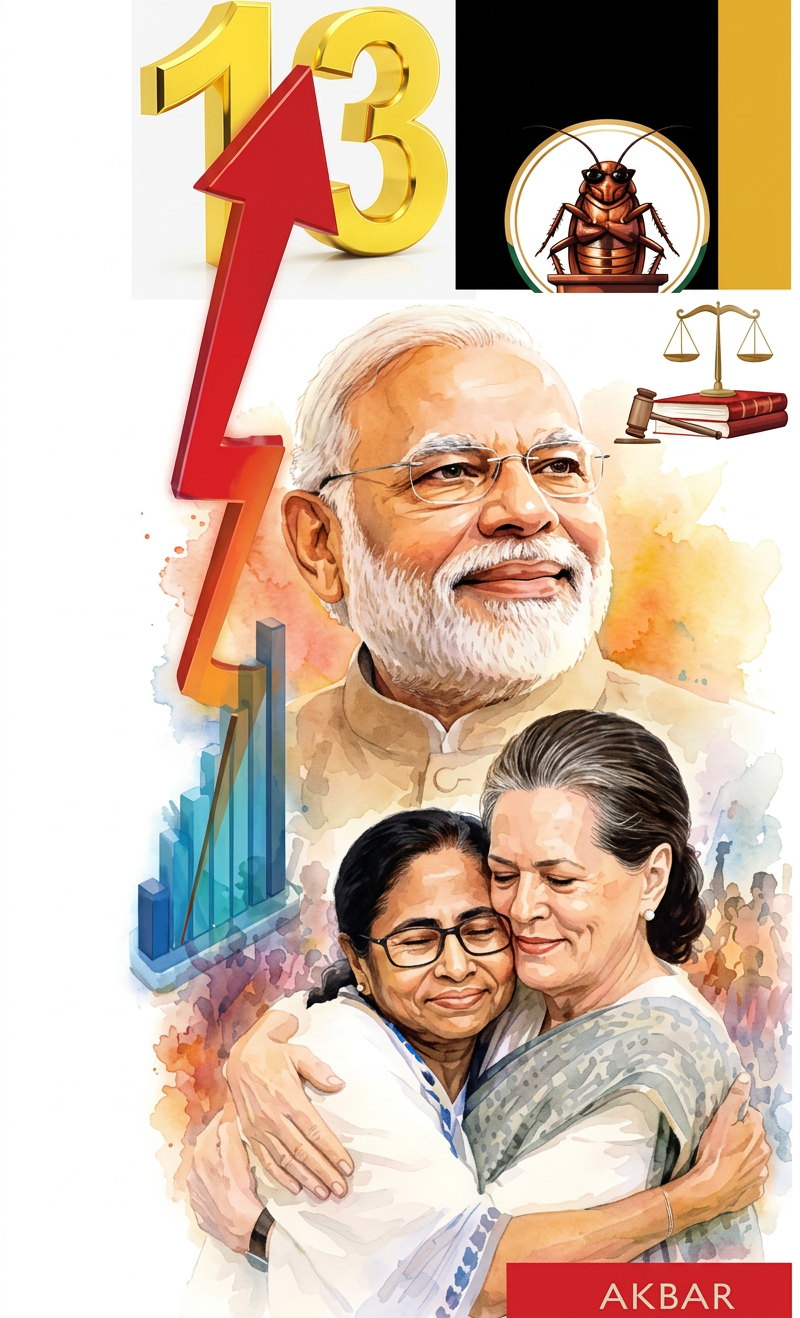
    On Monday, at the INDIA alliance meeting held in Delhi, Trinamool Congress supremo Mamata Banerjee, who appeared with a faded face, was tightly embraced by former Congress president Sonia Gandhi. Who other than one woman can understand another woman’s heart? “Some scenes cannot be expressed in words,” remarked a senior leader.

    These two were once described by international organizations as the most powerful leaders in the country. While Sonia ruled the country’s politics for more than ten years, Mamata Banerjee ruled Bengal politics for 15 years. But they are not unaware that the present circumstances are different.

    After the results of the five state elections announced last month, anti-BJP forces met again in Delhi. Mamata Banerjee and the Left parties, forgetting that until yesterday they were also fighting Congress, have become ready to join hands with Congress at the national level. Mamata Banerjee also appears to have forgotten that Rahul Gandhi, the Leader of the Opposition in the Lok Sabha, had only recently criticized her harshly over her anarchic and corrupt rule. She also may not now remember that in 2021 she dreamed of the Prime Minister’s post and declared, “Congress has become ineffective in the country. I alone will play the key role at the national level.”

    The tigress-like Mamata Banerjee, who rebelled against Congress in 1998 and launched her party by holding a rally in Kolkata while the AICC plenary session was taking place, now appears to have had her claws removed. Public representatives belonging to her party in both the Lok Sabha and the Assembly have declared rebellion against her. Her right-hand man Abhishek Banerjee, MP Kalyan Banerjee, and other party leaders are facing attacks on the streets. The same methods Mamata Banerjee once employed against her opponents are now being used against her by her rivals. While Mamata Banerjee and her followers are now crying in the wilderness on the streets of Kolkata, Congress leaders have become the ones standing by her. In this context, it appears that Mamata Banerjee has realized that Congress alone is her refuge if she is to face a mighty force like the BJP both in the state and in Delhi. Though Congress and the Left did not win many seats in the Bengal Assembly elections, they were able to damage the Trinamool considerably. In minority-dominated areas such as Murshidabad, Malda, and Uttar Dinajpur, the Congress–Left alliance ensured that Trinamool did not receive its traditional support. In 32 Assembly constituencies where Muslims constitute more than 50 percent of the population, Trinamool did not win even a single seat. In the Jangipur constituency, the Congress candidate secured 31,000 votes while the Trinamool candidate received only 10,542 votes. Likewise, in the Karandighi constituency, CPI(M) secured 39,000 votes, while the BJP candidate won with 20,000 votes. Perhaps the manner in which these results came has taught Mamata Banerjee lessons about her arrogance, authoritarian approach, and disregard for allies. That is why she is now seen on the streets of Delhi.

    Likewise, for the Left parties, whose ground is slipping from beneath their feet in the country, the streets of Delhi have also become a refuge. In the 140-member Kerala Assembly, the Congress-led UDF winning more than 100 seats, the BJP winning three seats, and the defeat of most ministers in Pinarayi Vijayan’s cabinet cannot be ignored. Analysts described the Left alliance’s defeat there as the result of Pinarayi Vijayan’s centralized and arrogant governance, severe disappointment among farmers, youth, and ASHA workers, dissatisfaction among party cadres, and public resentment against ten years of rule. Congress leaders such as Rahul Gandhi and Revanth Reddy criticized Pinarayi Vijayan, alleging that he was colluding with the BJP and encouraging corrupt elements. They questioned why central agencies had not investigated Vijayan. Be that as it may, the Left parties, which have reached a situation where they are not in power anywhere in the country for the first time in five decades, have realized that they have no option except to work together with other anti-BJP forces. Left leaders D. Raja and John Brittas, who attended the INDIA alliance meeting, have that clarity.

    The late CPI(M) General Secretary Sitaram Yechury, who passed away two years ago, understood the present situation in the country very well. When Congress inducted Prasenjit Bose, who had been expelled by CPI(M), Rahul Gandhi joked with Yechury, saying, “We have taken your comrade into our party.” Laughing, Yechury replied, “What is yours and ours? In this struggle, both of us are travelling in the same boat.” He had long ago understood the need for all anti-BJP forces to shed their narrow-mindedness and work together to confront the BJP, which was advancing unchecked across the country. Today, none of the parties in the NDA are fighting among themselves. But the parties in the INDIA alliance do not possess that level of unity. How much sincerity of purpose do the 23 parties that met at Delhi’s Constitution Club after nearly two years really have? What is the significance of the DMK and Aam Aadmi Party not attending? After the Emergency, in 1977, opposition parties contested against Congress under a single election symbol in the name of the Janata Party. How many parties today possess that same sincerity and fighting spirit? Can Congress provide leadership to other parties in the same way that the BJP has been able to guide even its allies along its ideological path?

    Two days after the INDIA alliance meeting, Prime Minister Narendra Modi organized a meeting of NDA allies on the occasion of completing 12 years in power. Though nominally an NDA meeting, it is in reality a BJP meeting. Leaving aside small states like Nagaland, Meghalaya, and Puducherry, Andhra Pradesh is the largest state where NDA rule is currently in effect. Until recently, Janata Dal (United) chief Nitish Kumar was the Chief Minister in Bihar. Now, even there, a BJP leader is Chief Minister. With his entry into the Rajya Sabha, the 12 JD(U) MPs in the Lok Sabha will have to regard Modi as their leader. While Trinamool has 28 MPs in the Lok Sabha, 20 MPs under the leadership of party chief whip Kakoli Ghosh Dastidar have decided to write to Speaker Om Birla seeking recognition as a separate group after rebelling against Mamata Banerjee. At some auspicious moment, they too may have no option but to join the BJP and wear the saffron scarf as BJP MPs. That means the BJP effectively already has a full majority in the Lok Sabha even without the support of the Telugu Desam Party. Moreover, seven MPs from Shiv Sena, five from Lok Janshakti Party, two from Janata Dal (Secular), two from Rashtriya Lok Dal, one from the NCP Pawar group, two from Apna Dal and Hindustani Awam Morcha, along with six MPs from northeastern states, are already supporting the BJP. Since Modi came to power, the Bharatiya Janata Party has earned the distinction of splitting several regional parties such as Shiv Sena, NCP, Lok Janshakti Party, Rashtriya Lok Samata Party, Aam Aadmi Party, and Trinamool, and also attracting many leaders from other parties into its fold. Not only that, during Modi’s tenure, parties such as BSP, BJD, DMK, and AIADMK have faced tests of survival, making their future uncertain. A situation has arisen in the country where many regional parties feel that their survival will be difficult unless they surrender to Modi.

    In this context, as Modi enters his 13th year in power today, no one can deny that his political strength is increasing day by day, despite social media commentary about how intense his politics may become, developments such as the “cockroach party,” the weakening of democratic institutions, allegations that the judiciary has surrendered, and the flood of criticism over the failure of institutions such as NEET and CBSE to conduct examinations properly. Without eliminating their internal contradictions and creating an equally compelling alternative vision, what change can opposition parties or other non-BJP forces achieve, no matter how many meetings they conduct?

  • Modi’s Political Dominance and the Challenges of Governance

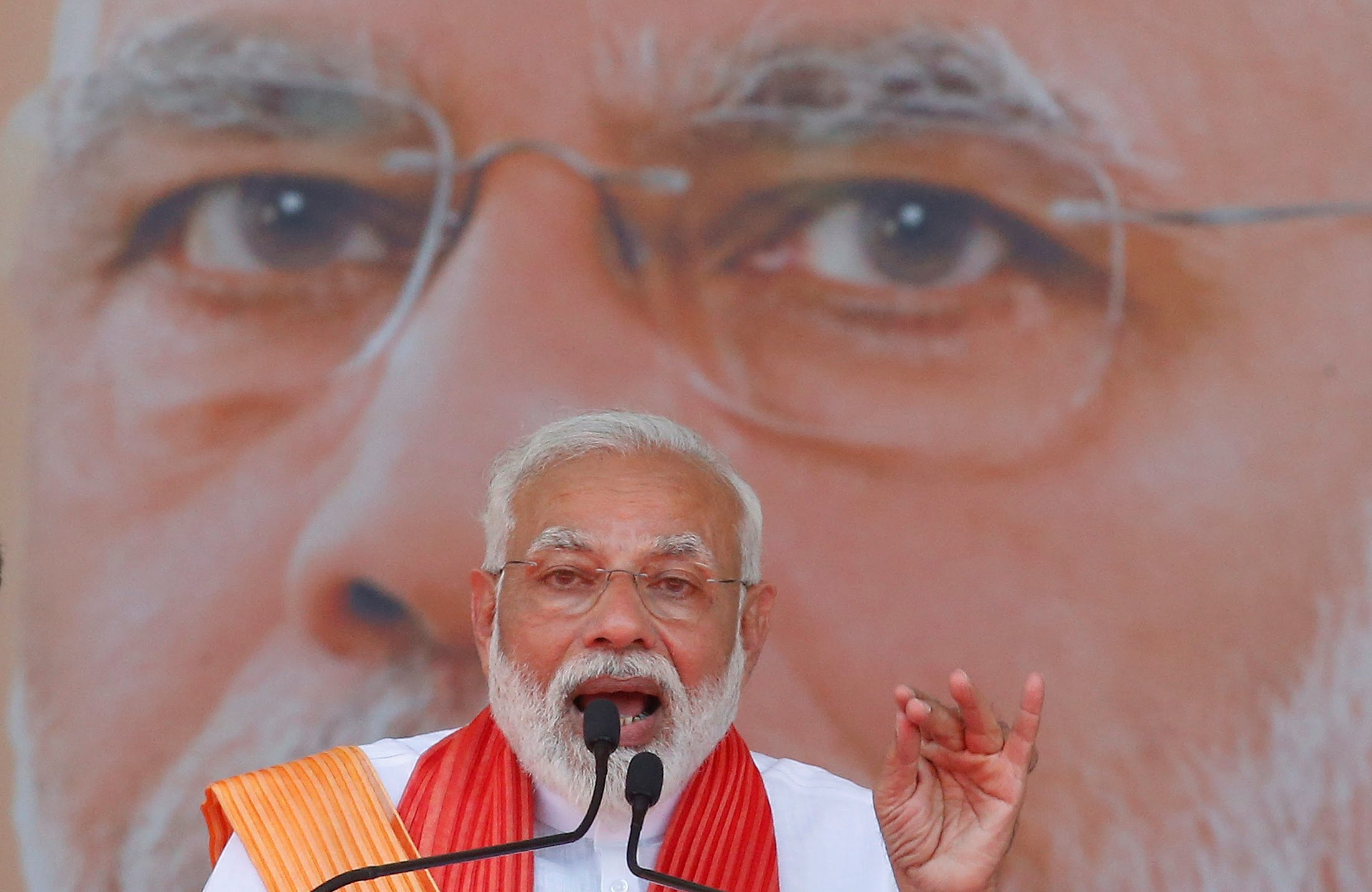
    “You win only when you play. If you don’t play, how can victory come?” Prime Minister Narendra Modi recently said while speaking to young children. Since joining the Bharatiya Janata Party (BJP) in 1987, Narendra Modi has been continuously playing in politics. Completing four decades in this political game next year, he has had no notable defeat so far. In 1987, when he was handed over the responsibility of the Ahmedabad Municipal Corporation as the BJP Gujarat General Secretary, he secured this victory for his party for the first time. Since then, he has never looked back.

    His journey of victory, which began in Gujarat with the corporation win, brought the party to power in the state, and later led to him personally taking over power as Chief Minister, delivering an unchallenged governance for 12 years. Without stopping there, even after taking over the responsibilities as the Prime Minister of the country in 2014, Modi has been continuously continuing in office for 12 years so far.

    By 1987, when Modi entered active politics, the Congress was in power at the Centre and in 15 states. With the recent victory in West Bengal, the BJP and its allies under Modi’s leadership have achieved power in 21 states. In a way, Modi is now in the ascendant phase of his political life. While on one hand preparing for the celebratory milestones of his 12 years of governance, on the other hand, he is getting ready for massive changes in both the party and the government. He is setting the stage for his next political game.

    “Victory is not just a game, it is also like riding a tiger,” political scientists often describe. Once you get down from it, it will swallow you. Baba Saheb Ambedkar said long ago that democracy is not just about victory in elections. Although Modi’s government is unchallenged in politics, India’s economic situation remains worrisome. Economists say that GDP growth is gradually declining, average inflation is doubling, and the pace of development is moving sluggishly. The monthly review prepared in May by the Ministry of Finance under the leadership of Union Finance Minister Nirmala Sitharaman made it clear that international developments are severely impacting India’s economic conditions. The value of the rupee is falling day by day. Crude oil import bills are rising. Reports are coming that petrol and diesel prices have increased four times since May 15 after the assembly election results, and there are chances of them rising again. For the second consecutive week, the decline in India’s foreign exchange reserves is clearly visible. Economists like former Economic Advisor Arvind Subramanian and representatives of the National Institute of Public Finance and Policy are warning that private investments in the country are also declining.

    In May last year, NITI Aayog CEO B.V.R. Subrahmanyam announced that India had overtaken Japan to become the fourth largest economy, but according to the World Economic Outlook recently released by the International Monetary Fund, India has dropped to the sixth largest economy. Regardless of this matter, irrespective of statistical details, everyone knows that the per capita income in the country is at a very low level. Economists state that since 1991, while per capita income in China has increased 38 times, it has increased only 8 times in India.

    The fact that Prime Minister Narendra Modi himself is appealing to the people to practice austerity measures indicates the severity of the situation. Economists say that the government is taking short-term measures from time to time but is not undertaking long-term measures. What are long-term measures? Discussions are ongoing whether it means further accelerating reforms or allowing foreign investments to enter more freely. No one has clarity on what steps Modi is taking in this direction. Organizations like NITI Aayog are also not transparently publishing reports on the country’s economic situation. It has been a long time since such organizations stopped trying to tell the government the actual situation, as they are instead eager to exaggerate minor developments into mountains. Will the situation improve merely by changing the heads of ministers as part of a cabinet reshuffle?

    Secondly, even though the opposition parties in this country have failed to win elections, they seem to have succeeded in creating an impression among the people that institutions are being weakened. They are giving scope to raise doubts not only on the functioning of institutions like the Election Commission, CBI, ED, IT, CVC, and National Testing Agency, but also on the judgments given by the Supreme Court. The strange thing is, even when elections are conducted properly, the credibility of the Election Commission is being questioned. Due to the indiscriminate deployment of agencies like the CBI, ED, and IT against political rivals, trust in them is lost even when they work genuinely. Judges are acting in a manner that raises suspicion whether the boundaries that should exist between the Supreme Court and the government are blurring.

    Ultimately, the fact that a miserable state exists in this country where even exams cannot be properly conducted for students was proven once again with the leak of NEET question papers. More recently, the controversy surrounding the CBSE’s On-Screen Marking (OSM) system has further deepened concerns about institutional competence. What began as isolated complaints soon turned into one of the biggest credibility crises faced by the country’s premier school education board. Remarkably, it was not political parties or government agencies that exposed the issue, but three young students. Vedant Shrivastava brought attention to the problem after allegedly receiving another student’s answer sheet during the verification process. Nisarga Adhikary, a young cybersecurity researcher, claimed to have uncovered serious vulnerabilities in the digital evaluation portal that could expose sensitive student data and examination records. Sarthak Sidhant raised questions regarding the tendering and procurement process behind the system’s implementation. Together, these three students forced a national debate on transparency, accountability, digital security, and administrative responsibility in the education system. Even CBSE was eventually compelled to acknowledge vulnerabilities in parts of the system after initially rejecting the allegations. The episode demonstrated how public institutions can lose credibility when legitimate concerns raised by students are not addressed promptly and transparently.

    The way the youth of this country responded in an unprecedented manner to the call given on social media under the name of ‘Cockroach Janata Party’ creates a feeling that a fire is smouldering somewhere. It is naive to think that those who ask questions will decrease just by suspending social media accounts. Therefore, it must be considered that the Modi government succeeds only when it tries not just to win elections, but to increase the credibility of institutions and to solve the problems of the youth of this country.

    Moreover, the political victories of the Modi government are not completed with the victory in Bengal. From next year onwards, they have to win again in BJP-ruled states. This includes the Prime Minister’s home state of Gujarat, as well as the largest state Uttar Pradesh, Madhya Pradesh, Rajasthan, and other states. The BJP’s situation in the four southern states is not very grand. In Karnataka, the BJP has no independent identity of its own outside of Yediyurappa. Even though several top RSS leaders like Dattatreya Hosabale, Santhosh, and Mukund hail from Karnataka, the BJP is unable to establish itself firmly there. As for Telangana, no party seems better than the BJP at cutting the very branch it is sitting on. In Tamil Nadu, Annamalai, who was once the party president, announced that the BJP has no future and is preparing to look out for his own path. BJP leaders do not seem to have realized that gaining acceptability in the South is more important than in Bengal.

    However, whatever Modi’s weaknesses may be, how far Congress is trying to utilize them remains a matter of debate. No one can say what Congress is doing to confront the BJP head-on in UP, Gujarat, Madhya Pradesh, and Rajasthan. After Congress won in Kerala, the Congress high command took 11 days to decide the Chief Minister. It took Rahul Gandhi these many days to realize that the people, senior party leaders, and the cadre there completely admire Satheesan. He could not restrain his right-hand man KC Venugopal, even though the latter made intense efforts to become the Chief Minister himself.

    Similarly, without even enjoying the happiness of winning in Kerala, the Karnataka headache started for Delhi. The Delhi elders are dragging both Siddaramaiah and DK Shivakumar along, in a helpless state where they cannot bring about a compromise between the two. Siddaramaiah, who represents the AHINDA group consisting of minorities, backward classes, and Dalits on one side, and DK, who is extremely loyal to the party and has stood by the high command in every crisis on the other side, have left the high command at a total loss. In fact, DK, who once had to move Gujarat MLAs to Bengaluru to ensure Ahmed Patel’s victory, had to get entangled in several cases. Ultimately, he even had to go to Tihar Jail. While it is justifiable to give the Chief Minister post to such a person as DK, nothing can be said right now about the future course of action of Siddaramaiah, who made it clear that he will remain active in politics and will not come to the Rajya Sabha.

    A situation arose where Shivakumar had no choice but to include everyone suggested by Siddaramaiah in his cabinet. For the past 20 days, Delhi hotels and the AICC have been overcrowded, initially with Kerala leaders and now with Karnataka leaders. Although infighting exists in Congress in every state, Delhi is in a situation where it can do nothing.

    That situation has never existed in the BJP. Even though there are BJP Chief Ministers in 17 states, there is no record of even a single one coming to Delhi for cabinet expansion or other changes. The BJP top brass has the grip to dictate who should be appointed without them needing to visit. That is the difference between the BJP and the Congress. That is also the secret behind their victories and defeats.

  • The Cockroach Crisis: Is India’s Judiciary Losing Public Trust?

    “If the judiciary loses its credibility, nothing else will remain. An independent judiciary is the lifeblood of the Constitution. Without it, judges will exist, courts will exist, and judgments will exist—but their heart and soul will disappear,” said Supreme Court Judge Ujjal Bhuyan in a recent memorial lecture in Pune.

    He referred to a stark reality: the collegium itself recorded in its minutes that a High Court judge was being transferred in accordance with the wishes of the Central Government. This serves as a clear example of how a judiciary constitutionally expected to function independently can find itself working under government pressure.

    “The judiciary must remain distant from party politics and function firmly. Changes in government should have absolutely no connection with the judiciary. It should act with goodwill and sympathy towards everyone, but should not side with anyone,” said the first Chief Justice of India, H. J. Kania, at the inaugural sitting of the Supreme Court. Yet, reviewing the situation more than 75 years after the Constitution came into force, deep doubts arise as to whether standards in the higher judiciary have improved or deteriorated.

    The Historical Shield and the Ultimate Downfall

    For nearly twenty-five years after the Constitution came into force, the judiciary largely fulfilled its responsibility of preserving its own existence, protecting the fundamental rights of citizens, and defining the limits of government authority. The Supreme Court progressively interpreted Articles 14, 15, 19, and 31. In the 1967 Golaknath case, it clarified that fundamental rights could not be diluted, and in the landmark 1973 Kesavananda Bharati case, it solidified that Parliament had no authority to alter the basic structure of the Constitution.

    However, after coming to power with an overwhelming majority in 1971, Indira Gandhi’s administration began to toy with judicial independence. The absolute peak of the judiciary’s downfall in capitulating to executive overreach was the infamous ADM Jabalpur case during the Emergency.

    When thousands of political opponents and journalists were jailed without trial, and citizens sought the intervention of the courts to protect their fundamental liberties, a five-judge Constitution Bench delivered one of the most disgraceful judgments in Indian history. By a 4:1 majority, the bench ruled that during an Emergency, citizens do not even possess the right to life under Article 21.

    The majority consisted of Chief Justice A. N. Ray, Justice P. N. Bhagwati, Justice M. H. Beg, and Justice Y. V. Chandrachud (father of former Chief Justice D. Y. Chandrachud). When Justice H. R. Khanna—the sole courageous dissenter—asked during the hearings, “Does that mean people cannot question even if they are shot dead in the name of Emergency?”, the then-Attorney General chillingly replied, “My Lord, that is what the law says.”

    A Era of Introspection and Activism

    Following the Emergency—one of the darkest chapters in judicial history—the Supreme Court undertook deep introspection and initiated significant corrective measures. Moving past its catastrophic failure, the court aggressively declared that the Constitution, not the executive, was supreme.

    It opened its doors to the masses through Public Interest Litigations (PILs), ordered the release of thousands of undertrial prisoners languishing in jails, liberated bonded laborers, and eventually introduced the collegium system to insulate judicial appointments from political interference.

    Most importantly, it expanded the scope of personal liberties, protected the environment, championed the interests of working women, and curbed the arbitrary dismissal of state governments by ruling that political majorities must be proven on the floor of the legislature. At that stage, judicial activism was a remarkable shield for the vulnerable.

    Modern Shadows and Internal Fractures

    If the Supreme Court denied protection to human life twenty-five years after Independence, today, five decades after that judgment, the core functioning of the institution faces renewed skepticism. We may not be living in a formal Emergency, but public faith in the judiciary is noticeably shrinking.

    The fact that sitting judges themselves feel compelled to speak out demands serious reflection:

    • Justice Ujjal Bhuyan publicly emphasized that no external forces should be allowed to intrude upon judicial independence, asserting that personal political or ideological views must not influence decisions on the bench.
    • Justice B. V. Nagarathna warned that judges must not succumb to external pressures, noting that those who cannot live contentedly on their legitimate income should be eliminated from the system entirely. “A tainted judge is a stain on the entire system,” she remarked.
    • Justice S. Muralidhar, former Chief Justice of the Orissa High Court, once noted: “Impartiality is the soul of the judiciary, and independence is the blood flowing through its veins.” Notably, during his tenure at the Delhi High Court, he was transferred overnight after questioning police inaction during civil unrest in the capital.

    In her book Constitution Is My Home, senior advocate Indira Jaising recalled a harrowing 2022 case involving sexual harassment allegations made by a female Additional District Judge against a Madhya Pradesh High Court judge. Not only did the victim fail to find immediate recourse, but she was also swiftly transferred and forced to resign.

    Through Jaising’s persistent legal battles, a Supreme Court bench headed by Justice L. Nageswara Rao eventually restored her position and questioned why the then-Chief Justice of the High Court had refused to even grant her an interview. Disturbingly, just days later, that very Chief Justice was elevated to the Supreme Court.

    Growing Questions and the “Cockroach” Backlash

    Why has it become necessary for judges to comment so defensively on their own institution? Critics increasingly argue that the higher judiciary—originally designed to protect the common citizen—is becoming overwhelmingly responsive to the wealthy, the state, and political elites.

    Calculated bench allocations and predictable judgments in politically sensitive cases have sparked intense debate. Former Supreme Court Bar Association President Dushyant Dave openly criticized the court for failing to check the erosion of vital institutions like the Election Commission, pointing out that judges routinely scramble for lucrative post-retirement positions.

    Simultaneously, ethical questions have mounted. Organizations like the Campaign for Judicial Accountability and Reforms (CJAR) heavily criticized several judges and their families for utilizing private aircraft provided by state governments, arguing it severely compromises judicial ethics. Furthermore, instances like the discovery of massive cash bundles at the residence of a former Delhi High Court judge—followed by an apparent lack of accountability—have deepened public cynicism.

    Perhaps because the public, especially the younger demographic, is closely watching these lapses, an explosive reaction occurred following recent remarks made by Supreme Court Judge Surya Kant.

    During a judicial hearing, Justice Surya Kant criticized unemployed youth, comparing them to “cockroaches” who populate social media, media outlets, and RTI activism to attack institutions. Though he later clarified that the comment was contextualized within a specific petition regarding a lawyer’s designation and was not aimed at the youth at large, the damage was done.

    Justice Surya Kant has faced widening backlash for a series of oral remarks. On May 11, 2026, during a hearing on the Pipavav Port expansion project in Gujarat, his comments drew sharp rebukes from environmentalists and legal experts. Former civil servants under the Constitutional Conduct Group warned that these remarks showed a disturbing pro-corporate bias from the bench, creating an atmosphere of fear that silences dissent. Over 70 lawyers noted that treating citizens who enforce environmental laws as “obstructionists” marks a dangerous jurisprudential shift.

    Similarly, on January 29, 2026, during a PIL hearing on domestic workers’ rights, Justice Surya Kant blamed trade unions for stifling industrial growth and shutting down traditional industries. Labor bodies, including the AITUC, strongly condemned the court for misreading economic realities, arguing that industrial stagnation is driven by corporate monopoly and pro-corporate state policies, not by workers asserting their legal rights.

    The Danger of Erased Boundaries

    Following the “cockroach” commentary, a young citizen created a social media movement under the banner of the “Cockroach Janata Party.” Millions responded. Instead of merely deflecting the insult, the youth weaponized it, using the platform to furiously criticize the government over unemployment, inflation, corruption, and systemic scams, proclaiming: “Yes, we are cockroaches.”

    This reaction highlights a profound systemic crisis. The derogatory comments were made by a member of the judiciary, yet the public directed its anger squarely at the executive government.

    This reveals a terrifying reality: the public no longer views the government and the judiciary as separate entities.

    In a constitutional democracy, nothing is more dangerous than the total erasure of the boundary between the ruling executive and the independent judiciary. The judiciary must aggressively reform and rescue itself from this crisis. If it fails, the day may soon arrive when the “cockroaches” themselves feel forced to become the arbiters of justice.

  • Tamil Nadu’s Message to India’s Political Class

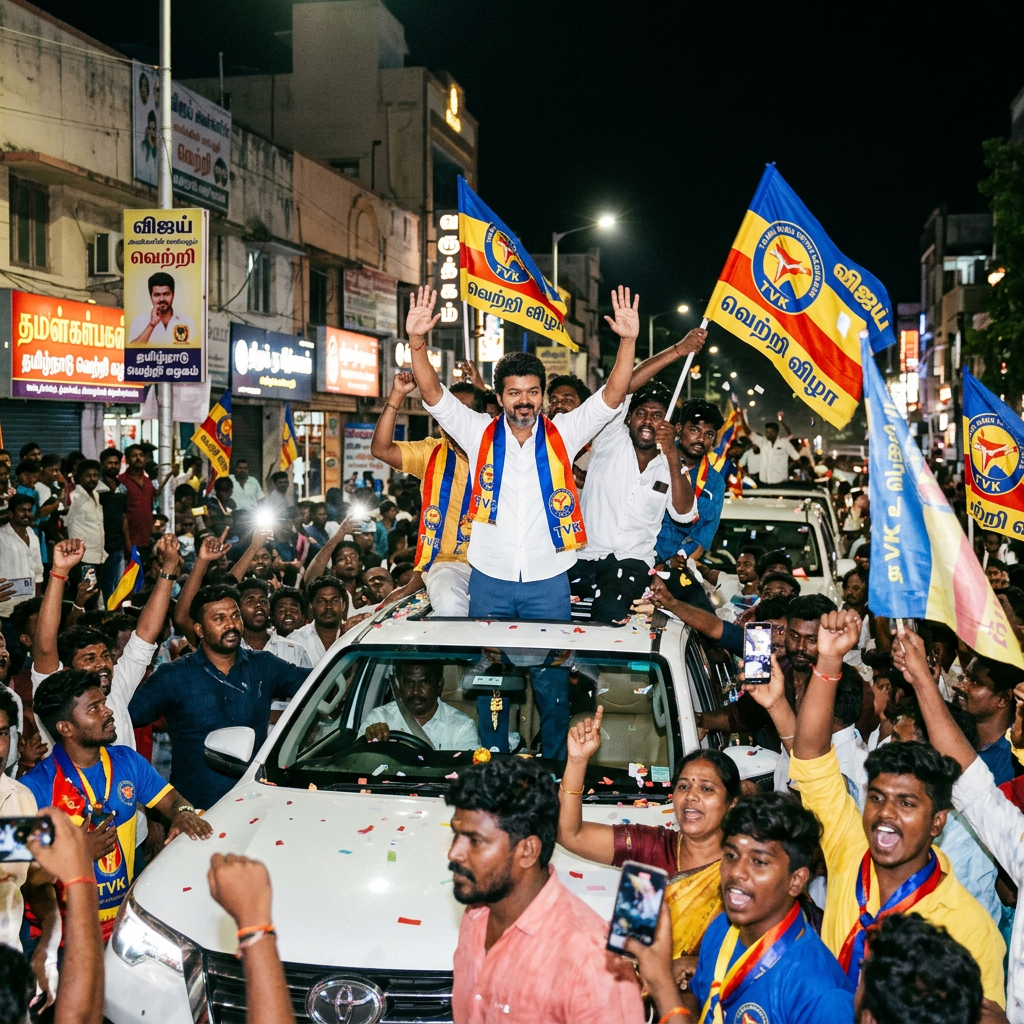
    Man standing on a car waving to crowd with supporters holding flags in a night rally
    Supporters cheer enthusiastically around a leader standing on a car during a lively political rally at night.

    In Andhra Pradesh, there was a political leader who used to send various kinds of gifts door to door in his constituency. On every occasion, he distributed sweets and snacks; during festivals, Raymond clothes for men and silk sarees for women. Every newly married couple received a gold mangalsutra pendant, silk clothes, and silver anklets as gifts. During elections, things went even further. Reports said that a separate truck was used exclusively for distributing cash lavishly. Even then, he lost the last election by a margin of more than 43,000 votes.

    This single example is enough to show that if people truly decide, no amount of inducement can make them surrender their conscience. Even though political parties and leaders are aware of this, they continue making every possible attempt to lure people and buy votes. This does nothing except create disgust among the public toward political leaders. When leaders try to purchase votes, people naturally begin to wonder how much these politicians are earning in politics and how much public money they are looting. Many people feel that all this money being distributed is nothing but wealth stolen from the public itself.

    Recently in Tamil Nadu, the DMK and AIADMK distributed money on a massive scale. Estimates suggest that between ₹20 crore and ₹50 crore was spent in each constituency. Videos showing these parties distributing cash in envelopes ranging from ₹3,000 to ₹10,000 circulated widely on social media, yet the Election Commission hardly paid attention. An NGO called “Arappor Iyakkam” even lodged a complaint with the Election Commission regarding the large-scale cash distribution. Surprisingly, the TVK party of actor Vijay, which reportedly did not distribute money at all, succeeded in getting the highest number of its candidates elected. Along with Chief Minister Stalin, 15 DMK ministers were defeated. In one constituency, a four-time DMK minister lost to an auto driver. Elsewhere, the son of a car driver won. In many constituencies, TVK candidates won with huge majorities, while in at least 20 seats they lost by extremely narrow margins. These developments prove that if elections had been conducted without the influence of money power, a massive Vijay wave would likely have swept Tamil Nadu.

    In recent democratic history, Vijay earned the distinction of winning elections in a state without purchasing votes from people. In fact, Vijay did not campaign extensively across the state. In many places, his party relied on cutouts, holograms, and duplicates for campaigning. Keeping in mind the stampede incident at Karur, he cancelled many rallies. TVK candidates themselves did not campaign aggressively in several constituencies. There were even reports that in some places DMK and AIADMK candidates offered money to TVK candidates and told them to stay home and rest. In many constituencies, TVK candidates did not even go to the counting centres. They were surprised to learn from television broadcasts that they had won.

    Although huge crowds attended Vijay’s meetings, many believed TVK could not succeed because the party lacked organizational machinery, proper local coordination, sufficient funds, and experienced candidates. In many constituencies, campaigns were carried out with nothing more than a small van, two auto-rickshaws, and a few children blowing whistles while walking ahead of the candidates. In several places, students and women voluntarily went door to door campaigning. Small donations were collected for campaign expenses. In some constituencies, there were not even TVK posters. Often, people could not even recognize TVK candidates when they walked on the roads.

    The Tamil Nadu elections should serve as a lesson to parties that rely on money power, muscle power, and manipulation of systems to come to power. It should open the eyes of those who collect funds from corporate companies in the name of electoral bonds, allot Rajya Sabha seats to donors, and even launch companies for them. Illegal funding from corporations forces governments to return favors through project allocations, ignore irregularities in those projects, and encourages politicians who buy votes to indulge in further corruption to recover their election expenses. Through such corrupt practices, entire systems have become rotten. Electoral corruption plays a major role in India’s political and administrative system. Legislatures are increasingly filled with corrupt individuals, corporates, and wealthy elites. Ordinary people are finding it impossible to contest elections. There is little doubt that black money amounting to 20–50 percent of the country’s GDP has become part of the electoral system.

    Officially, the Election Commission says that an MP candidate can spend up to ₹95 lakh and an MLA candidate up to ₹28 lakh. But politicians themselves say that in reality, this amount is not sufficient even for a single day of campaigning. Although the Election Commission officially seized black money worth ₹10,000 crore during the 2024 general elections, estimates suggest that around ₹1.35 lakh crore actually circulated during the elections—far exceeding the expenditure in the 2020 U.S. elections. The Centre for Media Studies had earlier estimated that an average of ₹1,500 is paid as bribes to every voter in the country. It would not be an exaggeration to say that election observers appointed by the Election Commission have become clowns in this entire drama. Instead of preventing electoral malpractice, they appear more focused on deciding which party should win.

    It appears that the people of Tamil Nadu responded against this vicious cycle of corruption and illegality. Out of the 107 MLAs elected from Vijay’s party, 93 were first-time entrants into politics. Half of them were between 40 and 45 years old. This helps explain the direction in which Tamil Nadu’s youth and Dalits are thinking. It also suggests that they are no longer interested in hollow identity slogans and ideological rhetoric. What they really want is simple: systems that function properly. They want efficient public services in return for the taxes they pay. They want government offices—especially revenue departments—to function properly, without power cuts and delays. Instead of political parties constantly raising emotional slogans and provoking caste, religious, or regional divisions to divert public attention, the country can become modern and ideal only when systems are reformed according to the aspirations of the youth.

    Although India ranks 91st among 182 countries in the corruption index, no government appears to be sincerely working to eliminate corruption within systems. Political parties focused solely on winning elections show little interest in institutional reforms. A recent example is the NEET question paper leak scandal. Over the last four years, question paper leaks have occurred in one form or another. Reports stated that question papers for the May 3 entrance examination were sold under the guise of “guess papers” for amounts ranging from ₹10 lakh to ₹25 lakh, and that a mafia network stretching from Rajasthan, Haryana, Maharashtra, and Uttarakhand to Kerala was responsible for the leak.

    Even after it was discovered last year that students who selected the same examination centre in Godhra, Gujarat scored unusually high marks, the examinations were not fully cancelled. Although a committee headed by former ISRO chairman Radhakrishnan was appointed to investigate the 2024 irregularities, its report merely gathered dust and was never implemented. Even after the CBI investigated 144 people who had purchased leaked question papers and submitted its findings to the Supreme Court, the Court concluded that there was no evidence of a nationwide systemic failure.

    Medical education in India costs crores of rupees. Affordable medical colleges are very few. This is one of the reasons behind examination paper leaks. What is the use of leaders delivering moral sermons when they cannot make education and healthcare accessible to ordinary citizens? After all, are these not the very sectors where people could save the most money?

    Meaningful change will not come unless the kind of political awareness shown by the generation that voted for Vijay in Tamil Nadu spreads across the country. Only when a new political consciousness emerges among the youth nationwide, as seen in Tamil Nadu, can real transformation become possible.

  • BJP’s Southern Challenge: Can the Saffron Wave Cross the Vindhyas?

    Crowd of BJP supporters holding Indian flags and BJP lotus flags at a political rally with party leaders on stage

    When will the BJP’s triumphant march reach the South?

    For several decades, red waves used to surge every year at Kolkata’s Brigade Parade Ground. But on May 9 this year, saffron waves swept across it instead. In the presence of Prime Minister Modi and thousands of people, Suvendu Adhikari took oath as the BJP’s first Chief Minister in West Bengal. Exactly a day later, on Sunday, in Chennai’s Jawaharlal Nehru Stadium, film actor Chandrasekaran Joseph Vijay took oath as the 9th Chief Minister of Tamil Nadu in the presence of national opposition leader Rahul Gandhi. Vijay’s coronation too witnessed an equally massive public turnout. This development clearly indicates that while the Bharatiya Janata Party has firmly rooted itself in Hindi-speaking states, expanded in western states like Gujarat and Maharashtra, in northeastern states such as Assam, Arunachal Pradesh, Manipur, and Tripura, and in the eastern coastal region first through Odisha and now Bengal, entering the South is not going to be easy. On one side stands Suvendu Adhikari, and on the other Joseph Vijay — both appearing as reflections of these changing political realities. Do these two events represent two distinct dimensions in the thinking of the Indian people?

    While Narendra Modi, standing beside Suvendu Adhikari in Bengal, is now eager to expand into the South, Rahul Gandhi, who stood beside Joseph Vijay after achieving success in Kerala, has been unable to regain lost ground in North India despite repeated efforts. The southern states that once resisted Congress have not particularly welcomed the BJP either. In Andhra Pradesh, Telangana, and Tamil Nadu, there has been no experiment or attempt left untried by the BJP to gain entry.

    In Andhra Pradesh, the BJP accepted the dominance of the Telugu Desam Party. In Karnataka, after losing power, it is making every possible effort to regain it. In Tamil Nadu, after realizing that strengthening independently is difficult, it had no choice but to once again ally with the AIADMK. In Kerala, although the BJP won 3 seats for the first time in this Assembly election, its vote share did not increase significantly compared to the past. If Kerala and Tamil Nadu remain distant dreams for the BJP, the only promising states appear to be Karnataka and Telangana. That is why Prime Minister Narendra Modi toured these two states immediately after the results of the five-state elections were announced. However, his tours in Karnataka and Telangana were markedly different. In Karnataka, Modi declared that people were inclining towards nationalist politics and that a saffron wave would soon sweep the state. But in Telangana, he did not express the same confidence.

    In 1984, among the only two seats won by the BJP nationwide, one was Mehsana in Gujarat and the other was Hanamkonda in Telangana. Today, while the BJP has come to power in many states including Gujarat, it has still not expanded in Telangana to the extent expected. Modi himself reportedly mentioned this to state leaders and criticized them. During Bandi Sanjay’s tenure as state president, some enthusiasm had developed within the BJP cadre, but later that momentum gradually faded. The Sangh Parivar organizations may be able to steer people toward Hindutva ideologically, but it is BJP leaders who must create political momentum among the people. During Modi’s latest visit, he did not publicly provide any direct guidance to BJP leaders. He knows that the strategies adopted in North India and Bengal may not work in the South. However, his words and meetings regarding Telangana suggest that he may have some strategy in mind. Time alone will reveal what it is.

    With the BJP’s victory in Bengal, it appears that after Mamata Banerjee, every force capable of challenging the saffron party is gradually disappearing. At the same time, questions are arising whether even the national party Congress is capable of taking on the BJP. Leaders who tried to unite opposition parties against the BJP have all collapsed one by one. Nitish Kumar, Mamata Banerjee, M.K. Stalin, KCR, Sharad Pawar, Kejriwal, and Uddhav Thackeray all once sought to unite the opposition against Modi. Nitish Kumar, who made intense efforts in 2023 to unify the opposition, later shifted towards the BJP for power and has now effectively handed over power to the BJP itself. Modi used every possible political strategy to sideline leaders capable of offering alternative politics nationally. None of them are now in a position to challenge Modi at the national level; instead, they are struggling for survival at the state level. In Maharashtra, after splitting the Shiv Sena and NCP to establish dominance, the BJP also encouraged rebellion within the Aam Aadmi Party. Although a new force has emerged in Tamil Nadu, it is too early to determine how much strength it can gather before the Lok Sabha elections. The Left parties’ only government is now under Congress influence. The Left’s presence in Parliament is also steadily declining.

    As regional parties and Left parties weaken, a situation is emerging where Congress alone must face the BJP. Perhaps the BJP desires exactly that. Anti-BJP politics appears to be either weakening or losing relevance altogether. This is evident both at the leadership level and at the ideological level. Consequently, even in the South, parties are no longer hesitant to join hands with the BJP or accept its political ideology. It is difficult to say how long it will take for anti-BJP sentiment to spread beyond the “paper tigers” of social media into the broader public.

    Congress ruled the country for decades after Independence, but gradually weakened over time. The condition Congress finds itself in today resembles the condition the Jana Sangh and later the BJP once faced. Within just two years, the BJP managed to come to power in Odisha, Bihar, and West Bengal in the East. It secured power for a third consecutive term in Assam. In the West, BJP has its own Chief Ministers in Rajasthan, Gujarat, and Maharashtra. In Gujarat, it has been in power continuously for 30 years. Except for Jharkhand and Himachal Pradesh, BJP Chief Ministers govern almost the entire Hindi belt. Even in Punjab, the BJP has already begun plans to gradually establish itself. If the BJP could establish dominance in the North, East, and West, is entering the South truly impossible?

    However, in electoral politics, the BJP has become so strategically sophisticated that defeating the party now seems nearly impossible. No one has been able to crack the BJP’s winning formula in elections. The BJP leaves no instrument unused in its pursuit of victory; whether those methods are ethical or unethical is irrelevant to the party. Since Trinamool Congress leaders themselves admitted that the BJP won 31 seats because of “Sir,” it is likely that the BJP deployed additional strategies to win the remaining seats.

    No political party can remain at its peak forever. If the BJP is to lose that position, it must become the cause of its own downfall. An alternative political force capable of dethroning the BJP must emerge. Conditions must arise where people begin resisting the party at every step. None of these three possibilities seem likely in the near future. Ordinarily, anti-incumbency sentiment against governments becomes visible, but the BJP has managed to overcome even that. BJP leaders are experts at neutralizing anti-government sentiment. In Assam, despite ruling twice, not only did Congress fail to defeat the BJP, but even Gaurav Gogoi — a three-time MP and Congress’s Chief Ministerial face — lost by a margin of 23,000 votes. What more needs to be said?

    It is impossible to predict how much strength the opposition can build before the 2029 general elections to challenge the BJP. It is uncertain how many parties will align nationally with a Congress that defeated the Left in Kerala while simultaneously trying to weaken Trinamool in Bengal with Left support. Even if all opposition parties unite again, creating an ideological foundation and leadership capable of defeating the BJP will not be easy. Leaders like Jayaprakash Narayan and V.P. Singh are unlikely to emerge again. In reality, many votes now won by regional parties once belonged to Congress. If regional parties weaken, Congress should theoretically regain those votes. But Congress has not been able to rebuild that strength. In Hindutva politics, the BJP has no competition. Organizationally too, Congress cannot match the BJP. Congress has failed to inspire confidence that it can defeat the BJP in a direct contest. What message will the elections in Uttar Pradesh, Madhya Pradesh, Rajasthan, Karnataka, Telangana, and other states over the next two years deliver? Will Karnataka and Telangana preserve their distinctiveness like Tamil Nadu? Only time will tell.