Tag: opposition

  • The Uncontainable Anger of India’s Disillusioned Youth

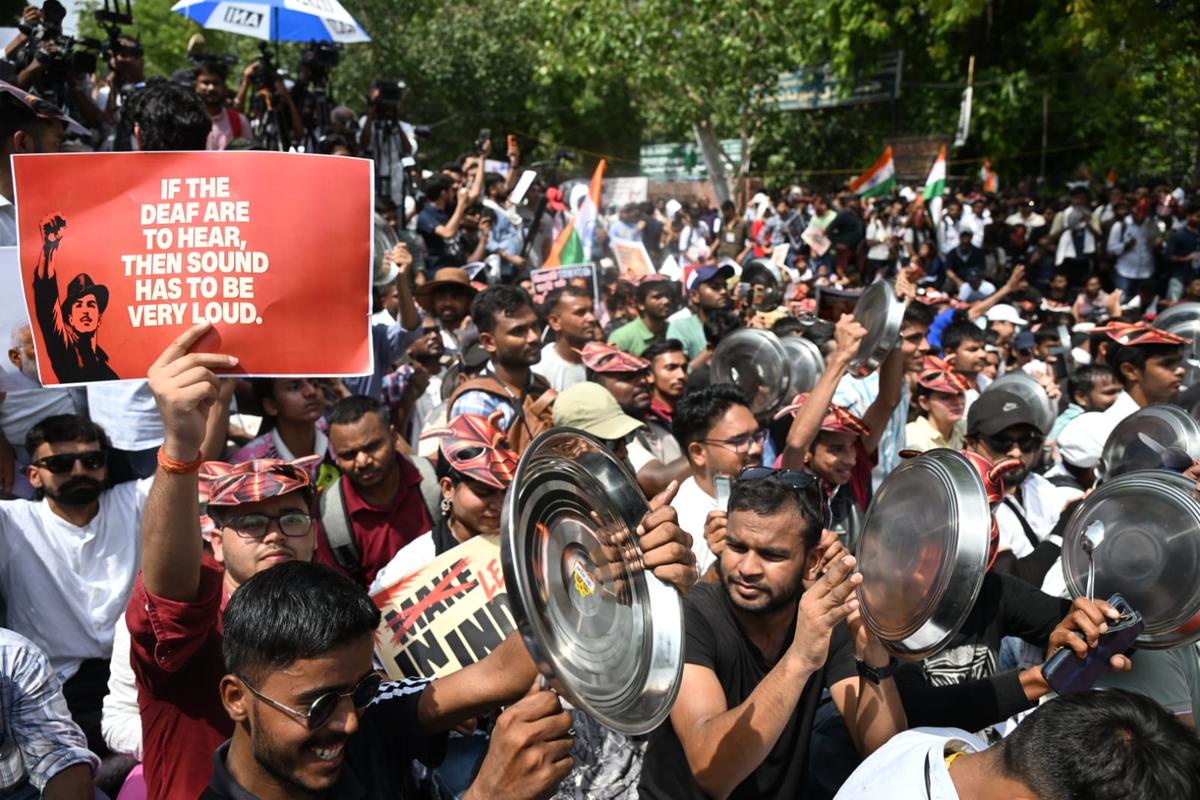
    “A small body of determined spirits fired by an unquenchable faith in their mission can alter the course of history,” said Mahatma Gandhi. India now seems to be moving toward an indefinable change. The siege of Parliament on the first day of the Monsoon Session in the national capital on Monday by activists of the Cockroach Janata Party (CJP)—who have been protesting for a month demanding the resignation of Union Education Minister Dharmendra Pradhan, holding him responsible for the NEET question paper leak—must be called a monumental development in recent times. Despite setting up four-tier barricades, deploying large-scale forces of the Rapid Action Force, CRPF, Delhi, and Tripura Police, closing metro stations, and shutting down the internet, the Cockroach army, thousands strong, charged up to the gates of Parliament. Even as the police beat them severely, the young men and women displayed sheer daring. The young people lying with injuries at Ram Manohar Lohia Hospital are direct witnesses to Monday’s brutality.

    It is clear that the Modi government, which remained unmoved despite a decade of attacks and criticism from the opposition, has been put on the defensive by this incident of the cockroach rebellion. A BJP MP said that it is not important how many people participated in the movement launched by the Cockroach Party, but how much impact it had. “My father is a very important leader in the BJP. However, the unfolding developments are not very healthy…” said a youth who participated in the Jantar Mantar protest. “Where politicians fail, children will question,” said a student.

    In reality, the Cockroach Janata Party is not an organization. It is a crowd of directionless young men and women in the country’s contemporary history. Those who came to the protest at Jantar Mantar or participated in the procession did not come because someone paid them. No one arranged buses or trains for their arrival. The discussion happening merely on social media made them set out for Delhi. They did not come raging only over the NEET question paper leak. The young men and women who came were simply fed up with the problems faced by youth—especially unemployment, meager salaries, systemic flaws, and the machinations of political parties. Those who came to the Jantar Mantar protest site did not have a specific goal. Youth aged between 14–28 cannot be fitted into the mold of Left or Right ideologies. The Emergency is not part of their experience. They do not know about Loknayak Jayaprakash Narayan, who once united the opposition. They lack even the experience of the Mandal and Kamandal movements. They have no memories of events that happened three decades ago. Struggling with contemporary issues, unable to decide what to do, with an uncertain future, and arriving with various questions… they are not bound by any traditional rules. Over the past four weeks, this protest platform served as a space where they asked their own questions and provided their own answers. That protest was widely publicized on social media. Examining alternative media sources makes one understand how concerned the youth were about the health condition of environmental activist Sonam Wangchuk, who has been on a hunger strike for more than three weeks.

    Believing that the opposition lacked credibility, that there was no alternative to them, and that whatever they did would pass, the Modi government seems to have underestimated the emergence of the Cockroach Janata Party. The Modi government was easily able to deal with the long-drawn protests by farmers over farm laws and Muslims over the Citizenship Amendment Act. It did not listen even to the cries of female wrestlers who questioned the assaults committed against them. Whichever movement occurred in the country, it adopted various means to damage its credibility. It berated the protesters with various names. The Modi government thought it would be enough to treat the surge of youth protest as a law-and-order issue and suppress it. As the Cockroach Party protest was reaching its peak, Delhi Police Commissioner Satish Golcha was removed and replaced by Anurag Kumar, who until then served as Special Director (Intelligence). As the in-charge of the Jammu & Kashmir desk, he played a key role in dismantling terrorist activities in Kashmir. There is no surprise in such a person attempting to suppress the youth protest with the same mindset.

    During the UPA government’s tenure as well, young men and women flooded the streets against the Nirbhaya rape incident. However, back then, social media was not as influential as it is now. There is no doubt that social media today has become an alternative media for the public. In fact, when Modi came to power, the BJP IT Cell carried out various campaigns to mobilize people, especially to inflame the emotions of Hindus. In particular, it made extensive use of WhatsApp groups. Today, those IT Cell campaigns seem to fade before the social media in the hands of the Gen Z generation. This development proves that if any campaign is not aligned with the sentiments of the people, it will not last long.

    The current generation has not failed to notice that the promises with which Modi came before the people have vanished into the background, and emotional issues have become the main agenda. Leave aside the failure to create jobs; they are closely observing the inability to conduct even exams properly, the failure to provide quality education, and the resorting to numerous machinations and unrighteous wars solely for the sake of power. Nevertheless, there is no evidence to say that the current generation is placing the opposition, especially the Congress, on a pedestal. It is an undeniable fact that for a decade, the Congress and other parties have failed to ignite public anger against Modi. However, no one expected that youth would step up where the opposition failed. If the Congress party had acted as a strong opposition and reflected the aspirations of the youth, the Cockroach Janata Party would not have emerged. It is an interesting point that many forces that failed to confront Modi are now visible in the Cockroach army.

    Strangely, on the first day of Parliament’s Monsoon Session, people did not care about the bills the government intended to introduce or the issues the opposition wanted to raise. The ‘Chalo Sansad’ call given by the Cockroach Janata Party received immense publicity. In a way, this development questioned not only the existence of the government but also the existence of the opposition. Congress leaders, who had been silent all this while on the Cockroach Janata Party protest, making a hue and cry about the lathi charge on the youth, or Rahul Gandhi protesting in front of the Prime Minister’s residence, are all part of Congress trying to prove its own existence. Time alone will tell whether Congress will resurrect itself as a strong opposition learning from the experience of the Cockroach Janata Party. Even for Modi, it is fortunate for the opposition to exist at least to some extent. Otherwise, there are chances of more entities like the Cockroach Janata Party being born.

    Moral responsibility has become an unacceptable taboo in present times. Today, there are no leaders like NTR, who made the entire cabinet resign because the budget was leaked, nor are there ministers who take responsibility and resign for train and plane accidents. When Dharmendra Pradhan is constantly utilized to win elections for the party, how can he focus on his ministerial responsibilities? It is true that Dharmendra Pradhan, who efficiently strategized for the BJP’s victories in Bihar, Haryana, and Bengal, did not manage his ministry efficiently. However, that mistake is not entirely his. Treating their party’s victory in elections as a matter of life and death and diverting all energy and skill in that direction is the cause of the failure of leaders like Dharmendra Pradhan. Will the Modi government act with sincerity at least now to take responsibility for the mistakes committed and build public trust in system institutions?
  • India at a Political Crossroads

    “Be extremely cautious while speaking about the theft of money from the donation boxes (hundis) at the Ram Temple in Ayodhya. This incident has hurt the entire Hindu community and the BJP. It happened because of a few wrong individuals. The government will not spare the culprits,” BJP National President Nitin Nabin said two days ago at a meeting of key party leaders in Uttar Pradesh. His remarks themselves reveal how deeply the incident has shaken the BJP.

    In fact, the thefts in Ayodhya came to light just as Prime Minister Narendra Modi was preparing for a major reshuffle in both the BJP organization and the Union government, including appointments of office-bearers and changes in the Cabinet. Before the upcoming Parliament session, Modi had intended to give both the party and the government a fresh shape. Several rounds of high-level discussions had already taken place.

    The very fact that the Prime Minister was planning a large-scale Cabinet reshuffle suggests that he was not fully satisfied with the performance of several ministries. He held lengthy review meetings with Cabinet ministers and Ministers of State, both individually and collectively, signaling that changes were inevitable. Reports suggesting that key ministers—including the Finance Minister and the Education Minister—might be shifted indicate dissatisfaction with the functioning of their departments.

    It is also noteworthy that Morning Consult, which has consistently reported rising approval ratings for the Prime Minister, has now indicated a decline from around 75–78% to 68–70%. It is therefore understandable that Modi would want to proceed cautiously. However, whether because he felt the timing was not right or due to internal challenges, the proposed reshuffle now appears to have been postponed. According to official sources, several ministers who feared removal have, for the time being, breathed a sigh of relief.

    Ayodhya is not the only issue. One controversy after another continues to emerge across the country.

    A dispute has arisen over the University Grants Commission’s equity regulations. The prestigious NEET-UG medical entrance examination has been rocked by allegations of irregularities and repeated paper leaks. Supporting protesting students, a prominent educationist and environmental activist from Ladakh has been on a hunger strike at Jantar Mantar for the past eight days.

    The government’s E20 ethanol blending policy has also come under severe criticism. Opponents argue that the policy threatens food security and allege that certain ministers have vested interests influencing policy decisions.

    Meanwhile, the ₹90,000-crore Great Nicobar Mega Infrastructure Project in the Andaman and Nicobar Islands has become the subject of intense controversy between the Centre, environmentalists, and opposition parties. Critics claim that the project would require cutting down nearly 15 million rare rainforest trees, damage fragile coral reefs and marine ecosystems, and threaten the survival of indigenous tribal communities. Against this backdrop, the recent removal of several officials from the Union Environment Ministry has also attracted considerable attention.

    The opposition is likely to use all these issues to create disruptions during the upcoming Monsoon Session of Parliament. But the question is: where is the opposition?

    Major constituents of the INDIA alliance—including the Trinamool Congress, Shiv Sena, and Aam Aadmi Party—have been weakened by large-scale defections, raising concerns about their political survival. In Tamil Nadu, after Congress aligned with TVK, the DMK has reportedly distanced itself from Congress. Sharad Pawar’s NCP is also facing an internal crisis. The Jharkhand Mukti Morcha’s position has become uncertain after it supported the BJP-backed independent candidate in recent Rajya Sabha elections. The Aam Aadmi Party has already declared that it is no longer part of the INDIA alliance.

    In these circumstances, even if Congress and a few other parties manage to disrupt Parliament for a day or two, the BJP may face little resistance in advancing its legislative agenda afterward.

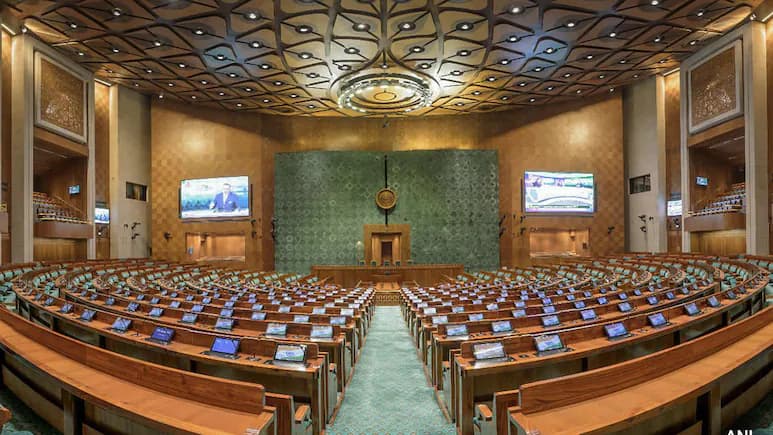
    Against this backdrop, the weakening of the opposition ahead of the Monsoon Session and the changing composition of Parliament represent significant developments in Indian politics.

    Even more important is the government’s reported intention to reintroduce the 130th and 131st Constitutional Amendment Bills. The opposition had successfully blocked these bills in April and again during a subsequent special session. But the situation is different now.

    If these two bills are passed, they are expected to bring significant changes to India’s political and constitutional framework. Alongside the Constitutional Amendment Bill providing women’s reservation, the government is also preparing to secure the required two-thirds majority for a delimitation bill.

    If passed, the delimitation exercise would proceed based on the previous Census rather than waiting for the ongoing Census. The bill may also specify the exact increase in the number of parliamentary seats. Furthermore, many observers believe that the Delimitation Commission constituted by the government could redraw constituency boundaries in ways that benefit the ruling BJP.

    The proposed 130th Constitutional Amendment Bill is equally significant. It would reportedly provide for the immediate removal of a Prime Minister, Chief Minister, Union Minister, or State Minister from office if they are arrested in a serious criminal case and remain in jail for 30 days. Many believe this provision is primarily aimed at opposition chief ministers and ministers.

    If the government succeeds in establishing dominance in Parliament and securing passage of these constitutional amendment bills during the Monsoon Session, there may be few obstacles left to passing other major legislation. Most notably, it would pave the way for legislation enabling simultaneous elections under the “One Nation, One Election” proposal.

    BJP chief ministers across the country have already declared their readiness for simultaneous elections. Party strategists reportedly believe that implementing women’s reservation alongside simultaneous elections would significantly strengthen the BJP’s prospects of returning to power once again.

    If that happens, it would mark a major transformation in Indian democracy. BJP circles also reportedly view this as an opportunity to postpone the Assembly elections due in Telangana, Madhya Pradesh, Chhattisgarh, and Rajasthan in 2028 until the next general election.

    This raises an important question: what will elections look like by 2029?

    The Congress does not appear to be taking seriously the possibility that the BJP could further consolidate its dominance in Parliament as several regional parties split or decline. Congress leaders seem to believe that if regional parties disappear, Congress itself will fill the vacuum.

    If that were to happen, India could gradually evolve into a two-party system. Whether the BJP or Congress, other parties could steadily weaken. Is such a development healthy for democracy? Would regional aspirations lose their place in Indian politics? These are questions that deserve discussion.

    The decline of Odia, Bengali, and Dravidian regional identity politics in electoral politics has contributed to these concerns. At the same time, another question must also be asked: have regional parties genuinely safeguarded regional aspirations? Or have parties willing to compromise anything for the survival of their leaders lost their credibility in the eyes of the people?

    It should not be forgotten that India has always functioned as a pluralistic democracy. Even when the Congress was the dominant political force, it was never the only one. During Jawaharlal Nehru’s tenure as Prime Minister, Congress won 364 seats with about 46% of the vote, but opposition parties together secured 54% of the vote and won 125 seats. They represented a wide variety of social groups.

    From the second general election onward, the number of regional parties steadily increased. Even Congress recognizes that this happened largely because of its own arrogance and overconfidence during its years of dominance. As a result, Dravidian parties, socialist parties, and various regional and identity-based political movements emerged, becoming symbols of India’s diversity.

    At one stage, coalition governments at the national level appeared to be the country’s permanent political reality. Leaders like Atal Bihari Vajpayee viewed regional aspirations as an essential expression of India’s pluralism and federal spirit.

    Today, however, history appears to be moving in the opposite direction.

    Whether this trend is dangerous or healthy is not the central question. More troubling is the fact that the number of voices willing to ask difficult questions is steadily diminishing.

  • Modi’s Ascendancy and the Opposition’s Search for Direction

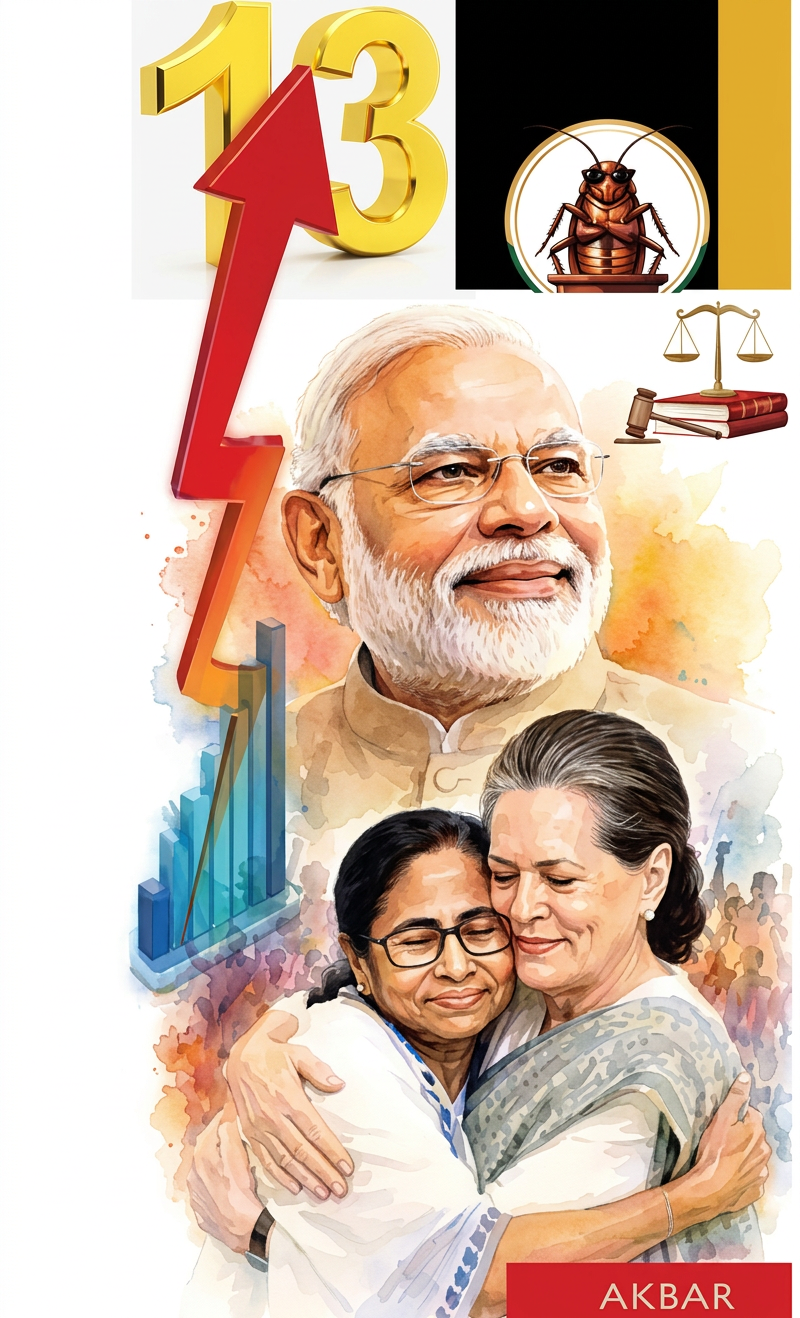
    On Monday, at the INDIA alliance meeting held in Delhi, Trinamool Congress supremo Mamata Banerjee, who appeared with a faded face, was tightly embraced by former Congress president Sonia Gandhi. Who other than one woman can understand another woman’s heart? “Some scenes cannot be expressed in words,” remarked a senior leader.

    These two were once described by international organizations as the most powerful leaders in the country. While Sonia ruled the country’s politics for more than ten years, Mamata Banerjee ruled Bengal politics for 15 years. But they are not unaware that the present circumstances are different.

    After the results of the five state elections announced last month, anti-BJP forces met again in Delhi. Mamata Banerjee and the Left parties, forgetting that until yesterday they were also fighting Congress, have become ready to join hands with Congress at the national level. Mamata Banerjee also appears to have forgotten that Rahul Gandhi, the Leader of the Opposition in the Lok Sabha, had only recently criticized her harshly over her anarchic and corrupt rule. She also may not now remember that in 2021 she dreamed of the Prime Minister’s post and declared, “Congress has become ineffective in the country. I alone will play the key role at the national level.”

    The tigress-like Mamata Banerjee, who rebelled against Congress in 1998 and launched her party by holding a rally in Kolkata while the AICC plenary session was taking place, now appears to have had her claws removed. Public representatives belonging to her party in both the Lok Sabha and the Assembly have declared rebellion against her. Her right-hand man Abhishek Banerjee, MP Kalyan Banerjee, and other party leaders are facing attacks on the streets. The same methods Mamata Banerjee once employed against her opponents are now being used against her by her rivals. While Mamata Banerjee and her followers are now crying in the wilderness on the streets of Kolkata, Congress leaders have become the ones standing by her. In this context, it appears that Mamata Banerjee has realized that Congress alone is her refuge if she is to face a mighty force like the BJP both in the state and in Delhi. Though Congress and the Left did not win many seats in the Bengal Assembly elections, they were able to damage the Trinamool considerably. In minority-dominated areas such as Murshidabad, Malda, and Uttar Dinajpur, the Congress–Left alliance ensured that Trinamool did not receive its traditional support. In 32 Assembly constituencies where Muslims constitute more than 50 percent of the population, Trinamool did not win even a single seat. In the Jangipur constituency, the Congress candidate secured 31,000 votes while the Trinamool candidate received only 10,542 votes. Likewise, in the Karandighi constituency, CPI(M) secured 39,000 votes, while the BJP candidate won with 20,000 votes. Perhaps the manner in which these results came has taught Mamata Banerjee lessons about her arrogance, authoritarian approach, and disregard for allies. That is why she is now seen on the streets of Delhi.

    Likewise, for the Left parties, whose ground is slipping from beneath their feet in the country, the streets of Delhi have also become a refuge. In the 140-member Kerala Assembly, the Congress-led UDF winning more than 100 seats, the BJP winning three seats, and the defeat of most ministers in Pinarayi Vijayan’s cabinet cannot be ignored. Analysts described the Left alliance’s defeat there as the result of Pinarayi Vijayan’s centralized and arrogant governance, severe disappointment among farmers, youth, and ASHA workers, dissatisfaction among party cadres, and public resentment against ten years of rule. Congress leaders such as Rahul Gandhi and Revanth Reddy criticized Pinarayi Vijayan, alleging that he was colluding with the BJP and encouraging corrupt elements. They questioned why central agencies had not investigated Vijayan. Be that as it may, the Left parties, which have reached a situation where they are not in power anywhere in the country for the first time in five decades, have realized that they have no option except to work together with other anti-BJP forces. Left leaders D. Raja and John Brittas, who attended the INDIA alliance meeting, have that clarity.

    The late CPI(M) General Secretary Sitaram Yechury, who passed away two years ago, understood the present situation in the country very well. When Congress inducted Prasenjit Bose, who had been expelled by CPI(M), Rahul Gandhi joked with Yechury, saying, “We have taken your comrade into our party.” Laughing, Yechury replied, “What is yours and ours? In this struggle, both of us are travelling in the same boat.” He had long ago understood the need for all anti-BJP forces to shed their narrow-mindedness and work together to confront the BJP, which was advancing unchecked across the country. Today, none of the parties in the NDA are fighting among themselves. But the parties in the INDIA alliance do not possess that level of unity. How much sincerity of purpose do the 23 parties that met at Delhi’s Constitution Club after nearly two years really have? What is the significance of the DMK and Aam Aadmi Party not attending? After the Emergency, in 1977, opposition parties contested against Congress under a single election symbol in the name of the Janata Party. How many parties today possess that same sincerity and fighting spirit? Can Congress provide leadership to other parties in the same way that the BJP has been able to guide even its allies along its ideological path?

    Two days after the INDIA alliance meeting, Prime Minister Narendra Modi organized a meeting of NDA allies on the occasion of completing 12 years in power. Though nominally an NDA meeting, it is in reality a BJP meeting. Leaving aside small states like Nagaland, Meghalaya, and Puducherry, Andhra Pradesh is the largest state where NDA rule is currently in effect. Until recently, Janata Dal (United) chief Nitish Kumar was the Chief Minister in Bihar. Now, even there, a BJP leader is Chief Minister. With his entry into the Rajya Sabha, the 12 JD(U) MPs in the Lok Sabha will have to regard Modi as their leader. While Trinamool has 28 MPs in the Lok Sabha, 20 MPs under the leadership of party chief whip Kakoli Ghosh Dastidar have decided to write to Speaker Om Birla seeking recognition as a separate group after rebelling against Mamata Banerjee. At some auspicious moment, they too may have no option but to join the BJP and wear the saffron scarf as BJP MPs. That means the BJP effectively already has a full majority in the Lok Sabha even without the support of the Telugu Desam Party. Moreover, seven MPs from Shiv Sena, five from Lok Janshakti Party, two from Janata Dal (Secular), two from Rashtriya Lok Dal, one from the NCP Pawar group, two from Apna Dal and Hindustani Awam Morcha, along with six MPs from northeastern states, are already supporting the BJP. Since Modi came to power, the Bharatiya Janata Party has earned the distinction of splitting several regional parties such as Shiv Sena, NCP, Lok Janshakti Party, Rashtriya Lok Samata Party, Aam Aadmi Party, and Trinamool, and also attracting many leaders from other parties into its fold. Not only that, during Modi’s tenure, parties such as BSP, BJD, DMK, and AIADMK have faced tests of survival, making their future uncertain. A situation has arisen in the country where many regional parties feel that their survival will be difficult unless they surrender to Modi.

    In this context, as Modi enters his 13th year in power today, no one can deny that his political strength is increasing day by day, despite social media commentary about how intense his politics may become, developments such as the “cockroach party,” the weakening of democratic institutions, allegations that the judiciary has surrendered, and the flood of criticism over the failure of institutions such as NEET and CBSE to conduct examinations properly. Without eliminating their internal contradictions and creating an equally compelling alternative vision, what change can opposition parties or other non-BJP forces achieve, no matter how many meetings they conduct?