Has there been a shift in the functioning of the Bharatiya Janata Party and the Union Government following the student protests in July that caused unprecedented shockwaves, the subsequent washed-out Monsoon Session of Parliament amid roaring slogans, and the trends seen in the by-elections across three Assembly constituencies including Bankipur? This has now become a major topic of discussion in the national capital. It goes without saying that the impact of these developments has also been felt deeply within the Rashtriya Swayamsevak Sangh (RSS). Seemingly startled by the changes taking place in society, the RSS has suddenly plunged into a massive nationwide mobilization drive aimed at youth and students. Thirty-two affiliate organizations of the RSS, including the BJP, are attending the three-day RSS All India Coordination Meeting (Akhil Bharatiya Samanwaya Baithak) held at Gudilova on the outskirts of Visakhapatnam. In these meetings as well, the primary agenda is: “How to improve engagement with Gen Z and the youth?” The Gudilova meetings are taking place at a time when a major internal overhaul within the RSS is slated for completion by March 2027 to present a brand-new face to the public under fresh leadership. These sessions are set to play a pivotal role in the Sangh’s evolution, with the distinct possibility of catalyzing a transformation within the Bharatiya Janata Party as well.
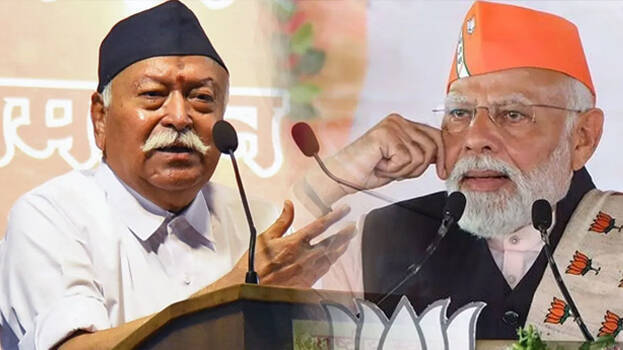
There is no doubt that the developments over the twelve years since the BJP came to power at the Centre have also influenced the RSS. While some within the Sangh might view the BJP as just one of its 32 affiliates, one cannot discount that the BJP, governing at the Centre under Modi’s leadership over this decade-plus period, has reshaped the Sangh itself. Having Sangh functionaries step into every Union ministry is one aspect; having the Sangh bear responsibility for the government’s missteps and transgressions is quite another. The Sangh once held the distinction of compelling veteran BJP leader L.K. Advani to resign simply for visiting Pakistan and paying glowing tributes to Muhammad Ali Jinnah. But does the Sangh still possess the power to exercise such moral and ideological authority under current conditions? This is the question now being debated. Having once played a central role in government appointments, alliance decisions, and candidate selections, the key issue today is whether the Sangh can question or confront the government. RSS Sarsanghchalak Mohan Bhagwat has repeatedly stated that rulers must heed the concerns of students and youth, and that the Modi government must acknowledge mistakes made in policy decisions. Yet, to what extent is the government engaging in self-reflection? This cannot be ignored. Today, several opposition leaders, including Rahul Gandhi, are dragging both the BJP and the RSS into the political arena and questioning their ideological clarity, effectively putting them on trial before the court of public opinion. It is not just the opposition; even the general public is increasingly finding it difficult to tell the Sangh and the BJP apart. Against this backdrop, it remains to be seen whether the RSS can redefine its future ideological role and reshape its affiliate, the BJP, to meet future needs.
In fact, a stage had arrived where the BJP argued it no longer needed the support of the RSS. During the 2024 Lok Sabha elections, the then BJP National President Jagat Prakash Nadda clearly stated: “In the beginning, when we lacked capability, we needed the RSS. Today, our party has expanded significantly and stands on its own feet. The BJP can run itself.” Thanks to Amit Shah’s strategic planning, the BJP emerged as the world’s largest party with 140 million members, constructing a massive apparatus capable of winning elections with ease. To make the BJP unchallenged, it succeeded in either subduing or splintering rival parties through persuasion or pressure. Consequently, despite securing only 240 seats in the 2024 elections, the leadership of Modi and Shah remained undisputed. Thereafter, by weakening opponents, it continued to win successive assembly elections, ultimately capturing Bengal as well. Many within the Sangh had little choice but to accept the leadership of Modi and Shah. Once a party emerges as an invincible force both internally and externally, which organization retains the ideological and moral authority to question its top leadership?
Perhaps the emergence of the Cockroach Janata Party and the student protests provided an opportunity for introspection over these developments. For more than a decade, Modi crafted a political ideology and an accompanying vocabulary, unleashing it upon the world. The BJP maintained a well-oiled machinery to embrace this discourse and direct sharp attacks at rivals. Any doubt as to whether Modi created the BJP’s ideological foundation or whether it carried the Sangh’s blessings evaporated; in short, “Modi-ism” indisputably dictated the ideology of both the BJP and the Sangh. The same “ism” prevailed across all key appointments, from Chief Ministers and Union Ministers to the party’s National President.
However, in the wake of the events in July, ideological analysts note a distinct Sangh imprint on the newly appointed team led by Nitin Nabin. Ideologue Ram Madhav, who remained distant from the BJP for nearly six years, was appointed as Vice President, while 11 out of 14 Vice Presidents and 11 out of 18 General Secretaries reportedly share a strong foundation in Sangh training. Furthermore, removing Amit Malviya—who headed the IT Cell for 11 years with a reputation for projecting any narrative as truth and launching aggressive attacks on opponents—and sidelining figures known for belligerent rhetoric like Tejasvi Surya are notable developments. Speculation suggests an effort is underway to steer the party away from Modi’s mindset and Amit Shah’s strategic style. Even so, will conditions return to the days when the BJP central office buzzed with healthy, regular interactions among party workers, media, and leaders like Venkaiah Naidu, Sushma Swaraj, Arun Jaitley, and Ananth Kumar? Turning back the clock is never easy.
Surprisingly, during his 13th Red Fort address on the occasion of the 80th Independence Day, Prime Minister Narendra Modi devoted little time to recounting the achievements of the past 12 years. He did not walk the path of Nehru, who spoke to a young India in the language of scientific temper and modern nation-building. He did not echo Lal Bahadur Shastri’s call of “Jai Jawan, Jai Kisan.” Nor did he emulate Atal Bihari Vajpayee by adding “Jai Vigyan” to emphasize the primacy of science. He did not seek to unpack complex economic reforms in simple language like P.V. Narasimha Rao, nor did he discuss a knowledge-based economy like Manmohan Singh. Departing from all of them, Narendra Modi added a new phrase to the lexicon of Indian politics: Dimagi Naxal (an intellectual or ideological Naxalite). Yet, Modi offered no definition for the term. Do those who question an education system that fails to provide jobs, those who raise their voices against paper leaks and unfulfilled promises, and those who take to the streets not just at Jantar Mantar but in cities like Ranchi and Patna fall into this category? Modi knows how to battle legacy systems; in the past, he successfully branded rivals as “Lutyens,” “Andolan Jeevis,” or “Urban Naxals,” lumping them all under a single ideological label. But dismissing Gen Z with such tags will not be easy. Does warning the nation to stay vigilant against thoughtful, questioning citizens from within reflect the true national spirit? In an India recognized globally as an intellectual powerhouse that has produced CEOs for major global enterprises, who exactly is Modi worried about?
After 12 years of uninterrupted rule, the new challenge Modi faces today is the inability to formulate an acceptable ideology and an appropriate vocabulary to match it. The primary reason is that neither the Bharatiya Janata Party nor the Rashtriya Swayamsevak Sangh has consistently built a robust, clear, scientific, and modern ideology suitable for the new generation, leaving room instead for a politics of slogans and abuse. What the country urgently needs today is not individuals who revel in having their names chanted, but an ideology that moves in step with the times.