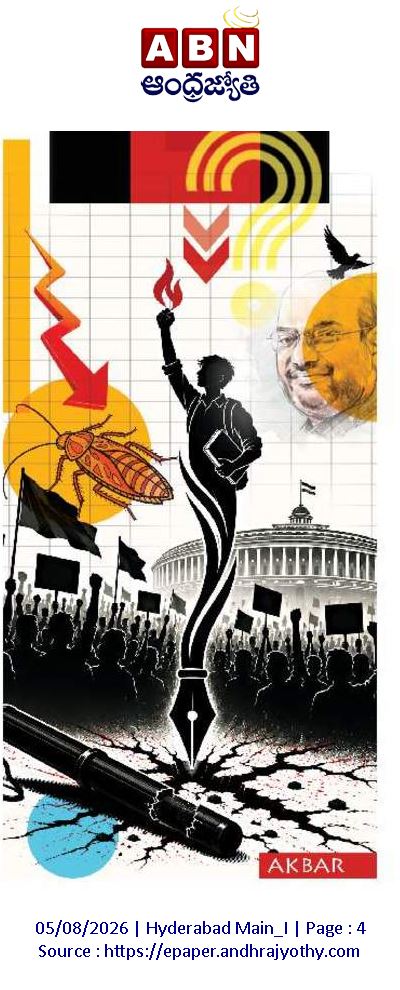
Even though more than a week has passed since the agitation ignited in the national capital, Delhi, by thousands of students and other forces under the banner of the “Cockroach Janata Party” subsided, its tremors have not yet died down. The situation has not completely settled even after the resignation of Union Education Minister Dharmendra Pradhan. The Opposition is stalling Parliament, demanding a statement from Union Home Minister Amit Shah regarding the lathi charge and firing of pellets on the students. It is gathered that the government, unable to introduce key bills apart from minor and insignificant ones, is planning to adjourn Parliament indefinitely as early as possible. Chief Justice of India Justice Surya Kant—who commented two weeks ago, “Why are you showing us scenes of lathi charge on students? Don’t waste our time”—is now enabling the government to withdraw FIRs against the students. Since the Centre itself approached the Supreme Court in this matter, he appears to be offering the government a way to save face.
On one side, although his fans and BJP leaders are abusing the students with various words, Prime Minister Narendra Modi announced with a very large heart that he has forgiven them. However, this announcement did not yield the expected positive results. Modi and Amit Shah are coming to Parliament, but they are not getting the opportunity to attend both Houses. Surprisingly, officials themselves say that the Home Minister is not coming to Kartavya Bhavan (the seat of the Home Ministry) at all, and is conducting one or two important meetings in his own room in Parliament. The only incident that made Modi very happy during this crisis was being entertained with songs, dances, and a torrential rain of praise on the occasion of the inauguration of Bhogapuram Airport in Andhra Pradesh. But as soon as he returned to Delhi, the situation returned to the same heat!
It is unknown how long this troubled period will last, but many observers say that the results of the three Assembly by-elections held during this time indicate a coming change in the country’s politics—especially the election results of the Bankipur constituency in Bihar. Bankipur, a constituency under the Patna Sahib Lok Sabha area in the capital of Bihar, became the center of the Cockroach Janata Party agitation. Recently, when students took to the streets across several cities in the country during the NEET question paper leak, its intensity was seen severely in Patna. Demanding the resignation of Union Education Minister Dharmendra Pradhan, thousands of students residing in colleges and hostels centered in Bankipur marched out in a procession. Normal life came to a standstill on Ashok Rajpath and Boring Road, where a large number of coaching centers for students are located in the city.
In Siwan and other key districts, the protest turned violent. Incidents such as lathi charges, stone-pelting, use of tear gas and water cannons, burning of police jeeps, and blockades of national highways took place. Videos of students being injured due to firing with AK-47s were circulated. Police barged into private hostels located in the narrow lanes of Bankipur, dragged out students who had come for coaching, and beat them severely. On the single day of the Bihar Bandh called on July 25, 690 people were detained. Murder charges were framed against many. The surprising fact is that while the Bankipur by-election was on July 30, the Bihar Home Department issued emergency orders on July 27 withdrawing all FIRs against the students. Yet, it was of no use.
In March 1974, when Patna University students laid siege to the Assembly under the leadership of Jayaprakash Narayan, several students lost their lives in the firing and lathi charge carried out by the police. Afterwards, at a public meeting held at Gandhi Maidan in the presence of lakhs of people, JP gave a call for “Sampoorna Kranti” (Total Revolution). The statue of Jayaprakash built at the crossroads right next to the same Gandhi Maidan in Bankipur stands as a direct witness to recent events. In the surroundings of this area, known as JP Golambar, police once again pounced upon students. Before the Emergency, the JP movement spread from Patna to Delhi. Now, the Cockroach protest from Delhi echoed in the streets of Patna. It is no exaggeration to say that this echo decided the Bankipur election results.
It goes without saying that in Bankipur, which had been in the BJP’s grip for the past three decades, the winner was not Prashant Kishor, leader of the Jan Suraaj Party that lost all its seats in the previous elections, but the students. It was only because he won five times from here that Nitin Nabin was able to become the BJP National President. The reason he gave up his MLA seat to choose the Rajya Sabha was that the top leaders of that party believed the BJP would win there effortlessly. The comment made by former Union Minister and Patna MP Ravi Shankar Prasad—”Even if a dog is fielded there, the BJP will make it win”—is proof of this. However, the BJP’s vote share plummeted from 62 percent to 34.4 percent in just one year! Because Kayasthas constitute 14 percent of the voters in Bankipur, Nitin Nabin used to win from there, as Bhumihars and Brahmins at 8 percent each, Rajputs at 7 percent, Kurmis at 5 percent, and Kushwahas at 3 percent also used to vote for him. In these by-elections, caste equations failed completely. These results must serve as an eye-opener to politicians who rely solely on caste equations!
The Bankipur election results are merely a warning that the Bharatiya Janata Party must act with extreme caution hereafter in urban areas with high concentrations of middle-class and upper-caste populations. Bankipur made it clear that educated young voters in this country can influence election results. BJP leaders can no longer remain confident that urban areas like Lucknow, Prayagraj, Kanpur, and Noida in Uttar Pradesh, where elections are due in another seven to eight months, will remain their strongholds as in the past.
Lekha Chakraborty, a prominent economist and professor at the National Institute of Public Finance and Policy (NIPFP) under the Union Ministry of Finance, attempted to scientifically analyze the students’ agitation. In a study, she expressed the view that just because individuals face similar problems, they do not fight spontaneously; when issues like paper leaks and job insecurity become strong motivators, combined with digital technology, youth unite on a massive scale. She stated that there is no connection between degrees and employment, and that only one-fourth of those with degrees get proper salaried jobs. One-third of the Periodic Labour Force lives on self-employment, and most of them depend on agriculture, earning low incomes.
The ‘State of Working India 2026’ report released by Azim Premji University also confirms the study conducted by Lekha Chakraborty. It stated that although education has become accessible to sections that did not benefit in the past, meaningful opportunities to convert their qualifications into productive employment are not arising. These studies express deep concern over faculty leaving public universities, the decline in curriculum quality, and the falling value of degrees.
They make it clear that advanced technology can reduce leaks and increase transparency, but it cannot create labor demand or restore the credibility of educational institutions. Economists themselves say that without increasing the education budget to 6 percent of GDP as recommended by the National Education Policy, and without properly building classrooms, providing teacher salaries and training, creating high-skilled jobs, and restoring the credibility of examinations, the problems cannot be solved. They warn that unresolved discontent provides continuous motivation to the people, and government suppression measures raise the danger level and strengthen collective unity.
If politicians thought as scientifically as economists think, why would problems turn into crises and water flow under their rugs? Famous historian Will Durant did not remark in vain regarding the fall of the Roman Empire: “Great empires are not conquered from the outside; they destroy themselves from within.”

