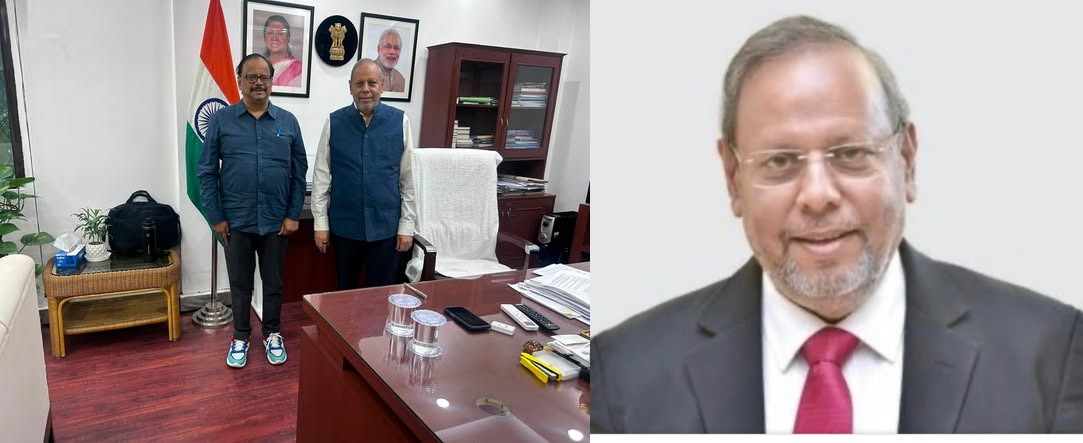
NEW DELHI — Strongly rejecting claims that India is a “dead economy,” Professor Suryadevara Mahendra Dev, Chairman of the Prime Minister’s Economic Advisory Council, stated that calling the nation’s financial state a dead economy on foreign soil is an insult to the country. Pointing to India’s 7.7 percent GDP growth rate as clear proof of resilience, he emphasized that Prime Minister Narendra Modi’s decisive reform measures—ranging from massive infrastructure capex to Atmanirbhar Bharat and deregulation—are driving the world’s fastest-growing major economy. However, he cautioned that states must curb unproductive freebies and balance welfare with development to avoid long-term debt traps.
In an exclusive interview with Andhra Jyothy Delhi representative A. Krishna Rao, Prof. Mahendra Dev outlined the country’s macroeconomic trajectory, regional growth dynamics, and structural reform imperatives.
Growth Resilience, Modi’s Reform Push & The Freebie Warning
Prof. Mahendra Dev highlighted that two key indicators prove ongoing economic momentum: rising investments and expanding exports. India’s investment rate currently stands at 32 percent, but achieving sustained 7 to 8 percent growth requires pushing this to 34 to 35 percent. While global headwinds—COVID-19, the Ukraine war, international tariffs, the Gulf crisis, and 80 percent crude oil import dependence—continue to exert pressure, policy initiatives under PM Modi are actively insulating the economy.
- Targeted Manufacturing & Self-Reliance: To counter global protectionism, PM Modi’s focus on manufacturing aims for self-reliance in strategic sectors like semiconductors, rare earths, and microchips. Atmanirbhar Bharat is not a return to the pre-1991 License Raj, but a push to build internationally competitive, high-quality domestic products.
- Ease of Doing Business: Deregulation and the repeal of obsolete laws under the Modi government have streamlined business operations, though execution needs to accelerate at the state level.
- Fiscal Prudence vs. Unproductive Freebies: Prof. Mahendra Dev cautioned that unproductive freebie schemes damage long-term financial health and drive up government debt. Welfare benefits must be strictly targeted toward eligible, underprivileged sections rather than affluent beneficiaries. Recalling an anecdote, he shared: “A politician once told me he owns 50 acres of land but still received ₹5 lakhs in his bank account under welfare schemes; people like that do not need schemes like Rythu Bharosa, do they?” While debt should be viewed as a ratio to GDP (with the Centre working to bring its debt down to 50 percent of GDP), states must maintain a strict equilibrium between welfare transfers and productive development spending.
Manufacturing, Labor & Demographic Strength
Addressing structural bottlenecks, Prof. Mahendra Dev noted that manufacturing remains stuck at 17 percent of GDP and must expand significantly. Women’s workforce participation also needs to rise from 35 percent to 50 percent.
On national employment, he clarified that government jobs constitute only 15 to 20 percent of total employment. The remaining 80 percent must come from agriculture, the private sector, manufacturing, and services. Job creation has not halted—as manufacturing grows by 17 percent and services by 53 percent, employment expands alongside. Furthermore, India’s demographic average age of 28 years is a major asset that can be transformed into human capital by aligning education with industry-required skills and integrating Artificial Intelligence into agriculture, healthcare, and production.
Regional Focus: Capital Development in AP & Telangana’s Growth
When addressing regional development, Prof. Mahendra Dev affirmed that a newly bifurcated state requires a major, single capital city to generate economic momentum.
- Amaravati & AP Clusters: Just as Hyderabad generates 67 percent of Telangana’s tax revenue due to its scale, developing Amaravati as the capital will create a multi-faceted economic spillover benefiting nearby Guntur, Machilipatnam, and Vijayawada. Dismissing the YSRCP’s three-capitals proposal as meaningless, he noted that Chief Minister Chandrababu Naidu is simultaneously driving cluster-based development across Visakhapatnam, Tirupati, Anantapur, Rajahmundry, Kadapa, and Kurnool. He added that IT Minister Nara Lokesh possesses a complete understanding of this cluster model.
- Telangana’s Future City: In Telangana, Chief Minister Revanth Reddy expanding Hyderabad under the prestigious “Future City” project is a right decision that will uplift adjoining districts. Since Telangana also faces a debt load, both states should formulate joint economic growth strategies.
Historical Legacy & Structural Reforms
Contextualizing India’s development journey, Prof. Mahendra Dev pointed out that for four decades starting from Jawaharlal Nehru’s tenure, India’s growth rate hovered at a low 3.5 percent. During this era, labor-intensive manufacturing, primary health, and primary education were neglected, whereas China and East Asian nations invested heavily in human capital as early as the 1960s.
Our pace of economic development went off track right from Nehru’s time, leaving structural problems as a historical legacy, while economic reforms were delayed by 15 years—Prof. Mahendra Dev smiled and remarked, “Everyone was a socialist back then, weren’t they?” While many nations reformed in the 1970s, India implemented reforms in the 1990s under P.V. Narasimha Rao.
Due to these legacy issues, India’s per capita income remains at around $3,000 (compared to China’s $12,000), meaning the economy cannot run like a tiger just yet. However, growth momentum picked up under the Vajpayee government in 2000 and continues strongly under PM Modi, setting the trajectory toward Viksit Bharat—an inclusive, environmentally sustainable, and fully developed economy.
Biographical Note
Prof. S. Mahendra Dev, son of the renowned philosopher, writer, and polymath Sanjeev Dev, was born in Tummapudi in Guntur district. He holds a Ph.D. from the Delhi School of Economics and completed post-doctoral research at Yale University. Over a distinguished career, he has held key leadership positions—including Director and Vice-Chancellor of the Indira Gandhi Institute of Development Research (IGIDR) established by the Reserve Bank of India, Chairman of the Commission for Agricultural Costs and Prices (CACP), and Director of the Centre for Economic and Social Studies (CESS) in Hyderabad.
 akrishnarao