In the 2017 Legislative Council elections, some leaders from Rayalaseema exerted intense pressure on the Returning Officer, Satyanarayana Rao, who was then serving as the Assembly Secretary, to reject the nomination of a candidate. They also tried to influence him with inducements. Frightened and disturbed, that Returning Officer reportedly approached Chief Minister Chandrababu Naidu. It is said that he told the officer, “Do not yield to any pressures. Act fearlessly according to the rules.”
In 2009, during the YSR era, Telugu Desam Party candidate Kadiri Baburao, who contested for the Legislative Assembly from Kanigiri, forgot to sign in one place in his affidavit. The Returning Officer, who maintained strategic silence without saying anything until 5 p.m., later rejected Baburao’s nomination papers on the grounds that the signature was missing. Baburao was known to be a close associate of the prominent film actor Nandamuri Balakrishna. These are merely examples to illustrate how crucial a role Returning Officers play in determining the fate of candidates. Just as Jayadratha in the Mahabharata possessed the power to prevent the Pandavas from entering the battlefield even for a single day, Returning Officers too occasionally play the role of Jayadratha in the electoral battle. Their power is that formidable.
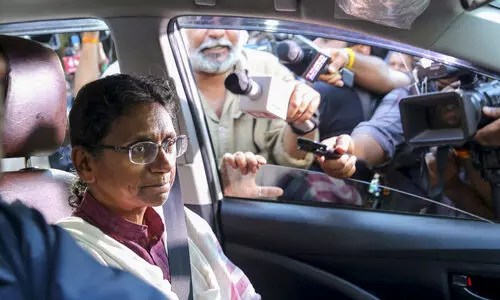
Recently, in Madhya Pradesh, Returning Officer Arvind Sharma played a key role in rejecting the nomination papers of Congress candidate and party General Secretary Meenakshi Natarajan. Arvind Sharma, who is a Principal Secretary in the Madhya Pradesh government, had previously served as a Director in the Lok Sabha. The very fact that he came to Madhya Pradesh with the assistance of Narendra Singh Tomar, who was the Agriculture Minister during the period when farmers were protesting against the farm laws, indicates the strength of his connections with the BJP. Tomar is now the Speaker of the Madhya Pradesh Assembly.
Perhaps BJP circles were aware of the complaint filed in Hyderabad against Meenakshi Natarajan even before they received official notification of it. Otherwise, they would not have fielded a third candidate despite lacking the necessary strength. Meenakshi filing her nomination, the BJP immediately reminding the Returning Officer about the case against her, the officer promptly rejecting her nomination, and then announcing the BJP candidate as elected unopposed—all of this happened in rapid succession. It appears that whatever the BJP does is executed with meticulous planning and considerable advance preparation.
Although the Modi government convened special sessions of Parliament for three days last April, it failed to secure passage of the Delimitation and Women’s Reservation Bills, which it had introduced with great prestige. This was the first time since Modi came to power that the opposition succeeded in preventing the passage of such bills. Following the BJP’s first-ever sweeping victory with an overwhelming majority in West Bengal, the party’s confidence increased. It sought to employ all possible methods to increase its strength in both Houses of Parliament.
As part of that effort, twenty Lok Sabha members belonging to the Trinamool Congress reportedly broke away from the party, joined an obscure party called the Nationalist Citizens Party, and declared support for the NDA. Three Rajya Sabha members belonging to that party resigned. Negotiations are reportedly underway with others as well. Leaders who until recently criticized Modi during the Bengal elections are now said to regard him as their leader. In Jharkhand, efforts are underway to field Parimal Nathwani, considered Ambani’s right-hand man, as an independent candidate and thereby attract legislators from the ruling party to their side. By strategically ensuring the rejection of Meenakshi Natarajan’s nomination, three BJP candidates from Madhya Pradesh were elected unopposed. Not only that, across the country nineteen BJP MPs won without any contest. These developments make it clear that the Modi government is preparing the ground to ensure that it faces no obstacles in either House and can pass the bills it desires. Although the NDA has not yet reached a two-thirds majority in both Houses, discussions are taking place in the national capital about how many more people the BJP might bring into its fold by the time the monsoon session begins in July.
After the rejection of Meenakshi Natarajan’s nomination and the surrender of Trinamool Congress members to the NDA, a sense of anxiety regarding political survival has reportedly emerged in every party across the country. Reports suggest that even the Shiv Sena led by Uddhav Thackeray and the NCP led by Pawar are facing an existential test. In this context, it is becoming clear that the Modi government has prepared the ground to secure passage during the monsoon session of several important bills, including the Delimitation and Women’s Reservation Bills.
The surprising thing is that although Returning Officers have behaved controversially in the past, no one has received as much sympathy as Meenakshi Natarajan. That may be because she is a Gandhian who leads a very simple life, making her a rare kind of political leader. There is little point in criticizing the Returning Officer here. “What can we do if orders come from above?” said one official from Madhya Pradesh.
Rejecting her nomination on the basis of a case filed on the basis of a private complaint entirely unrelated to her appears completely unreasonable. Many individuals who have served as Returning Officers in legislative bodies say that under Section 33A of the Representation of the People Act, only cases in which a charge sheet has been filed, charges have been framed, and which are punishable with imprisonment of more than two years need to be disclosed. Even if the Returning Officer believed that the affidavit had not been fully completed, they say that a nomination should not be rejected solely for that reason and that the candidate should be given another opportunity to correct the error.
On the very day Meenakshi Natarajan’s nomination was rejected in Madhya Pradesh, a BJP candidate in Jharkhand was given 24 hours to correct an error in his affidavit. There have been many such instances across the country where Returning Officers have acted fairly. Officials should facilitate a candidate’s democratic election, not create obstacles preventing that candidate from being elected. When officials act in accordance with the political interests of the ruling party, it becomes clear that democracy in our country is not in a healthy condition.
Another surprising aspect is that courts also do not make efforts to dispose of election petitions quickly and thereby give wronged candidates an opportunity to be re-elected. Recently, even the Madras High Court criticized the Supreme Court on this issue. In a petition filed by a candidate who lost by just 49 votes in a constituency during the 2016 Tamil Nadu Assembly elections, it took the Supreme Court six years to deliver a verdict. What benefit is there in the court declaring that the defeated candidate had actually won? By then, the term of the Assembly had already ended. The Madras High Court criticized even the Supreme Court, saying that justice had become a mockery.
A similar situation occurred in the case of Ponguleti Sudhakar Reddy versus Tummala Nageswara Rao. Although the case was filed in 1999 and Tummala had won, it took the High Court seven years to decide the matter.
When Meenakshi Natarajan approached the Supreme Court claiming that her nomination had been unfairly rejected, it refused to intervene. The Supreme Court held that under Article 329(b), elections to legislative bodies cannot be challenged. The Court clarified that she could, if she wished, file an election petition in the High Court. The Supreme Court is also aware of the deplorable condition of election petitions in the country’s judicial system. A former Supreme Court judge said that, based on past experience, no one knows how many years it will take for Meenakshi Natarajan’s petition to be decided.
In a speech in 2019, then Vice President Venkaiah Naidu also said that courts should establish special benches for election petitions and deliver decisions within six months. If the Supreme Court does not decide the matter and election petitions do not receive speedy judgments, who will protect the democracy that is being crushed in between?
Moreover, under the current circumstances in the country, the attitude adopted by the courts appears peculiar. A situation is arising in which the courts themselves characterize those filing cases on public issues as cockroaches, idle people, or obstacles to development. “The Centre is spending money to build roads. Who are you to question the progress of roads under the Right to Information Act? This is yellow journalism,” the Supreme Court reportedly told an RTI activist on Tuesday before dismissing the case.
Some say that it is politics for the ruling party to try to secure majorities in legislative bodies and achieve its desired objectives. Others call it Machiavellian politics. Whatever one may call it, it is not wrong to question the methods being adopted and the institutions that are failing.