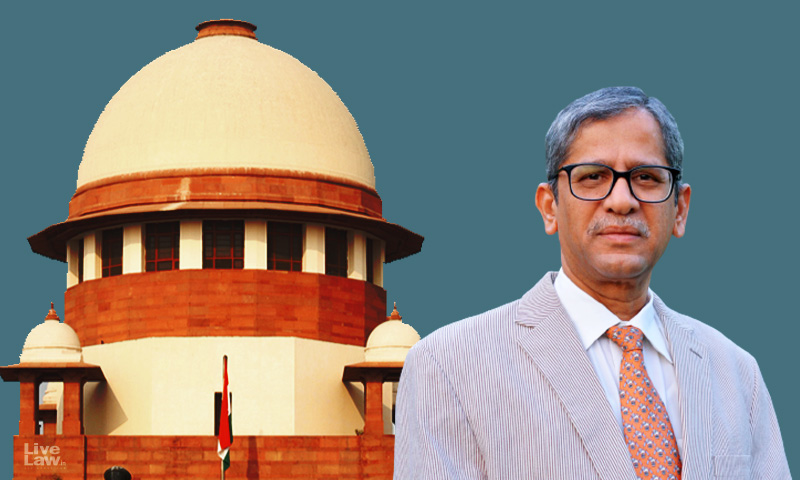
Former Chief Justice of India Justice N. V. Ramana voiced deep concern over recent global developments, warning that the current international climate reflects a troubling erosion of diplomatic norms and respect for national sovereignty. He remarked that certain actions and statements by powerful world leaders signal a growing disregard for the foundational principle that nations must govern their own affairs without external interference. Justice Ramana was among the first former constitutional functionaries to openly warn against the dangers of silence in the face of such developments.
He was speaking at the 20th Memorial Lecture organised by the Badrivishal Pannalal Pitti Trust in Hyderabad on March 28, 2026, held to mark the 98th birth anniversary of the late socialist leader Badrivishal Pannalal Pitti. The event featured reflections on Pitti’s legacy alongside discussions on contemporary issues of national and global importance.
Justice Ramana noted that claims of having “stopped” conflicts involving other countries, along with interventions in regions such as Venezuela and Iran, raise serious questions about the intent and legitimacy of such actions. According to him, these moves lack the essence of diplomacy and instead challenge the very idea of sovereignty, often reflecting arrogance, economic greed, and a desire to control natural resources under the guise of maintaining order and stability.
He emphasized that the notion of one nation intervening in another’s internal matters, particularly in regions that are home to ancient civilizations, is deeply concerning. He observed that for powerful countries, morality often becomes negotiable, shaped by strategic and economic interests, while for less powerful nations, morality and sovereignty remain central, rooted in hard-won independence achieved through long struggles and sacrifices.
Highlighting the global impact of such tensions, he pointed out that conflicts between major powers have far-reaching consequences, affecting ordinary citizens across the world. In this context, he stressed that the responsibility to respond does not lie with any one nation or political group but must be shared collectively, calling for a unified global voice against actions that undermine peace and sovereignty.
Turning to the question of ideology, Justice Ramana said ideology is not confined to politics alone but is a manifestation of an individual’s values, closely tied to human principles and beliefs. He observed that a decline in human values has led to a weakening of commitment to ideologies, even as numerous ideologies continue to promise visions of a perfect society. Emphasising the need for clarity of purpose, he said individuals must focus on their “swadharma,” or inner duty, rather than attempting to adopt every ideological framework.
Recalling India’s past approach to global issues, Justice Ramana said he was reminded of an article by journalist Krishna Rao of Andhra Jyothy, which brought back an important moment in recent history. He noted that in 2003, under the leadership of former Prime Minister Atal Bihari Vajpayee, the Indian Parliament had taken a principled stand by condemning the United States’ actions in Iraq. He described it as a moment of moral clarity that reflected India’s commitment to universal fundamental values, adding that such clarity now appears to have diminished, with the world growing quieter even in the face of visible suffering.
Drawing from history, he warned against the dangers of silence by invoking the words of Martin Niemöller in the context of the Second World War: “First they came for the Communists, and I did not speak out—because I was not a Communist. Then they came for the Socialists, and I did not speak out—because I was not a Socialist. Then they came for the trade unionists, and I did not speak out—because I was not a trade unionist. Then they came for the Jews, and I did not speak out—because I was not a Jew. Then they came for me—and there was no one left to speak for me.”
Expressing disappointment over what he described as a lack of moral leadership globally, Justice Ramana said that many leaders have remained silent in the face of war and suffering. He lamented the absence of a widely respected international figure who can command moral authority and mobilize collective resistance against injustice.
Justice Ramana urged individuals and nations alike not to remain silent in the face of suffering, cautioning that failing to support others in times of crisis ultimately weakens collective security and undermines the very values that sustain a just and equitable world order.
Rising Political Opportunism Undermines Democratic Values
At the political level, he noted that while different parties have held power over time, none have succeeded in building an ideal society. This, he said, is because political parties have largely failed to translate their ideologies into meaningful action, echoing the idea of a “poverty of philosophy.” He described ideology as the crucial link between political parties and the people, but pointed out that in recent years, loyalty has increasingly shifted from principles to power.
Justice Ramana highlighted a growing trend where elected representatives switch allegiances based on electoral prospects, sometimes even immediately before or after elections. Such actions, he said, undermine democratic values and reduce ideology to mere opportunism. He cautioned that when ideologies are not backed by action, the effectiveness of democratic institutions diminishes and public trust is eroded.
Referring to rising instances of political defections, he said that constitutional mechanisms meant to address such practices are being undermined, turning what was once seen as political betrayal into an accepted strategy. He warned that treating the voter’s mandate as a transferable asset poses a serious threat to democracy, adding that morality cannot be enforced by law alone and must be internalised by those in positions of power.
He also expressed concern over increasing divisions in society despite the weakening of ideological commitment, particularly the use of misunderstood religious ideologies as tools for polarisation. Emphasising that all religions fundamentally promote values of peace, compassion and fraternity, he said the true strength of a society lies in its ability to embrace diversity and coexist harmoniously.
 akrishnarao