“Be extremely cautious while speaking about the theft of money from the donation boxes (hundis) at the Ram Temple in Ayodhya. This incident has hurt the entire Hindu community and the BJP. It happened because of a few wrong individuals. The government will not spare the culprits,” BJP National President Nitin Nabin said two days ago at a meeting of key party leaders in Uttar Pradesh. His remarks themselves reveal how deeply the incident has shaken the BJP.
In fact, the thefts in Ayodhya came to light just as Prime Minister Narendra Modi was preparing for a major reshuffle in both the BJP organization and the Union government, including appointments of office-bearers and changes in the Cabinet. Before the upcoming Parliament session, Modi had intended to give both the party and the government a fresh shape. Several rounds of high-level discussions had already taken place.
The very fact that the Prime Minister was planning a large-scale Cabinet reshuffle suggests that he was not fully satisfied with the performance of several ministries. He held lengthy review meetings with Cabinet ministers and Ministers of State, both individually and collectively, signaling that changes were inevitable. Reports suggesting that key ministers—including the Finance Minister and the Education Minister—might be shifted indicate dissatisfaction with the functioning of their departments.
It is also noteworthy that Morning Consult, which has consistently reported rising approval ratings for the Prime Minister, has now indicated a decline from around 75–78% to 68–70%. It is therefore understandable that Modi would want to proceed cautiously. However, whether because he felt the timing was not right or due to internal challenges, the proposed reshuffle now appears to have been postponed. According to official sources, several ministers who feared removal have, for the time being, breathed a sigh of relief.
Ayodhya is not the only issue. One controversy after another continues to emerge across the country.
A dispute has arisen over the University Grants Commission’s equity regulations. The prestigious NEET-UG medical entrance examination has been rocked by allegations of irregularities and repeated paper leaks. Supporting protesting students, a prominent educationist and environmental activist from Ladakh has been on a hunger strike at Jantar Mantar for the past eight days.
The government’s E20 ethanol blending policy has also come under severe criticism. Opponents argue that the policy threatens food security and allege that certain ministers have vested interests influencing policy decisions.
Meanwhile, the ₹90,000-crore Great Nicobar Mega Infrastructure Project in the Andaman and Nicobar Islands has become the subject of intense controversy between the Centre, environmentalists, and opposition parties. Critics claim that the project would require cutting down nearly 15 million rare rainforest trees, damage fragile coral reefs and marine ecosystems, and threaten the survival of indigenous tribal communities. Against this backdrop, the recent removal of several officials from the Union Environment Ministry has also attracted considerable attention.
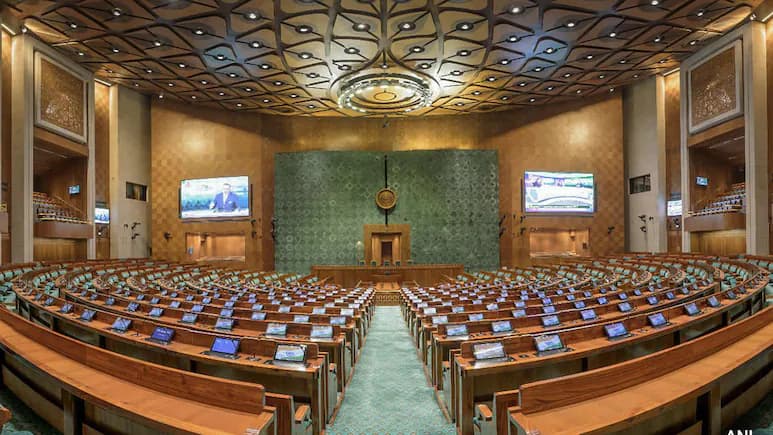
The opposition is likely to use all these issues to create disruptions during the upcoming Monsoon Session of Parliament. But the question is: where is the opposition?
Major constituents of the INDIA alliance—including the Trinamool Congress, Shiv Sena, and Aam Aadmi Party—have been weakened by large-scale defections, raising concerns about their political survival. In Tamil Nadu, after Congress aligned with TVK, the DMK has reportedly distanced itself from Congress. Sharad Pawar’s NCP is also facing an internal crisis. The Jharkhand Mukti Morcha’s position has become uncertain after it supported the BJP-backed independent candidate in recent Rajya Sabha elections. The Aam Aadmi Party has already declared that it is no longer part of the INDIA alliance.
In these circumstances, even if Congress and a few other parties manage to disrupt Parliament for a day or two, the BJP may face little resistance in advancing its legislative agenda afterward.
Against this backdrop, the weakening of the opposition ahead of the Monsoon Session and the changing composition of Parliament represent significant developments in Indian politics.
Even more important is the government’s reported intention to reintroduce the 130th and 131st Constitutional Amendment Bills. The opposition had successfully blocked these bills in April and again during a subsequent special session. But the situation is different now.
If these two bills are passed, they are expected to bring significant changes to India’s political and constitutional framework. Alongside the Constitutional Amendment Bill providing women’s reservation, the government is also preparing to secure the required two-thirds majority for a delimitation bill.
If passed, the delimitation exercise would proceed based on the previous Census rather than waiting for the ongoing Census. The bill may also specify the exact increase in the number of parliamentary seats. Furthermore, many observers believe that the Delimitation Commission constituted by the government could redraw constituency boundaries in ways that benefit the ruling BJP.
The proposed 130th Constitutional Amendment Bill is equally significant. It would reportedly provide for the immediate removal of a Prime Minister, Chief Minister, Union Minister, or State Minister from office if they are arrested in a serious criminal case and remain in jail for 30 days. Many believe this provision is primarily aimed at opposition chief ministers and ministers.
If the government succeeds in establishing dominance in Parliament and securing passage of these constitutional amendment bills during the Monsoon Session, there may be few obstacles left to passing other major legislation. Most notably, it would pave the way for legislation enabling simultaneous elections under the “One Nation, One Election” proposal.
BJP chief ministers across the country have already declared their readiness for simultaneous elections. Party strategists reportedly believe that implementing women’s reservation alongside simultaneous elections would significantly strengthen the BJP’s prospects of returning to power once again.
If that happens, it would mark a major transformation in Indian democracy. BJP circles also reportedly view this as an opportunity to postpone the Assembly elections due in Telangana, Madhya Pradesh, Chhattisgarh, and Rajasthan in 2028 until the next general election.
This raises an important question: what will elections look like by 2029?
The Congress does not appear to be taking seriously the possibility that the BJP could further consolidate its dominance in Parliament as several regional parties split or decline. Congress leaders seem to believe that if regional parties disappear, Congress itself will fill the vacuum.
If that were to happen, India could gradually evolve into a two-party system. Whether the BJP or Congress, other parties could steadily weaken. Is such a development healthy for democracy? Would regional aspirations lose their place in Indian politics? These are questions that deserve discussion.
The decline of Odia, Bengali, and Dravidian regional identity politics in electoral politics has contributed to these concerns. At the same time, another question must also be asked: have regional parties genuinely safeguarded regional aspirations? Or have parties willing to compromise anything for the survival of their leaders lost their credibility in the eyes of the people?
It should not be forgotten that India has always functioned as a pluralistic democracy. Even when the Congress was the dominant political force, it was never the only one. During Jawaharlal Nehru’s tenure as Prime Minister, Congress won 364 seats with about 46% of the vote, but opposition parties together secured 54% of the vote and won 125 seats. They represented a wide variety of social groups.
From the second general election onward, the number of regional parties steadily increased. Even Congress recognizes that this happened largely because of its own arrogance and overconfidence during its years of dominance. As a result, Dravidian parties, socialist parties, and various regional and identity-based political movements emerged, becoming symbols of India’s diversity.
At one stage, coalition governments at the national level appeared to be the country’s permanent political reality. Leaders like Atal Bihari Vajpayee viewed regional aspirations as an essential expression of India’s pluralism and federal spirit.
Today, however, history appears to be moving in the opposite direction.
Whether this trend is dangerous or healthy is not the central question. More troubling is the fact that the number of voices willing to ask difficult questions is steadily diminishing.

