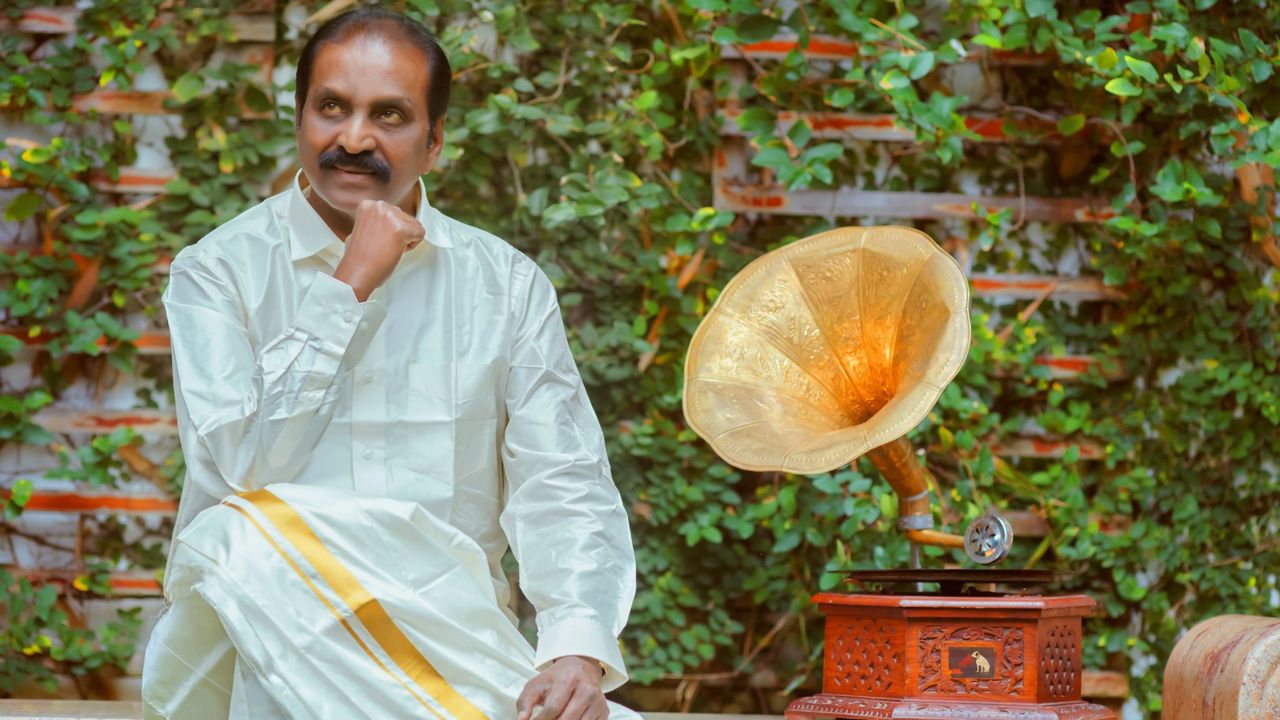
At a poetry festival held in 1975 at Pachaiyappa’s College in Chennai, the then Chief Minister M. Karunanidhi came and read poetry. At the same festival, a 23-year-old young man read his poems and said that from the age of 12, Karunanidhi had been his inspiration in poetry. Listening to those poems and the young man’s words, Karunanidhi was deeply impressed and suggested, “Why don’t you write for Kunkumam magazine?” From then on, a friendship developed between Karunanidhi and that young man. Whether Karunanidhi won or lost in politics, the friendship continued unchanged. Karunanidhi would even attend small programs for his sake. Out of the 37 books written by that young man, Karunanidhi himself released 18 of them. That young man is none other than Vairamuthu, who was selected for the Jnanpith Award, which is considered as the highest literary award in India. on Saturday. After C. Narayana Reddy, Vairamuthu is another writer who has received the Jnanpith Award as both a film lyricist and a literary figure.
The Jnanpith Award is India’s highest literary honour, often called the “Nobel Prize of Indian literature,” awarded annually for outstanding contributions to literature by Indian citizens. It includes a ₹11 lakh cash prize, a citation, and a bronze Saraswati idol. Vairamuthu was selected for the 2025 (59th) award, becoming the third Tamil writer honoured
Seventy-three-year-old Vairamuthu published his first poetry collection when he was just 19 years old. While he was still a student, that poetry collection became a textbook. Born in Mettur in Theni district, Vairamuthu, who belonged to the Kshatriya community, continued his education while doing agriculture. His poems express rural life, human relationships, the environment, and the dangers arising from globalization. Social problems such as poverty, a mother’s love, child marriages, and lack of freedom appear throughout his poetry. He says, “My poetry is the voice of those who remain silent.” Ancient Sangam literature has greatly influenced him. Blending ancient literary words with modern music is his specialty.
After reading Vairamuthu’s poems, Bharathiraja gave him the opportunity to write songs for films in 1980, when he was 27 years old. His first song was sung by S. P. Balasubrahmanyam. From then on, he never looked back. Over the past 46 years, he has written about 7,500 songs. Directors and composers such as K. Balachander, A. R. Rahman, Ilaiyaraaja, and Mani Ratnam made his songs resonate on people’s lips. Singers like S. P. Balasubrahmanyam, Shankar Mahadevan, K. S. Chithra, and P. Unnikrishnan gave melodic beauty to his poetry. The song “Chinna Chinna Aasai” that he wrote for the Tamil film Roja later became a hit in many languages including Telugu. Not only songs, he also wrote screenplays and dialogues. At the same time, he never stopped writing poetry.
Vairamuthu belonged to one of the 14 villages submerged because of the Vaigai dam; his novel Kallikkattu Ithikasam, which depicts the tears, blood, and suffering of the displaced people affected by modernization, received the Sahitya Akademi Award. Another novel, Karuvachi Kaviyam, about the life of a rural woman crushed by patriarchy, also became famous. Along with Padma Shri and Padma Bhushan, he has received many honors. As a lyricist, he has won the National Award seven times. Just as Viswanatha Satyanarayana is recognized as “Kavisamrat” in Telugu, Vairamuthu received the title “Kavisamrat” in Tamil. This title was presented when Atal Bihari Vajpayee was the Prime Minister.
No bird
builds a nest
and rents it out.
No animal
steals land
that it does not need.
O human, observe—
the life that lives together
without collapsing
still exists in the forest,
not in human society.
Through such lines, Vairamuthu feels that the forest and the animals living there are nobler than humans.
Even if you leave,
your shadow
still remains the same—
waiting
in the depths of my heart.
In these lines, Vairamuthu continues searching for the woman he loved.
I was like the distant sky;
with your scarf
you pulled me close.
How did you capture
the twenty-five years of my life
in a single moment?
He asks her.
If life suddenly falls apart,
where can I find her again?
In the east and the west
I search for her in vain.
Like a tiny drop of dew
she sits silently
upon a lonely blade of green grass.
As memories slip away
like rivers unseen,
the days themselves
melt away
in meaningless silence.
He writes that humanity cannot flourish in a society that does not respect womanhood.
Vairamuthu loves trees and nature deeply. He writes:
“A tree is a painting drawn by creation, an exclamation mark standing on the earth, branches—hands rising to touch the stars in the sky.”
And he says:
“Alas, human! If you truly want to become human, come to the tree! Within every human there is a Bodhi tree.”
In the poem Pilupu (“The Call”), a mother tells her child:
“Even if a star sleeps among the clouds,
even if the wind sleeps among the leaves,
my eyes will stay awake all night for you.”
Though Vairamuthu writes songs for films, he does not wait for them to appear in movies. He keeps writing continuously. They eventually flow into films as songs. In an interview he once said:
“I keep writing pallavis day and night. What I give is actually the eleventh pallavi. The first ten pallavis fall into the dustbin of my mind. I clean the dirt from gold before giving it to directors. I can feed today the hunger that will come in the future.”
I am privileged to be part of the Jnanpith jury panel led by noted writer Pratibha Ray, along with Madhav Kaushik, K. Srinivasa Rao, Damodar Mauzo, Prafulla Shiledar, Keshubhai Desai, and Janaki Prasad Sharma. Writers from across the country were considered for the award.. This time, many great writers from across the country were considered for the Jnanpith Award. However, in the last six decades, only two writers from Tamil Nadu—Akilan in 1975 and Jayakanthan in 2002—received this award. That means no writer from Tamil Nadu had received the Jnanpith in the past 24 years. Along with this consideration, Vairamuthu’s literary brilliance led to his selection.
“My father M. Karunanidhi would have embraced Vairamuthu and celebrated with joy if he were alive today. I now stand in his place,” announced M. K. Stalin.
Unfortunately, there have also been sexual harassment allegations made against Vairamuthu way back in 2018. There is no known criminal conviction or active police investigation. He has strongly denied these allegations and stated that they are false and motivated. He has said that if the allegations are true, those concerned can file a case and he is ready to face the court. Asking people not to judge him prematurely, he remarked that no one should decide whether he is a good or bad person until the court delivers its verdict, and that he will bow to the court’s decision.

 akrishnarao