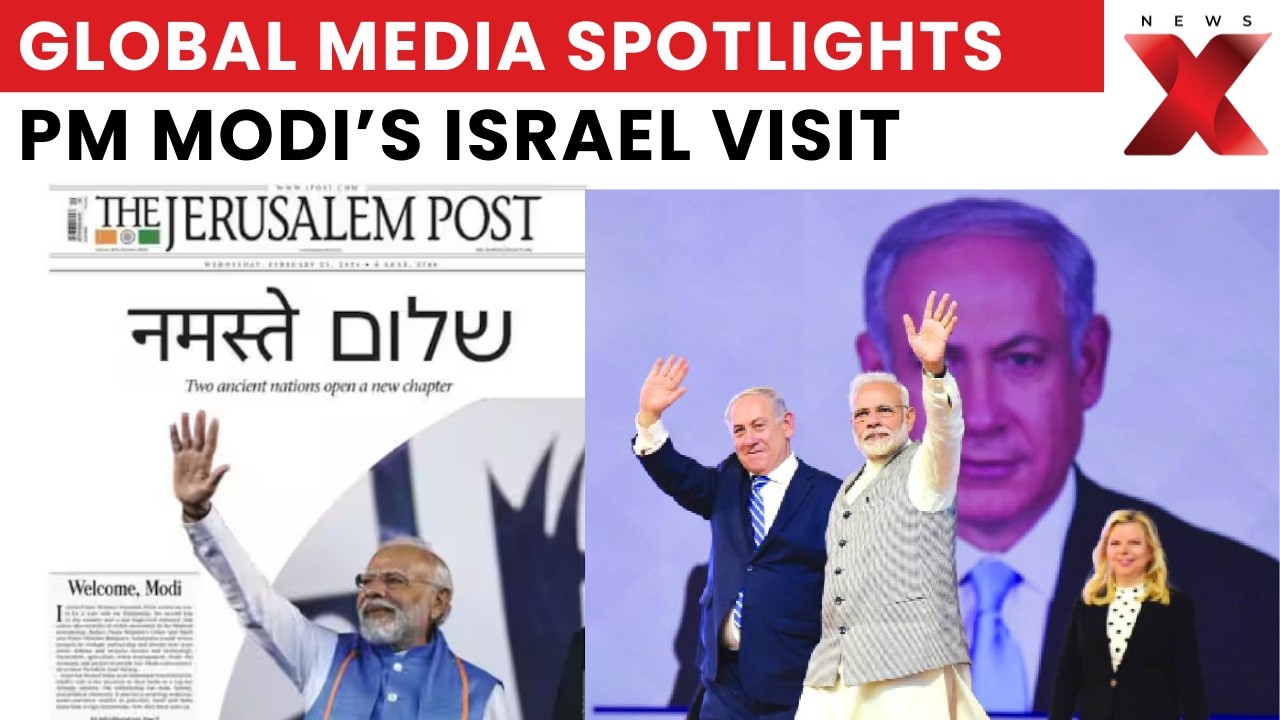
Prime Minister Narendra Modi’s 2026 visit to Israel marked more than a diplomatic engagement; it signalled a consolidation of India’s strategic recalibration in West Asia, where national interest, geopolitical ambition, and ideological comfort increasingly intersect. By addressing the Knesset and appearing publicly alongside Israeli Prime Minister Benjamin Netanyahu at a time of intense international scrutiny of Israel’s Gaza campaign, Modi underscored that New Delhi’s foreign policy today is anchored in security, technology, and strategic leverage rather than moral symbolism.
Convergence with US Strategy and Corridor Geopolitics
India’s growing closeness to Israel aligns in significant ways with broader United States regional objectives. Initiatives such as I2U2 and the India-Middle East-Europe Economic Corridor form part of a new connectivity architecture linking India, the Gulf, Israel, and Europe. These projects are widely viewed as alternatives to China’s Belt and Road Initiative and represent an effort to reconfigure trade and infrastructure flows across West Asia. For Washington, they reinforce a cooperative bloc of technology-driven partners; for India, they advance its ambition to become a central node in global manufacturing and logistics networks. The convergence reflects overlapping strategic incentives rather than simple alignment.
The corridor dimension is particularly transformative. If realised at scale, the India-Middle East-Europe Economic Corridor could recalibrate trade routes, reduce reliance on traditional chokepoints, bypass Pakistan, and position India centrally within emerging transcontinental supply chains. For Israel, integration into such a corridor strengthens its logistical and geopolitical role as a bridge between Europe and Asia.
Gaza, Terrorism, and Diplomatic Calibration
The Gaza conflict formed an unavoidable backdrop. Modi’s unequivocal condemnation of the October 7 Hamas attack during his speech at the Knesset was consistent with India’s long-standing zero-tolerance posture toward terrorism, shaped by its own security challenges. At the same time, he avoided strong public criticism of Israel’s ongoing military campaign. This calibrated messaging reflects India’s decision to prioritise counterterror solidarity and defence cooperation while maintaining rhetorical support for peace and a two-state solution.
By condemning Hamas in clear terms, New Delhi reinforced its own narrative against cross-border militancy while avoiding diplomatic friction with Israel at a moment of expanding strategic engagement.
Defence Cooperation and “Sudarshan Chakra”
Defence cooperation lies at the heart of this partnership. India’s conceptual push toward a multi-layered air defence architecture, often described under the banner of “Mission Sudarshan Chakra,” dovetails with Israeli systems such as Iron Dome, Iron Beam, and the Arrow missile defense system. These battle-tested technologies enhance India’s capacity to counter drones, rockets, cruise missiles, and ballistic threats from both Pakistan and China.
The cooperation extends beyond procurement to joint development, technology transfer, artificial intelligence integration, cybersecurity collaboration, and space research involving the Indian Space Research Organisation and the Israel Space Agency. For India, the gains are deterrence strength, technological acceleration, and progress toward defence self-reliance.
For Netanyahu, the optics of a major Asian power standing firmly beside Israel were invaluable. It demonstrated that Israel is not isolated and that influential emerging powers remain willing to deepen ties despite controversy. Modi’s visit offered a counter-narrative to claims of diplomatic marginalisation.
Ideological Optics and Domestic Political Resonance
Symbolism played a visible role in shaping domestic optics. Cultural gestures during the welcome ceremony, widely circulated across Israeli and Indian media, reinforced perceptions of ideological comfort between the two leaderships. The Rashtriya Swayamsevak Sangh (RSS), ideological parent of Modi’s Bharatiya Janata Party, has historically expressed admiration for aspects of Jewish nationalism, civilizational revival, and Israel’s security doctrine. The visit feeds into a broader narrative of civilizational confidence and muscular security policy that resonates strongly with the ruling party’s support base.
Has India Reversed Its Pro-Palestinian Position?
The central question remains whether India’s historically sympathetic stance toward Palestinians has been completely reversed. The answer is nuanced. India has not formally abandoned its support for a two-state solution, nor has it withdrawn diplomatic recognition of Palestine. It continues to reiterate its commitment to dialogue and peaceful resolution. However, what has changed is the priority structure. Palestine no longer defines India’s West Asia policy.
However, from a realist perspective, what New Delhi is practising is calibrated self-interest. The distinction between “calibrated pragmatism” and “calibrated self-interest” in India’s current Israel policy is less about contradiction and more about emphasis. In classical diplomatic language, pragmatism implies flexibility guided by national interest while maintaining normative commitments. Self-interest, by contrast, suggests a sharper prioritisation of material and political gains, even if that means diluting earlier moral positions. India’s present approach arguably contains elements of both.
Will This Shield Modi from Domestic Opposition?
A crucial dimension is whether this approach protects Modi’s political interests amid criticism from opposition parties. Critics argue that India’s visible proximity to Israel during a humanitarian crisis risks undermining its moral standing and alienating sections of India’s Muslim population. They frame the visit as a departure from India’s historical commitment to anti-colonial solidarity and Global South leadership.
However, in electoral terms, the strategic framing of the visit may blunt much of this criticism. By emphasising counterterrorism, national security, defence modernisation, and technological advancement, the government situates the Israel relationship within themes that enjoy broad public resonance. For a significant segment of the electorate, strong condemnation of Hamas aligns with India’s own security concerns, while high-technology defence agreements signal preparedness against external threats. In a political landscape where leadership perception and national security credentials carry substantial weight, imagery can outweigh normative debates for many voters. For now, the strategic and security narrative appears more electorally potent than moral critique.
Balancing Arab Relations
India’s relations with Arab states require careful management. The country relies heavily on Gulf nations for energy imports, trade, and remittances from its diaspora. Yet several Gulf governments themselves pursue pragmatic engagement with Israel within broader economic frameworks. Thus far, Arab governments appear to interpret India’s Israel engagement as strategic pragmatism rather than ideological hostility.
It is clear that India has moved beyond classical non-alignment toward selective alignment driven by sectoral advantage. Israel offers advanced defence technology, innovation ecosystems, and connectivity potential. In return, Israel gains market access, diplomatic legitimacy, and a powerful Asian partner at a moment of global contention.
India’s sympathy for Palestine has not disappeared, but it has been strategically recalibrated and deprioritised. Whether this recalibration fully insulates Modi from domestic criticism remains contingent on political developments, but in the present context, the alignment appears designed not only to advance strategic interests abroad but also to consolidate political capital at home.
 akrishnarao