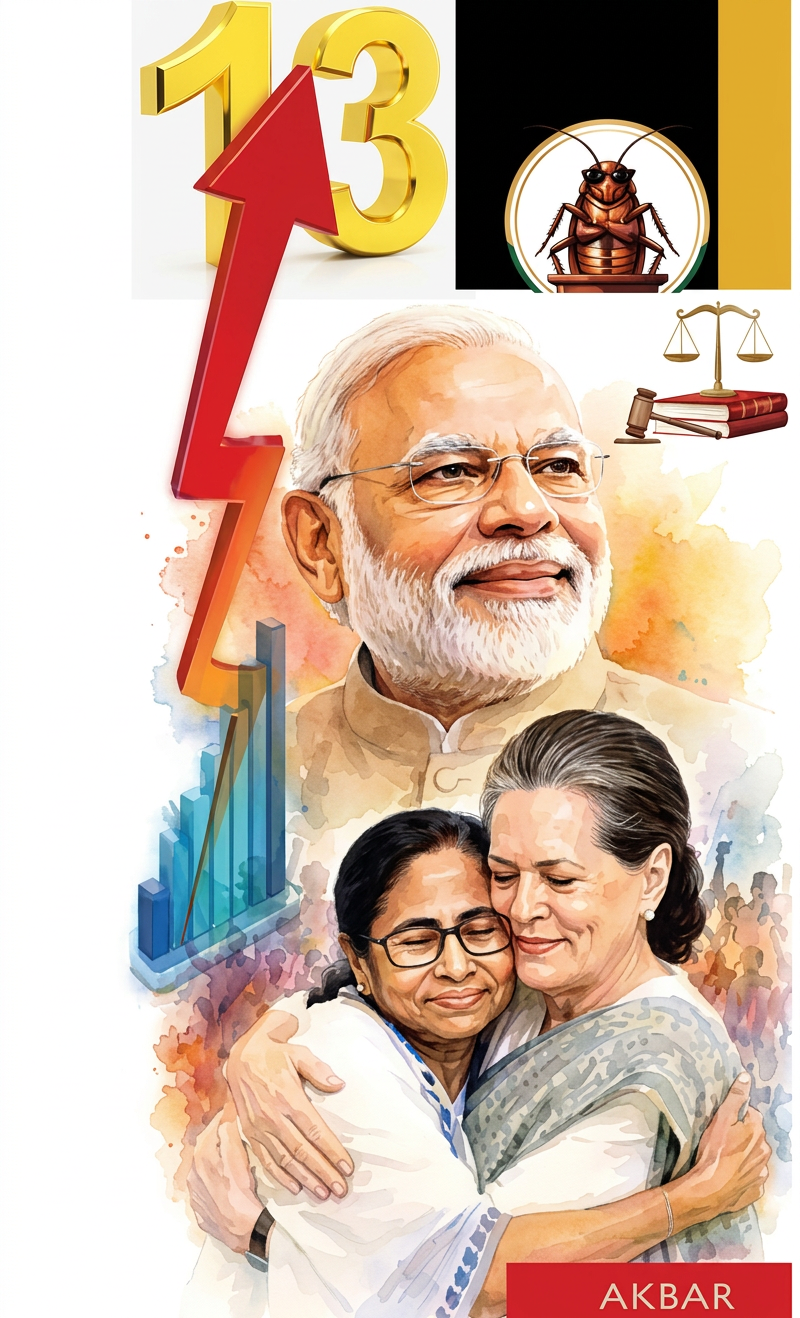
On Monday, at the INDIA alliance meeting held in Delhi, Trinamool Congress supremo Mamata Banerjee, who appeared with a faded face, was tightly embraced by former Congress president Sonia Gandhi. Who other than one woman can understand another woman’s heart? “Some scenes cannot be expressed in words,” remarked a senior leader.
These two were once described by international organizations as the most powerful leaders in the country. While Sonia ruled the country’s politics for more than ten years, Mamata Banerjee ruled Bengal politics for 15 years. But they are not unaware that the present circumstances are different.
After the results of the five state elections announced last month, anti-BJP forces met again in Delhi. Mamata Banerjee and the Left parties, forgetting that until yesterday they were also fighting Congress, have become ready to join hands with Congress at the national level. Mamata Banerjee also appears to have forgotten that Rahul Gandhi, the Leader of the Opposition in the Lok Sabha, had only recently criticized her harshly over her anarchic and corrupt rule. She also may not now remember that in 2021 she dreamed of the Prime Minister’s post and declared, “Congress has become ineffective in the country. I alone will play the key role at the national level.”
The tigress-like Mamata Banerjee, who rebelled against Congress in 1998 and launched her party by holding a rally in Kolkata while the AICC plenary session was taking place, now appears to have had her claws removed. Public representatives belonging to her party in both the Lok Sabha and the Assembly have declared rebellion against her. Her right-hand man Abhishek Banerjee, MP Kalyan Banerjee, and other party leaders are facing attacks on the streets. The same methods Mamata Banerjee once employed against her opponents are now being used against her by her rivals. While Mamata Banerjee and her followers are now crying in the wilderness on the streets of Kolkata, Congress leaders have become the ones standing by her. In this context, it appears that Mamata Banerjee has realized that Congress alone is her refuge if she is to face a mighty force like the BJP both in the state and in Delhi. Though Congress and the Left did not win many seats in the Bengal Assembly elections, they were able to damage the Trinamool considerably. In minority-dominated areas such as Murshidabad, Malda, and Uttar Dinajpur, the Congress–Left alliance ensured that Trinamool did not receive its traditional support. In 32 Assembly constituencies where Muslims constitute more than 50 percent of the population, Trinamool did not win even a single seat. In the Jangipur constituency, the Congress candidate secured 31,000 votes while the Trinamool candidate received only 10,542 votes. Likewise, in the Karandighi constituency, CPI(M) secured 39,000 votes, while the BJP candidate won with 20,000 votes. Perhaps the manner in which these results came has taught Mamata Banerjee lessons about her arrogance, authoritarian approach, and disregard for allies. That is why she is now seen on the streets of Delhi.
Likewise, for the Left parties, whose ground is slipping from beneath their feet in the country, the streets of Delhi have also become a refuge. In the 140-member Kerala Assembly, the Congress-led UDF winning more than 100 seats, the BJP winning three seats, and the defeat of most ministers in Pinarayi Vijayan’s cabinet cannot be ignored. Analysts described the Left alliance’s defeat there as the result of Pinarayi Vijayan’s centralized and arrogant governance, severe disappointment among farmers, youth, and ASHA workers, dissatisfaction among party cadres, and public resentment against ten years of rule. Congress leaders such as Rahul Gandhi and Revanth Reddy criticized Pinarayi Vijayan, alleging that he was colluding with the BJP and encouraging corrupt elements. They questioned why central agencies had not investigated Vijayan. Be that as it may, the Left parties, which have reached a situation where they are not in power anywhere in the country for the first time in five decades, have realized that they have no option except to work together with other anti-BJP forces. Left leaders D. Raja and John Brittas, who attended the INDIA alliance meeting, have that clarity.
The late CPI(M) General Secretary Sitaram Yechury, who passed away two years ago, understood the present situation in the country very well. When Congress inducted Prasenjit Bose, who had been expelled by CPI(M), Rahul Gandhi joked with Yechury, saying, “We have taken your comrade into our party.” Laughing, Yechury replied, “What is yours and ours? In this struggle, both of us are travelling in the same boat.” He had long ago understood the need for all anti-BJP forces to shed their narrow-mindedness and work together to confront the BJP, which was advancing unchecked across the country. Today, none of the parties in the NDA are fighting among themselves. But the parties in the INDIA alliance do not possess that level of unity. How much sincerity of purpose do the 23 parties that met at Delhi’s Constitution Club after nearly two years really have? What is the significance of the DMK and Aam Aadmi Party not attending? After the Emergency, in 1977, opposition parties contested against Congress under a single election symbol in the name of the Janata Party. How many parties today possess that same sincerity and fighting spirit? Can Congress provide leadership to other parties in the same way that the BJP has been able to guide even its allies along its ideological path?
Two days after the INDIA alliance meeting, Prime Minister Narendra Modi organized a meeting of NDA allies on the occasion of completing 12 years in power. Though nominally an NDA meeting, it is in reality a BJP meeting. Leaving aside small states like Nagaland, Meghalaya, and Puducherry, Andhra Pradesh is the largest state where NDA rule is currently in effect. Until recently, Janata Dal (United) chief Nitish Kumar was the Chief Minister in Bihar. Now, even there, a BJP leader is Chief Minister. With his entry into the Rajya Sabha, the 12 JD(U) MPs in the Lok Sabha will have to regard Modi as their leader. While Trinamool has 28 MPs in the Lok Sabha, 20 MPs under the leadership of party chief whip Kakoli Ghosh Dastidar have decided to write to Speaker Om Birla seeking recognition as a separate group after rebelling against Mamata Banerjee. At some auspicious moment, they too may have no option but to join the BJP and wear the saffron scarf as BJP MPs. That means the BJP effectively already has a full majority in the Lok Sabha even without the support of the Telugu Desam Party. Moreover, seven MPs from Shiv Sena, five from Lok Janshakti Party, two from Janata Dal (Secular), two from Rashtriya Lok Dal, one from the NCP Pawar group, two from Apna Dal and Hindustani Awam Morcha, along with six MPs from northeastern states, are already supporting the BJP. Since Modi came to power, the Bharatiya Janata Party has earned the distinction of splitting several regional parties such as Shiv Sena, NCP, Lok Janshakti Party, Rashtriya Lok Samata Party, Aam Aadmi Party, and Trinamool, and also attracting many leaders from other parties into its fold. Not only that, during Modi’s tenure, parties such as BSP, BJD, DMK, and AIADMK have faced tests of survival, making their future uncertain. A situation has arisen in the country where many regional parties feel that their survival will be difficult unless they surrender to Modi.
In this context, as Modi enters his 13th year in power today, no one can deny that his political strength is increasing day by day, despite social media commentary about how intense his politics may become, developments such as the “cockroach party,” the weakening of democratic institutions, allegations that the judiciary has surrendered, and the flood of criticism over the failure of institutions such as NEET and CBSE to conduct examinations properly. Without eliminating their internal contradictions and creating an equally compelling alternative vision, what change can opposition parties or other non-BJP forces achieve, no matter how many meetings they conduct?
 akrishnarao