Tag: West Bengal

  • “Beyond the Uproar: Elections Will Decide All”

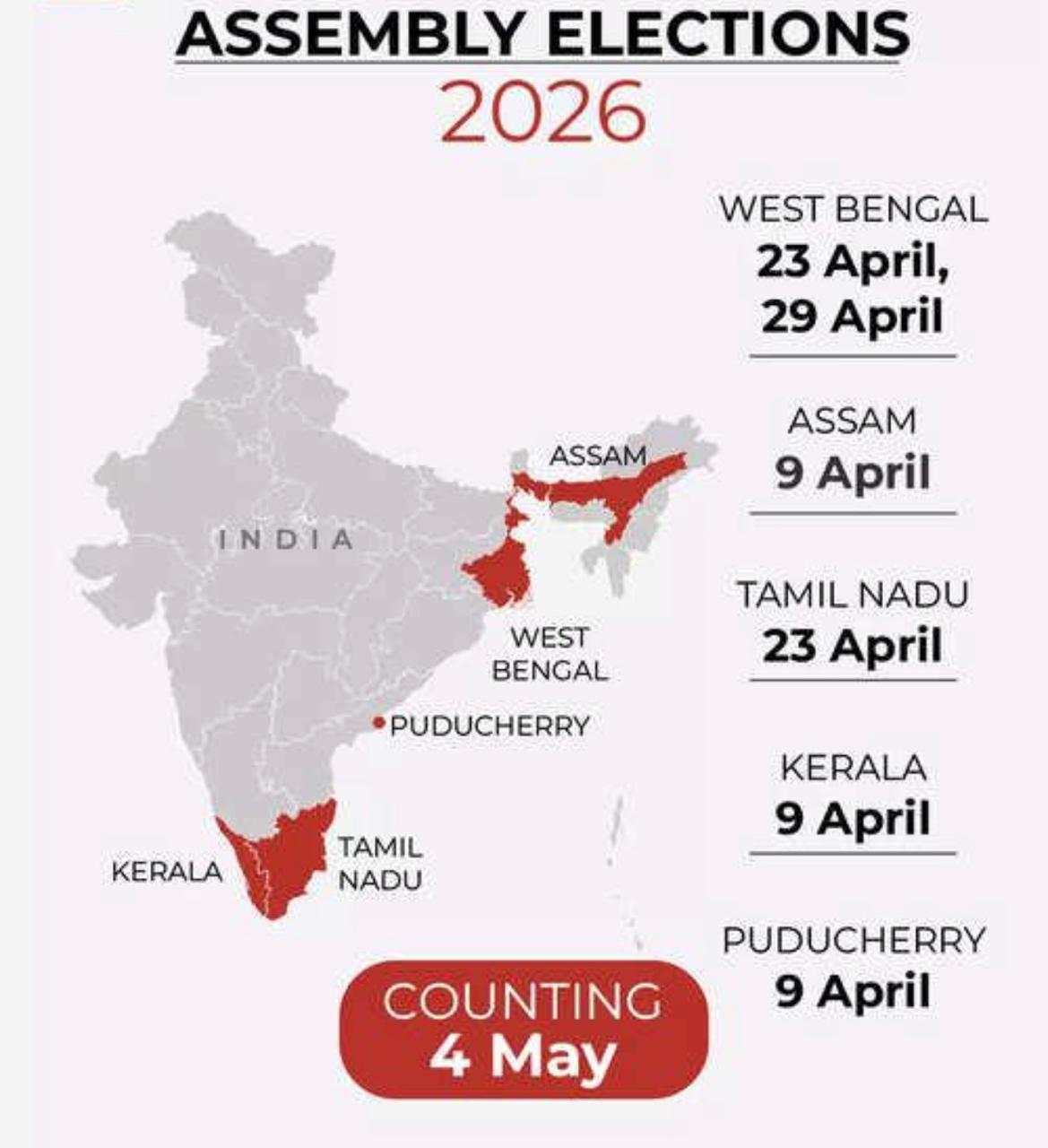
    Elections have been announced in a Union Territory. Now everyone’s attention is on the developments taking place in the election-bound states. For the past two days, parliamentary proceedings have been running smoothly. The government and the Speaker agreeing to lift the suspension of eight MPs who were suspended in previous sessions is an indication that some understanding has been reached between both sides. However, no matter how much uproar is created in Parliament, or how stubbornly the government behaves, ultimately both the ruling party and the opposition must prove their strength before the people, right? Unless public anger against the government erupts and is reflected in election results, there is no benefit in stalling Parliament. After Parliament discussed and rejected the no-confidence motion brought against him over two days, Speaker Om Birla, upon resuming his seat, remarked, “These two days of the House’s time have been wasted.”

    It is surprising that the opposition was not even ready for voting on the no-confidence motion they themselves introduced. Wouldn’t it have been better if a message had gone out that 233 opposition members in the House opposed Om Birla? Perhaps the opposition feared that it would give an impression to the public that they are not united. It is noteworthy that MPs from the Samajwadi Party and Trinamool Congress did not sign the no-confidence motion. Even so, adhering to opposition dharma, they spoke in favor of it. While a discussion was supposed to take place on the no-confidence motion against Om Birla, insisting on discussing West Asia and stalling the House suggests that Congress was not serious about its own motion and had its reasons. Yet, their opposition is directed more at Modi than at Birla, isn’t it?

    In fact, Parliament provides an excellent platform for the opposition to clearly present their views and attract public attention. In the past, leaders like Hiren Mukherjee, Indrajit Gupta, Piloo Mody, Atal Bihari Vajpayee, George Fernandes, Sushma Swaraj, Arun Jaitley, and Venkaiah Naidu made remarkable speeches while in opposition, which established them as national leaders. Compared to them, it must be said that Rahul Gandhi has not yet emerged as a powerful orator in Parliament. It cannot be said that Congress lacks good speakers, but since Rahul Gandhi is the Leader of the Opposition, politics revolves around him. He seems to have developed a style of creating commotion by bringing up topics like Nirav or Epstein just moments after beginning to speak. Perhaps he is missing the opportunity to present the same issues in a powerful, flowing speech that could captivate not only members but the entire nation. On the other hand, Priyanka Gandhi Vadra, though she has delivered only a few speeches so far, has made them widely discussed. After she challenged, “Make all your criticisms against Nehru at once… let’s discuss them,” the ruling party’s criticism of Nehru in Parliament subsided. During the debate on the no-confidence motion against Om Birla, Trinamool MP and 33-year-old actress Sayoni Ghosh spoke so effectively and exposed the BJP’s stance in a way that no one had expected.

    The fortune of the Bharatiya Janata Party, especially Prime Minister Narendra Modi, lies in the fact that the opposition has not only failed to stand strong in elections but is also not effectively using Parliament as a platform. Even though there are many issues to criticize Modi on, Congress’s attacks are not reaching the public strongly. Interestingly, even in states where the BJP is not very strong, there are intellectuals who argue that Modi is extremely powerful. For example, in Karnataka, Tamil Nadu, Kerala, Andhra Pradesh, and Telangana, the BJP is not very strong. Yet, if two people from these regions talk for ten minutes, Modi’s name repeatedly comes up in their conversation. There are more people overestimating Modi’s strength than perhaps necessary. It is said that a German leader once remarked, “Even criticizing me is a crime, and ignoring me is also a crime!” This situation is perhaps pushing Modi to consider simultaneous elections.

    Coming to the southern states, after losing in Karnataka in 2023, the BJP has not yet recovered and is struggling with internal conflicts. B. S. Yediyurappa has completed 50 years in politics but has made it clear that he is not ready to retire. Just as there is uncertainty at the national level about who will succeed Modi, in Karnataka too it is unclear who will lead after Yediyurappa. Even BJP leaders themselves cannot say whether the party will strengthen in Karnataka by the next elections. In Telangana, everyone knows the BJP is struggling to rise above the third position. In Kerala, which is heading into assembly elections, it is not easy to predict whether the BJP will increase its vote share or win even ten seats. In Tamil Nadu, the confusion within the BJP is evident from its own actions. Despite attempts to split the AIADMK or promote Annamalai, the BJP has not gained strength. Ultimately, it has had to ally again with the AIADMK and depend on the seats given by it, even resorting to moves like offering the Deputy Chief Minister post to actor Vijay, who is new to politics. No matter how much the BJP expands in northern India, the people of the southern states have not yet embraced it. It is leaders who are welcoming it with shawls, not the people!

    At the national level, the BJP’s strategy broadly includes consolidating Hindu votes, pursuing politics in the name of nationalism, and projecting Modi as a strong leader. However, in states like West Bengal, Assam, Tamil Nadu, Kerala, and Puducherry, where elections are being held, Hindutva politics is not as strong as in the north and west. A form of sub-nationalism exists in these states, similar to Andhra Pradesh and Telangana. Therefore, making BJP-style politics succeed in these states is a real test for the party and for Modi. The BJP knows that fighting regional parties is not as easy as fighting Congress. Moreover, in states where the BJP has won, even relatively unknown leaders have been accepted as Chief Ministers. But such a situation does not exist in the current election-bound states. When L. K. Advani was BJP president, strong leadership was built in every state, including leaders like Modi. Today, Modi does not have leaders at either the national or regional level who can stand beside him and draw public applause. This is both his strength and his weakness.

    In the southern states, apart from marginally increasing vote share and maintaining alliances, there is little the BJP can achieve. Winning West Bengal is a major challenge for Modi. Modi and Amit Shah are making every possible effort to defeat Mamata Banerjee this time. They are well aware that Hindutva politics alone cannot secure victory in Bengal. Efforts such as revising voter lists and allegedly removing over six million voters, replacing the governor with IPS officer R. N. Ravi, making administrative changes, conducting ED raids, and consolidating Hindu votes are all being undertaken. Addressing a rally at Kolkata’s Parade Ground a day before the election announcement, Modi expressed concern that Hindus might become a minority in Bengal. The BJP’s strength in Bengal is gradually increasing. However, Modi and Amit Shah failed to defeat Mamata Banerjee in 2016 and 2021. Now they are facing her for the third time. Although they could not defeat Arvind Kejriwal in Delhi in 2015 and 2020, they managed to secure victory in 2025 on the third attempt. Will they be able to repeat that success in Bengal this time? Can Bengal be compared with Delhi? In any case, past elections are one thing, and the upcoming elections are another. These elections can be seen as a trial by fire for the strategies Modi has pursued over the past twelve years. Will Modi be able to withstand the challenges emerging at both national and international levels, counter questions about his policies, and outmaneuver opposition strategies to stand tall like a formidable leader?
  • What does Nitish’s exit indicate?

    This is a story from two decades ago. In January 2006, an unprecedented Congress Party plenary was held at the Balayogi Auditorium in Hyderabad. Chief Minister Y. S. Rajasekhara Reddy and his associate K. V. P. Ramachandra Rao worked day and night to make the plenary a grand success. Congress president Sonia Gandhi was delighted after seeing the arrangements made in Hyderabad. After that, speculation arose that KVP would surely get a Rajya Sabha seat in the upcoming elections. When the time for selecting candidates approached, one day I asked AICC general secretary Digvijaya Singh, and he said that KVP had a good chance of getting the Rajya Sabha seat. I wrote that as a news report.

    The next day, when the media met Digvijaya Singh, a colleague asked him, “A report has come that KVP will be given a Rajya Sabha seat. Is he the one getting it?” Digvijaya Singh laughed and asked, “Who told you that? By the way, who is KVP?” Within a single day the mood of the Congress high command had changed. Some of YSR’s rivals in Delhi had told Sonia all sorts of things and changed her mind. In those days the Congress was in power in about 16 states. For every small matter YSR had to explain himself to Delhi. He had to wait another two years before his close confidant could get a Rajya Sabha seat.

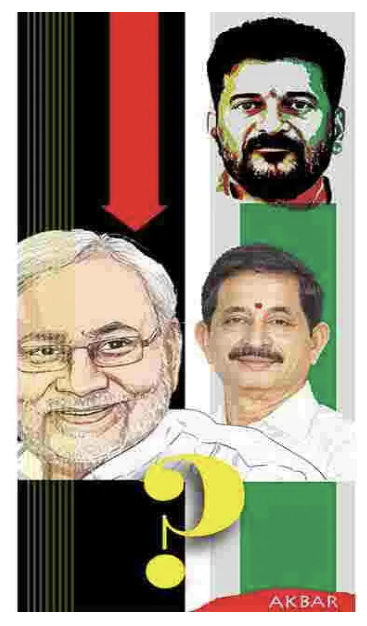
    Compared with YSR’s situation then, the present Telangana Chief Minister Revanth Reddy can be described as extremely powerful. YSR could not get a Rajya Sabha seat immediately for his right-hand man even after asking, but Revanth succeeded in securing one for Vem Narender Reddy. Though YSR had been a loyal Congress leader for decades, even when he wanted his brother Y. S. Vivekananda Reddy to resign so that his son Y. S. Jagan Mohan Reddy could get the Kadapa seat, the high command did not agree. It took YSR many years to win over the Congress leadership. After his death, the high command did not hesitate to file cases against his son.

    But what is the secret behind Revanth Reddy’s success? Within four years of joining the Congress he became PCC president, and within another four years he became Chief Minister. Not only in the Rajya Sabha seat issue but in many matters he has been able to make the high command accept his word.

    Just as the unanimous election of Vem Narender Reddy to the Rajya Sabha from Telangana carries political significance, the decision of Bihar Chief Minister Nitish Kumar to contest for the Rajya Sabha also has equal importance. One development reflects the changed culture of power within the Congress, while the other reflects the expanding political dominance of the Bharatiya Janata Party across the country.

    Even leaders within his party are still shocked that Nitish Kumar, who served as Chief Minister of Bihar for nearly two decades and played a key role in the NDA’s victories, gave up the post. In internal meetings of the Janata Dal (United), several leaders questioned his decision. Party workers vandalized the JD(U) office outside Nitish Kumar’s residence at 1 Anne Marg. They raised slogans saying unknown conspirators were behind his resignation. Until recently no one imagined that Nitish’s son Nishant would enter politics. Moreover, Nitish himself had strongly criticized dynastic politics on several occasions. Even though he says he is voluntarily going to the Rajya Sabha, anyone observing the present course of national politics understands that his resignation as Chief Minister was not a natural development.

    In fact, it is believed that the BJP had long been writing the script for Nitish to leave Patna and move to Delhi. Reports say that after Union Home Minister Amit Shah’s three-day tour of the Seemanchal region in the last week of February and his discussions with party leaders, the decision was finalized. Through intermediaries Nitish was reportedly told that he had no option but to step aside. The BJP, which has already consolidated its hold over the Hindi belt, has long been strategizing to completely capture Bihar as well. Many political observers believe that this development happened because the BJP has begun moving its pieces to ideologically take control of Bihar, thereby tightening its grip over power politics across northern India.

    With about 18 percent Muslims and a border with Bangladesh, it would not be surprising if the BJP wanted to turn Bihar into a laboratory for Hindutva and nationalism. Some have even described this development as a bloodless coup. The social forces unleashed in Bihar through Mandal politics had brought leaders like Lalu Prasad Yadav and Nitish Kumar—disciples of socialist leader Karpoori Thakur—to prominence. They had given a sense of dignity to backward classes and emerged as forces that could not be ignored.

    There is historical significance in the BJP coming to power in the same Bihar where Lalu Prasad Yadav had once stopped L. K. Advani’s Ram Rath Yatra. Analysts say that Nitish Kumar—who created the conditions that eventually allowed the BJP to come to power there—now giving up his position for the party could herald major political developments across the country.

    The Janata Dal, which emerged in 1988 under the leadership of V. P. Singh against the Congress, has a long history. In 1989 it played a key role in the National Front government in which the Telugu Desam Party was a partner. In 1991 it emerged as the third largest party. In the United Front government that came to power in Delhi after P. V. Narasimha Rao, the Janata Dal was again a crucial participant. Later it split into several factions but survived in the form of parties such as Biju Janata Dal in Odisha, Janata Dal (Secular) in Karnataka, Rashtriya Janata Dal in Bihar, and Janata Dal (United).

    But now, with JD(U) handing over power in Bihar to the BJP, political observers believe this marks the final chapter in the history of the Janata Dal. The political strategies used by the BJP to weaken Janata Dal factions in Odisha and Karnataka are already recorded in history. Lalu Prasad Yadav, who was once part of the old Janata Dal, has retired from active politics after getting entangled in corruption cases. Ram Vilas Paswan has passed away. The final phase of the Janata Dal (United) under Nitish’s leadership has now begun.

    The Bihar elections held last year were fought entirely under Nitish’s leadership. Though the BJP initially hesitated to project him as the chief ministerial candidate, it later had to compromise. They entered the election with the slogan “Pachchis se Tees (from 2025 to 2030), once again Nitish.” Yet, even with four years remaining in the term, Nitish’s rule has ended within just four months. Amit Shah himself stood beside him when he filed his nomination for the Rajya Sabha.

    In fact, though the BJP won more seats than JD(U) in both the 2020 and 2025 elections, it continued to keep Nitish as Chief Minister out of political necessity. If it has now decided to assume power itself, it means Nitish must have been completely neutralized. His attempts to touch Narendra Modi’s feet during the NDA meeting in 2024 and again at the Patna airport after his swearing-in are cited as examples. His ill health also added to his weakness.

    Nitish Kumar, who broke away from Lalu Prasad and built his own party, is not an ordinary politician. In the early days he conducted “Janata Darbars” and personally resolved people’s grievances. Brick by brick he brought extremely backward non-Yadav groups closer to him. He earned the title “Sushasan Babu.” He also gained strong support from women. During his 20-year rule he brought at least some change to Bihar. Although in the last elections the JD(U) won only four seats fewer than the BJP, the latter seems to have gained confidence that it can take control of the party and run politics in Bihar on its own, and also attract all the social groups that Nitish had mobilized.

    After the NDA’s victory in Maharashtra in 2024, the BJP sidelined Eknath Shinde, the leader of the Shiv Sena breakaway faction who had been Chief Minister until then, and installed its own leader as Chief Minister. Though a similar formula was applied in Bihar, Nitish Kumar was allowed to continue as Chief Minister for four months. In the BJP, touching feet or excessive praise does not change the party’s assessment of individuals.

    Above all, the BJP’s determination to establish a two-party system in the country has now materialized in Bihar. Just as the BJP is confronting the Samajwadi Party in Uttar Pradesh and the Trinamool Congress in West Bengal, it is moving in the same direction across the country. Preparing for the simultaneous elections expected in 2029 in a presidential-style contest, Narendra Modi is positioning himself as an unbeatable leader on one side.

    But whom are the opposition parties preparing to face him? And in this battle, what will be the future of other regional party leaders?