BJP’s Delayed Response to the Opposition’s Vote Theft Allegations
“We must counter the opposition’s misinformation campaign over vote theft. We should organize press conferences, padayatras (foot marches), and meetings with prominent personalities, intellectuals, youth and students,” Union Home Minister Amit Shah reportedly said two days ago at a meeting with key BJP leaders.
The fact that BJP’s top leaders took so long to mobilize the party nationwide, even after the opposition had been staging street protests against the Election Commission for several days, suggests that the Centre considerably delayed assessing the seriousness of the issue. The BJP may succeed in suppressing the protests organized by the Cockroach Janata Party, sending its members to jail and intimidating them. It may also impose restrictions on protests and criticism from being circulated on social media. But silencing political parties is not that easy. The authorities may issue orders prohibiting protests at Jantar Mantar, but, just as a flowing stream finds its own course, protests too will find their own way.
Barely had the Navratri festivities ended when the Congress, as though unwilling to delay any further, made arrangements for a massive rally at Ramlila Maidan on November 1. Lakhs of Congress workers from across the country are expected to descend on Delhi. Meanwhile, various groups are continuing their demonstrations against the Election Commission not only in different states but also in several countries. Educated people and young people in the United States, Canada, England, Ireland, Germany, Spain, the Netherlands, the Czech Republic and Australia are also staging protests demanding the resignation of Chief Election Commissioner Gyanesh Kumar. In these circumstances, it is difficult to say how successful BJP leaders will be in convincing the public that no vote theft has taken place.
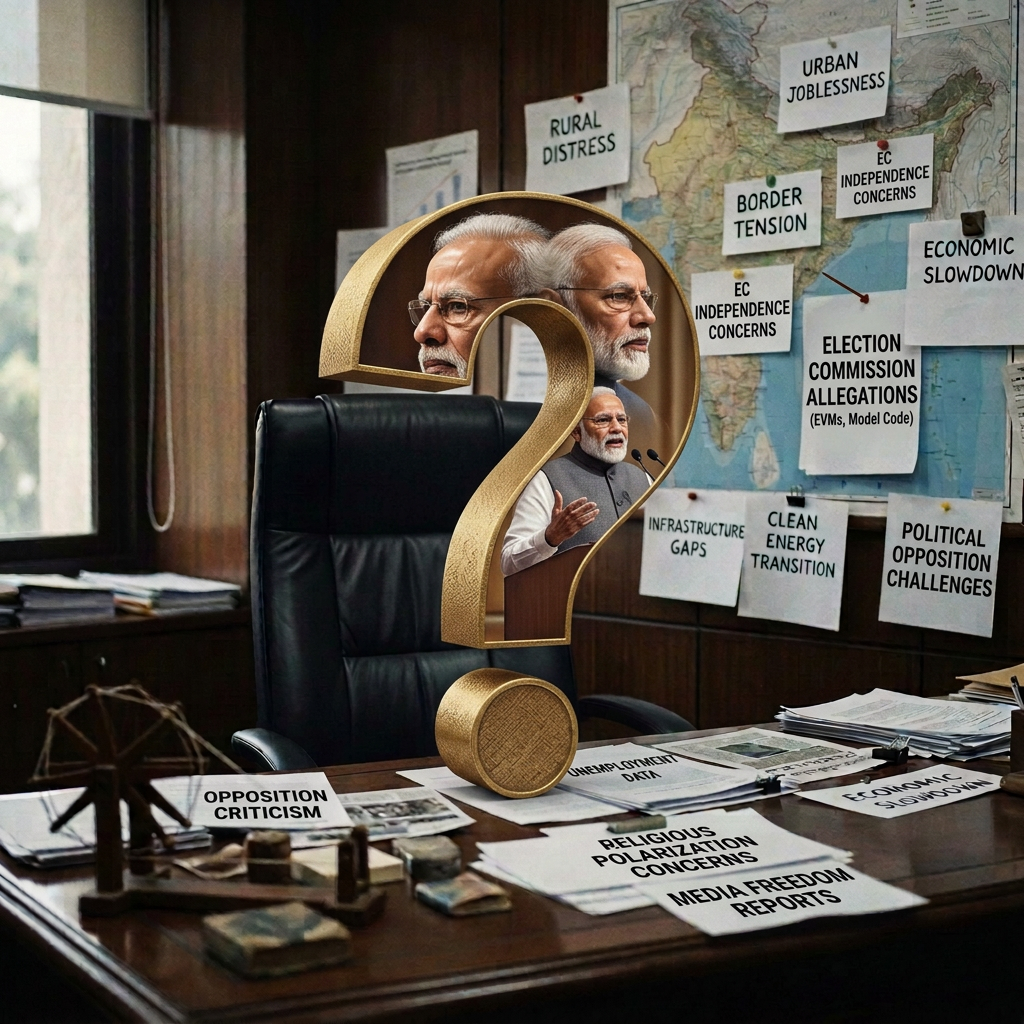
Problems are not always something people deliberately bring upon themselves. Sometimes excessive confidence, complacency and overdependence on others can lead to a failure to take the right decisions at the right time, thereby creating problems. Apart from such self-inflicted mistakes, circumstances beyond our control can also create difficulties. Even Prime Minister Narendra Modi, who was once considered an invincible force, is now facing challenges not only in governance and within his party but also on the international front. The problems Modi faces and the allegations levelled against him are not merely matters of his personal reputation; they also have implications for the country’s reputation.
What does the opposition have to lose? It will do everything necessary to return to power. It will magnify problems and create a major controversy whenever it finds an opportunity. The BJP did exactly the same in the past. Just as the Congress is now protesting against the Election Commission, alleging that it is helping the BJP win elections, the BJP too had earlier accused the Congress of electoral malpractice.
In particular, between 2009 and 2011, when the BJP was in opposition, it launched an intense political campaign questioning the credibility of Electronic Voting Machines (EVMs). During the 2009 election campaign, BJP leader Lal Krishna Advani raised several questions about the reliability of EVMs. He argued that Germany and the United States were not using them either. In 2010, former Rajya Sabha member GVL Narasimha Rao even wrote a book titled Democracy at Risk, with Advani writing its foreword. The BJP held numerous press conferences demanding the reintroduction of ballot papers. It repeatedly sent delegations to the Election Commission and submitted representations to the President as well.
When Naveen Chawla, who had been accused of several excesses during the Emergency, was appointed an Election Commissioner, the BJP launched an aggressive campaign against his appointment. Yet the Congress ignored its objections and subsequently promoted him to the position of Chief Election Commissioner. The BJP then strongly demanded that the government should not have complete authority over the appointment of Election Commissioners. It wanted the Prime Minister, the Chief Justice of India and the Leader of the Opposition to be included in the committee responsible for appointing them. Advani wrote extensively about the issue on his blog.
Ironically, after coming to power, the BJP defended the very EVMs it had vehemently criticized. It also ensured that the Chief Justice of India was excluded from the committee responsible for appointing Election Commissioners.
Today, history is repeating itself. The Congress is making the same allegations against the Election Commission that the BJP had made earlier, only more aggressively. When the BJP approached the Supreme Court demanding the removal of Naveen Chawla, the Congress has now approached the courts seeking to send Gyanesh Kumar home. However, the protests being organized today by the Congress, other political parties and young people, particularly under the banner of the Cockroach Janata Party, against the large-scale deletion of voters under the SIR process were not witnessed on the same scale back then.
The BJP’s top leadership did not become active until the campaign alleging that the party was winning elections through electoral manipulation gained momentum and became the principal weapon of the opposition and other forces opposed to it.
Prime Minister Narendra Modi is now facing not only the opposition’s protests over alleged electoral irregularities but also a range of other developments that are creating political difficulties. The favourable circumstances that existed when he came to power in 2014 are gradually diminishing. Much like the law of diminishing marginal utility in economics, Modi appears to be facing the danger of diminishing political returns.
The contradictions between India’s aspiration for strategic autonomy and the pressures exerted by countries such as the United States and China, which are competing for geopolitical influence and economic and technological dominance, are becoming increasingly evident. Growing tensions between nationalism and democratic dissent, as well as the widening gap between economic development and people’s aspirations and the needs of the youth, are exposing the deeper vulnerabilities of Indian politics.
Politically, too, everything does not appear to be going smoothly for the BJP under the leadership of Modi and Amit Shah.
Although special parliamentary sessions were held last April, the government failed to secure the majority required to pass the delimitation and women’s reservation bills. The monsoon session of Parliament was virtually washed out amid the opposition’s uproar over the NEET paper leak controversy and the theft at the Ram temple in Ayodhya.
Although the monsoon session was not prorogued with the intention of holding special sessions before the winter session, which was scheduled to begin in the last week of November, the government has so far been unable to convene them.
Recently, reports emerged that two Election Commissioners had differences over the SIR process, prompting the Congress and other groups to take to the streets. For the past six months, there have been reports that Modi would reshuffle his Cabinet and fill several vacancies. However, it appears that he has been unable to move forward because of various difficulties and opposition.
Political observers are now closely watching what the Modi government can do not only to counter the opposition’s criticism of the SIR process, introduce the bills it has planned in Parliament and carry out the changes it intends to make in the government, but also to turn public opinion in its favour.
Keeping institutions under one’s control indefinitely and continuing in power through the strength of the government is not a healthy sign in politics.
The five state elections scheduled for February–March next year are extremely crucial for the BJP. In four of these states—Uttarakhand, Manipur, Goa and Punjab—the BJP does not appear to be in a favourable position.
In Uttar Pradesh, the BJP won 255 of the 403 seats in 2022. Of these, it won 23 seats by margins of less than 5,000 votes, three seats by less than 3,000 votes, 11 seats by less than 2,000 votes and another 11 seats by less than 1,000 votes. In seven constituencies, its victory margin was less than 500 votes.
Without these 55 seats, the BJP would not have secured a majority. Moreover, the Samajwadi Party and the Congress did not contest the 2022 elections together.
In the 2024 Lok Sabha elections, the BJP’s strength in Uttar Pradesh fell from 62 seats to 33. The Samajwadi Party and the Congress established their dominance in 223 Assembly segments across the state.
While the law-and-order situation and Yogi Adityanath’s personal integrity are considered favourable factors for him in Uttar Pradesh, there are not many aspects of his administration that deserve high marks. Newspaper reports indicate that corruption is rampant at the grassroots level, with the collapse of bridges built at a cost of thousands of crores of rupees being cited as evidence of this corruption.
The criticism surrounding the theft of donations in Ayodhya and the active participation of several young people from Uttar Pradesh in the Gen Z protests are indicators of changing political circumstances.
Adding to these developments are the political differences between Delhi and Lucknow. There is also discussion within party circles about the apparent reluctance of the BJP’s top leadership to see Yogi Adityanath continue as Chief Minister.
Standing firm against international pressures and dealing with the growing problems confronting the country, both within and outside its borders, has become an uphill task for Modi at this juncture—a veritable tightrope walk.

