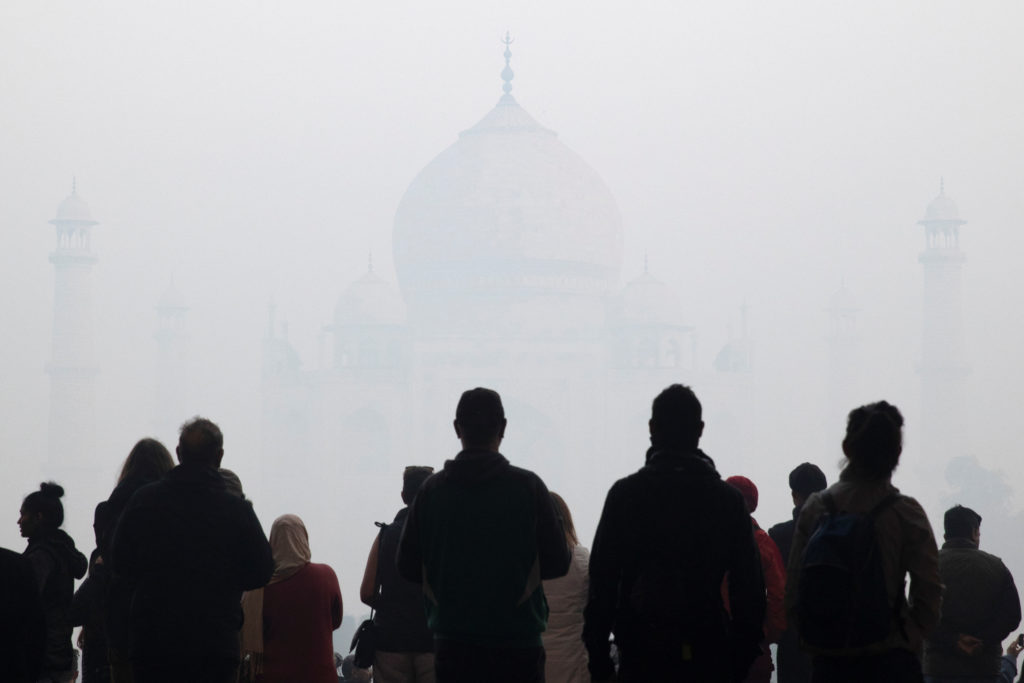
Air pollution has engulfed India’s national capital. What were once winter mornings marked by dew on leaves are now defined by thick smog. At daybreak, a chemical sting in the eyes and persistent coughing have become routine. Although the Air Quality Index (AQI), which exceeded 300 during November and December, may have declined to around 260 by the end of January, daily life in Delhi remains severely affected.
Beyond the toxic air outside Parliament, the atmosphere within appears no less suffocating. In both Houses, heated confrontations between the ruling party and the opposition have created a climate of near-constant disruption. Prime Minister Narendra Modi did not attend the Lok Sabha to respond to the debate on the motion thanking the President for her address, but he did speak in the Rajya Sabha, launching familiar attacks on the Congress. As he has often done, Modi traced the party’s alleged failures back to the Indira Gandhi era, accused the opposition of seeking his political demise, and charged it with disrespecting Dalits and Sikhs. The speech bore a closer resemblance to an election rally than a parliamentary response. Few leaders in India match Modi’s effectiveness as a political orator—a point even his critics concede.
The government has attempted to sidestep discussion of a book written by former Army Chief General Manoj Naravane, but the opposition appears determined to keep the issue alive. The debate on the President’s address ended amid disorder, and there are signs that the upcoming Budget discussion may face similar disruptions. Meanwhile, Commerce Minister Piyush Goyal has said an India–US trade agreement could be finalized within days. Whether India has made significant concessions will only become clear once the details are released. Politically, the agreement represents another test for Modi, even as his opponents watch closely for potential revelations from the so-called Epstein files.
At the World Economic Forum, IMF Chief Economist Gita Gopinath underscored a more fundamental challenge. She said air pollution poses a far greater threat to India’s economy than US tariffs on Indian goods. Gopinath noted that air pollution causes an estimated 1.7 million deaths annually and discourages foreign investment. She warned that the resulting health costs, premature deaths, and productivity losses could reduce India’s GDP by as much as 9.5 percent. India’s Commerce Minister Ashwini Vaishnaw, who was present at the forum, offered no public response.
These concerns are echoed within India’s own policy establishment. The National Institute of Public Finance and Policy (NIPFP) has described air pollution as a failure of government policy and an ongoing public health emergency. Economist Lekha Chakraborty has pointed to rising cases of severe respiratory illness in public hospitals, increasing health expenditures, and declining labor force participation—all of which weigh on economic growth. Air pollution, she argues, is not an unavoidable risk but a solvable problem. Yet it continues to reflect governance shortcomings. Despite India’s claims of leadership in environmental economic federalism, implementation remains weak.
China’s experience offers a contrast. Both India and China enacted environmental laws around 2000, but China followed up with sustained, long-term action. It invested heavily in pollution-control technologies, shut down thousands of obsolete and highly polluting industrial units, and aggressively promoted electric vehicles. China’s progress demonstrates what political will and consistent policy execution can achieve.
India today faces two parallel forms of pollution—one in its air, and the other in its politics. Leaders appear more invested in applause, spectacle, and rhetoric than in effective governance that delivers tangible improvements to citizens’ lives.
 akrishnarao