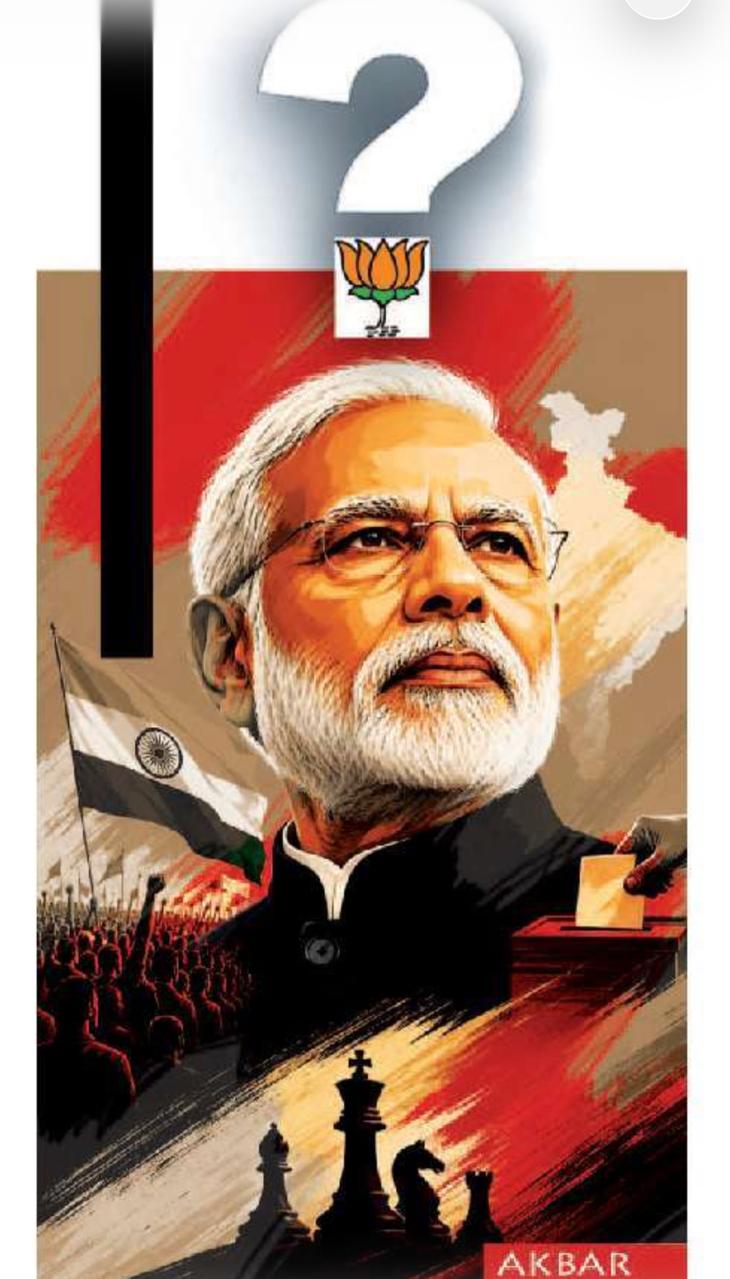
A few days ago, Prime Minister Narendra Modi remarked that “the Congress is a parasite; it survives by depending on other parties and abandons them once its needs are fulfilled.” He may have made this comment keeping in mind the Congress party’s decision in Tamil Nadu to distance itself from the DMK and join hands with actor Vijay’s TVK. However, judging by the developments of the past few days, it has become impossible to predict how many parties will remain in the INDIA alliance or how many parties will remain in the National Democratic Alliance led by Modi by the time of the 2029 elections. Several regional parties are facing an existential test and must decide their future course, though they do not have much time to do so.
In this context, the question arises: will the next general election witness a direct contest between the BJP and the Congress? The Congress does not appear particularly worried about regional parties splitting or aligning with the BJP. In fact, many regional parties have occupied the political space that once belonged to the Congress. The Congress also does not seem to be taking very seriously the BJP’s war-footing strategies to increase its strength in both Houses of Parliament. It appears that the Congress is moving with the objective of confronting the BJP directly by 2029. In particular, the party seems to be focusing on how to mobilize the youth.
The Congress rarely appears to work according to a clear and consistent agenda. Until recently, it focused on caste census, social justice, and reservations. Now, observing growing unrest among the youth, it has begun efforts to attract them. It organized a massive rally titled “Chhatron Ki Goonj” in Kota, Rajasthan, where Rahul Gandhi addressed thousands of young men and women. The growing influence of the “Cockroach Janata Party” may also have strengthened Rahul Gandhi’s resolve to appeal to young voters. Several studies after the 2024 Lok Sabha elections indicated that in many states, women, youth, and especially first-time voters favored the BJP. Will this situation change by 2029? Can the Congress regain its lost support among youth and women? This question is crucial to the party’s future.
At the same time, the BJP’s intensive efforts to increase its strength in both the Lok Sabha and Rajya Sabha and to bring many parties to its side cannot be dismissed lightly. According to an RSS leader, the Hindutva agenda remains the BJP’s highest priority. Only by remaining in power not just in 2029 but for several more decades can that agenda be fully implemented. As part of this objective, the BJP has focused on many regional parties across the country. It is rapidly moving to absorb parties such as JD(U), Trinamool Congress, Shiv Sena, and NCP. In Tamil Nadu, the DMK; in Jharkhand, the JMM; in Telangana, the BRS; and in Delhi, the AAP are now facing a difficult test of deciding their future direction. The BJP’s strategy is to bring various parties to its side through persuasion or pressure in order to fulfill its broader agenda.
To ensure that the 2024 election results are not repeated in 2029 and that it does not again face the risk of losing its majority, the BJP is taking rapid measures. Delimitation and women’s reservation are among the most important of these. It hardly needs to be said that the Modi government’s approach to constituency delimitation would be favorable to the BJP. The party appears determined to ensure that neither the Congress nor regional parties outside the NDA gain significant advantage from the exercise. The BJP is attempting to secure more seats in Uttar Pradesh, Maharashtra, and West Bengal, where it fell short of expectations in the last elections, and to gain additional seats in Bihar, Jharkhand, Haryana, Rajasthan, and other states through changes in geographical and demographic arrangements.
The consequences of delimitation in Assam and Jammu and Kashmir are already known. In Assam, Muslim-majority constituencies in Lower Assam and the Barak Valley were divided, and the fragmented areas were merged with constituencies dominated by local populations. This caused severe damage to the Congress and the AIUDF. The increase in seats reserved for Scheduled Tribes and Scheduled Castes benefited the BJP’s regional allies. Similarly, in Jammu and Kashmir, the number of Hindu-majority seats in Jammu increased relative to Muslim-majority seats in the Kashmir Valley. Furthermore, increasing the number of seats helps counter anti-incumbency against sitting legislators. By allocating newly created seats to youth, women, and newcomers, the BJP aims to maximize its majority.
It is difficult to determine to what extent the Congress understands the BJP’s comprehensive strategies. The Congress campaign against the BJP remains largely centered on Narendra Modi. Instead of preparing itself ideologically to confront the growing influence of the RSS across the country, it raises unproductive debates such as whether the organization possesses formal registration. This creates doubts about whether the Congress truly understands the BJP’s strategies.
Out of India’s 4,123 Assembly seats, the Congress holds only 662. The party failed to win even a single Assembly seat in five states. In states such as Uttar Pradesh, Bihar, Gujarat, and Odisha, it won less than ten percent of the seats. In the 2024 general elections, the BJP and the Congress directly contested 286 constituencies; the BJP won 180 and the Congress 83. Gaurav Gogoi, who serves as Deputy Leader in the Lok Sabha and PCC president, recently suffered a crushing defeat in the Assam Assembly elections. Another Lok Sabha member and two-time Chief Minister, V. Vaithilingam, the Puducherry PCC president, even lost his deposit in the previous Assembly elections.
Why is the Congress unable to convert anti-incumbency sentiment into political gains? Until it answers this question, no number of rallies or dramatic displays will strengthen the party. Regional parties face the same problem, and many of them are also splitting. Rather than merely blaming the BJP, the leaders of these parties must honestly examine why these divisions are occurring and why people are turning against them. What is the present condition of the Left parties, which were once strong ideological forces?
The reality is that regional strongholds based solely on a single leader’s charisma or caste equations are collapsing rapidly. It is becoming clear that political ambitions unsupported by ideology cannot succeed indefinitely. This explains why the futures of Mamata Banerjee, Sharad Pawar, Uddhav Thackeray, Arvind Kejriwal, K. Chandrashekar Rao, Naveen Patnaik, and Jagan Mohan Reddy appear uncertain. None of the regional giants currently enjoys overwhelming influence. The conduct of successors in some parties also appears unpromising. As one analyst observed, these are not ordinary developments but indications of deep structural changes taking place within India’s political system.
Although the BJP revolves around Modi, it is not a Modi-dependent party. Numerous powerful forces behind the BJP ensure that its strategies, expansion, and actions align with long-term objectives. Both the RSS and the BJP understand that Modi is merely an important instrument in achieving these goals.
The same cannot be said about the Congress. Under its dynastic leadership, there is little evidence that Rahul Gandhi is attempting to build a strong organizational and ideological structure that extends to every village and transforms the Congress into an overwhelmingly popular mass party. It has been demonstrated repeatedly that power cannot be attained merely through the opponent’s weaknesses, mistakes, or anti-incumbency.
There is little reason to fear that India’s political system is collapsing. In reality, it is undergoing a phase of reorganization. As regional voices weaken, it is increasingly evident that future elections may witness a principal contest between two national poles. Regional forces struggling for survival may inevitably gravitate toward one of these poles. Delimitation and the absorption of regional forces may naturally increase the Congress’s seat tally to some extent. However, if it wishes to create a political wave and capture power, politics must once again be shaped by influential national ideologies rather than individual leaders.
 akrishnarao