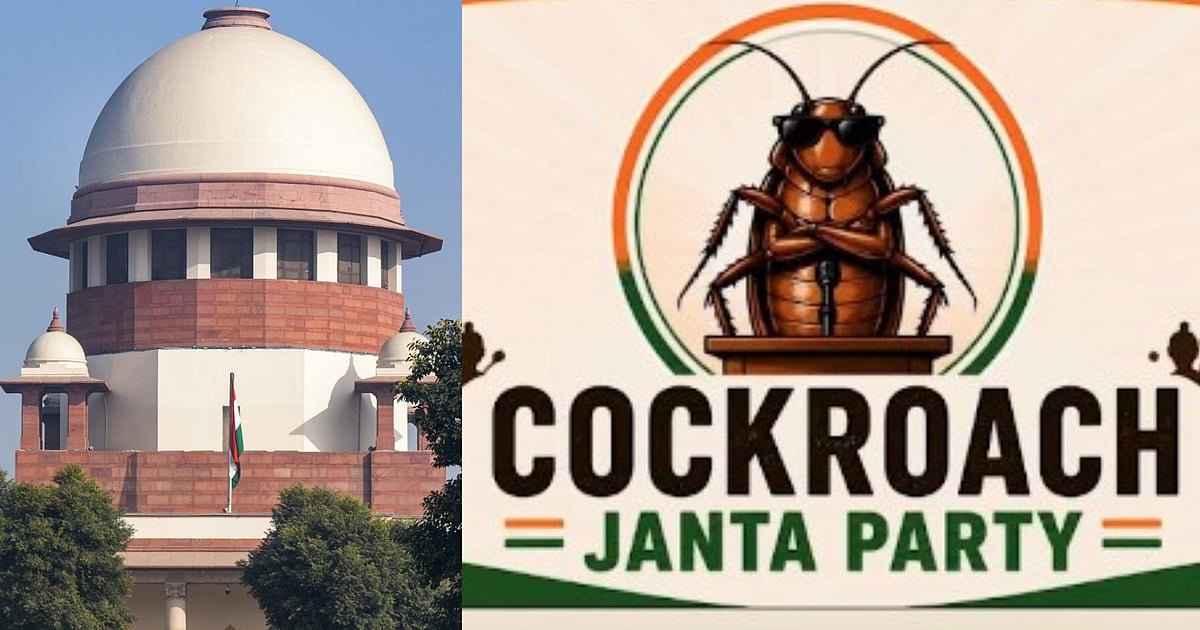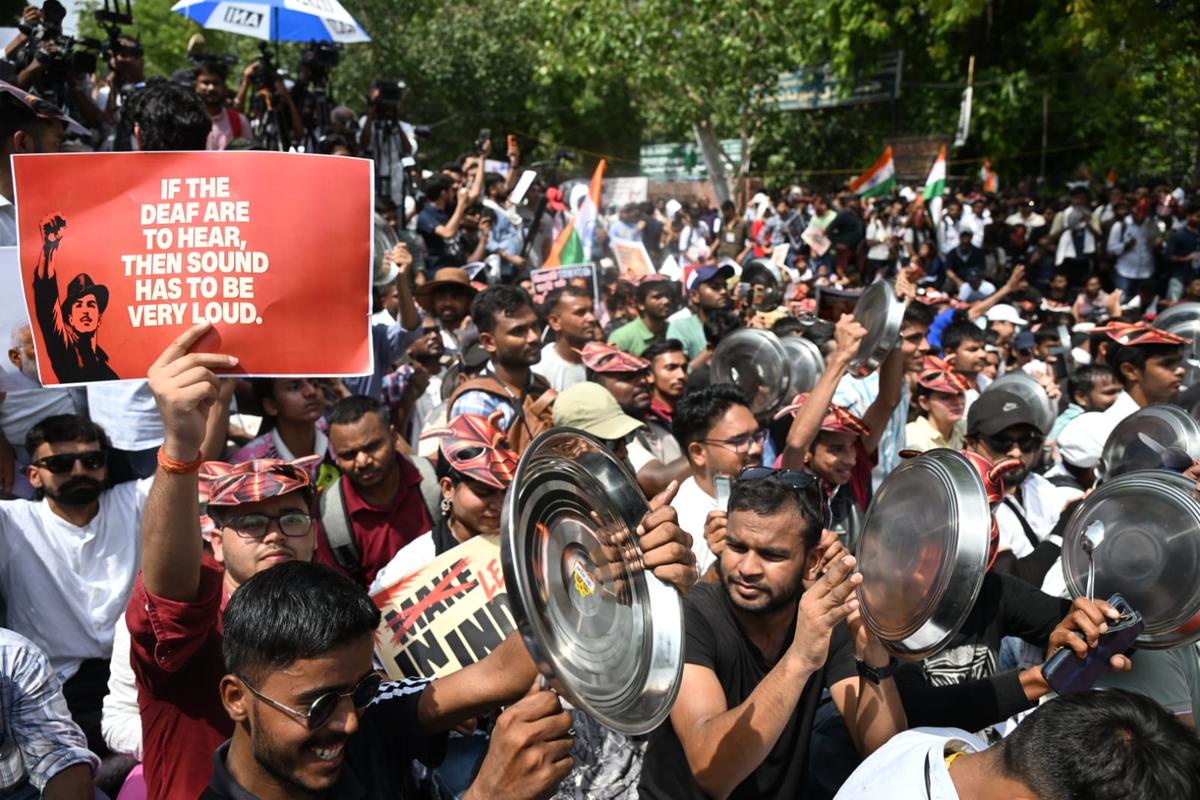
“A small body of determined spirits fired by an unquenchable faith in their mission can alter the course of history,” said Mahatma Gandhi. India now seems to be moving toward an indefinable change. The siege of Parliament on the first day of the Monsoon Session in the national capital on Monday by activists of the Cockroach Janata Party (CJP)—who have been protesting for a month demanding the resignation of Union Education Minister Dharmendra Pradhan, holding him responsible for the NEET question paper leak—must be called a monumental development in recent times. Despite setting up four-tier barricades, deploying large-scale forces of the Rapid Action Force, CRPF, Delhi, and Tripura Police, closing metro stations, and shutting down the internet, the Cockroach army, thousands strong, charged up to the gates of Parliament. Even as the police beat them severely, the young men and women displayed sheer daring. The young people lying with injuries at Ram Manohar Lohia Hospital are direct witnesses to Monday’s brutality.
It is clear that the Modi government, which remained unmoved despite a decade of attacks and criticism from the opposition, has been put on the defensive by this incident of the cockroach rebellion. A BJP MP said that it is not important how many people participated in the movement launched by the Cockroach Party, but how much impact it had. “My father is a very important leader in the BJP. However, the unfolding developments are not very healthy…” said a youth who participated in the Jantar Mantar protest. “Where politicians fail, children will question,” said a student.
In reality, the Cockroach Janata Party is not an organization. It is a crowd of directionless young men and women in the country’s contemporary history. Those who came to the protest at Jantar Mantar or participated in the procession did not come because someone paid them. No one arranged buses or trains for their arrival. The discussion happening merely on social media made them set out for Delhi. They did not come raging only over the NEET question paper leak. The young men and women who came were simply fed up with the problems faced by youth—especially unemployment, meager salaries, systemic flaws, and the machinations of political parties. Those who came to the Jantar Mantar protest site did not have a specific goal. Youth aged between 14–28 cannot be fitted into the mold of Left or Right ideologies. The Emergency is not part of their experience. They do not know about Loknayak Jayaprakash Narayan, who once united the opposition. They lack even the experience of the Mandal and Kamandal movements. They have no memories of events that happened three decades ago. Struggling with contemporary issues, unable to decide what to do, with an uncertain future, and arriving with various questions… they are not bound by any traditional rules. Over the past four weeks, this protest platform served as a space where they asked their own questions and provided their own answers. That protest was widely publicized on social media. Examining alternative media sources makes one understand how concerned the youth were about the health condition of environmental activist Sonam Wangchuk, who has been on a hunger strike for more than three weeks.
Believing that the opposition lacked credibility, that there was no alternative to them, and that whatever they did would pass, the Modi government seems to have underestimated the emergence of the Cockroach Janata Party. The Modi government was easily able to deal with the long-drawn protests by farmers over farm laws and Muslims over the Citizenship Amendment Act. It did not listen even to the cries of female wrestlers who questioned the assaults committed against them. Whichever movement occurred in the country, it adopted various means to damage its credibility. It berated the protesters with various names. The Modi government thought it would be enough to treat the surge of youth protest as a law-and-order issue and suppress it. As the Cockroach Party protest was reaching its peak, Delhi Police Commissioner Satish Golcha was removed and replaced by Anurag Kumar, who until then served as Special Director (Intelligence). As the in-charge of the Jammu & Kashmir desk, he played a key role in dismantling terrorist activities in Kashmir. There is no surprise in such a person attempting to suppress the youth protest with the same mindset.
During the UPA government’s tenure as well, young men and women flooded the streets against the Nirbhaya rape incident. However, back then, social media was not as influential as it is now. There is no doubt that social media today has become an alternative media for the public. In fact, when Modi came to power, the BJP IT Cell carried out various campaigns to mobilize people, especially to inflame the emotions of Hindus. In particular, it made extensive use of WhatsApp groups. Today, those IT Cell campaigns seem to fade before the social media in the hands of the Gen Z generation. This development proves that if any campaign is not aligned with the sentiments of the people, it will not last long.
The current generation has not failed to notice that the promises with which Modi came before the people have vanished into the background, and emotional issues have become the main agenda. Leave aside the failure to create jobs; they are closely observing the inability to conduct even exams properly, the failure to provide quality education, and the resorting to numerous machinations and unrighteous wars solely for the sake of power. Nevertheless, there is no evidence to say that the current generation is placing the opposition, especially the Congress, on a pedestal. It is an undeniable fact that for a decade, the Congress and other parties have failed to ignite public anger against Modi. However, no one expected that youth would step up where the opposition failed. If the Congress party had acted as a strong opposition and reflected the aspirations of the youth, the Cockroach Janata Party would not have emerged. It is an interesting point that many forces that failed to confront Modi are now visible in the Cockroach army.
Strangely, on the first day of Parliament’s Monsoon Session, people did not care about the bills the government intended to introduce or the issues the opposition wanted to raise. The ‘Chalo Sansad’ call given by the Cockroach Janata Party received immense publicity. In a way, this development questioned not only the existence of the government but also the existence of the opposition. Congress leaders, who had been silent all this while on the Cockroach Janata Party protest, making a hue and cry about the lathi charge on the youth, or Rahul Gandhi protesting in front of the Prime Minister’s residence, are all part of Congress trying to prove its own existence. Time alone will tell whether Congress will resurrect itself as a strong opposition learning from the experience of the Cockroach Janata Party. Even for Modi, it is fortunate for the opposition to exist at least to some extent. Otherwise, there are chances of more entities like the Cockroach Janata Party being born.
Moral responsibility has become an unacceptable taboo in present times. Today, there are no leaders like NTR, who made the entire cabinet resign because the budget was leaked, nor are there ministers who take responsibility and resign for train and plane accidents. When Dharmendra Pradhan is constantly utilized to win elections for the party, how can he focus on his ministerial responsibilities? It is true that Dharmendra Pradhan, who efficiently strategized for the BJP’s victories in Bihar, Haryana, and Bengal, did not manage his ministry efficiently. However, that mistake is not entirely his. Treating their party’s victory in elections as a matter of life and death and diverting all energy and skill in that direction is the cause of the failure of leaders like Dharmendra Pradhan. Will the Modi government act with sincerity at least now to take responsibility for the mistakes committed and build public trust in system institutions?