“Do you remember, twenty-five years ago, I came to your house on a scooter to meet your father?” Prime Minister Narendra Modi said, addressing a young leader from Gujarat. To another leader, he remarked, “When you came to assist the Ekta Yatra alongside Murli Manohar Joshi in 1991, you were just a boy serving us snacks.” To yet another leader from Andhra Pradesh, Modi said, “In 2014, before I became Prime Minister, when I visited Hyderabad, the youth conference at LB Stadium was organized under your leadership, wasn’t it? Even though entry tickets were charged back then, the youth turned up in massive numbers.” These exchanges took place during Modi’s nearly four-hour-long meeting with the newly appointed BJP office-bearers. Seating all the office-bearers around him and allowing nearly 50 of them to speak, Modi surprised them by intermittently recalling his personal bonds and past memories with them. A few even shed tears. “Modi’s memory is extraordinary,” remarked one leader. “A meeting of the new team was scheduled, sir. I requested the Prime Minister that it would be great if he attended,” said National President Nitin Nabin. “How can I refuse when the captain orders? Meeting all of you feels like being at home among family members,” Modi replied with a smile. Stalwarts such as former Rajasthan Chief Minister Vasundhara Raje, renowned ideologue Ram Madhav, and National General Secretary (Organization) B.L. Santhosh sat listening intently as Modi spoke. After the meeting, he posed for a group photograph with everyone and dined with them. Notably, Home Minister Amit Shah did not attend this crucial meeting.
In the past, when Jagat Prakash Nadda appointed office-bearers after becoming party president, Modi did not act in such an extraordinary manner. Back then, they were summoned to the Prime Minister’s Office, photographed in groups, and sent off. What message did Modi intend to convey this time by personally visiting the party headquarters to attend this meeting? Modi implicitly signaled that he personally vetted everyone’s background before selecting them, making it clear that this is his own team. His intention may also have been to convey that he is the sole leader of both the government and the party, that he will steer both, and that he will not yield that space to a second-in-command. His remarks subtly indicated that he will also have a decisive say in assigning responsibilities to them in the coming days. In light of recent national developments, it is evident that Narendra Modi has resolved to bring the situation entirely under his control. Over the past few days, he has been holding extended one-on-one discussions with union ministers. Speculation is also rife that he is setting the stage for a major cabinet reshuffle in the near future.
The fundamental question remains: does Modi intend to steer the party and the government in a new direction that strengthens them ideologically? Ideologically, he imparted very little to the office-bearers. He asked them not to dwell on current national controversies but to focus squarely on Viksit Bharat (Developed India). He urged them to connect with the public, win the trust of the youth, maintain simplicity, and focus on social media. As usual, he instructed the party to project his leadership among the people. On the occasion of his birthday on September 17, he called for an aggressive month-long series of programs under the banner of Seva Sankalp Abhiyan. Furthermore, he decided that celebrations should be held to mark the completion of 25 years since he first assumed office as the Chief Minister of Gujarat.
There are no ideologues left in the BJP to answer why the party and the Union government are increasingly turning personality-centric. It is clear, however, that Modi seeks to project himself as the protagonist in both the party and the government, cultivating an aura of reverence. The primary resolution passed by the BJP in the office-bearers’ meeting was a commitment to protect the sanctity of the national song, Vande Mataram. The meeting strongly condemned the Congress Working Committee’s decision to sing only the first two stanzas of Vande Mataram.
Whether demanding the singing of Vande Mataram in its entirety will mobilize the masses and lead to the cultural nationalism the BJP envisions remains a matter of debate. It also remains to be seen how much emotional resonance a legal mandate to sing Vande Mataram fully—rather than limiting it to two stanzas—will generate among the public, especially Gen Z. Can national unity truly be achieved through legislation? Nevertheless, there is no doubt that this marks a sharp ideological divide between the BJP and the Congress. However, one must question whether either party is genuinely reflecting on this ideological standpoint with depth and sincerity.
For the Bharatiya Janata Party, this may serve as an effective distraction from competitive exam paper leaks, student protests, and alleged financial irregularities in the Shri Ram Janmabhoomi Teerth Kshetra Trust in Ayodhya. The Congress, meanwhile, is striving hard to keep these issues alive. While the government attempts to defuse student protests using the Supreme Court as a shield through a committee headed by a former Supreme Court judge, Congress Opposition Leader Rahul Gandhi created a stir at a police station questioning why an FIR was not registered regarding the use of pellets. To counter criticism over the Ayodhya episode, as the BJP pushed for a mandate to sing Vande Mataram in full, UP Congress President Ajay Rai visited Ayodhya directly and recited the Hanuman Chalisa at Hanuman Garhi. Meanwhile, in Pune, Rahul Gandhi accused the BJP of harboring a Manuvadi mindset.
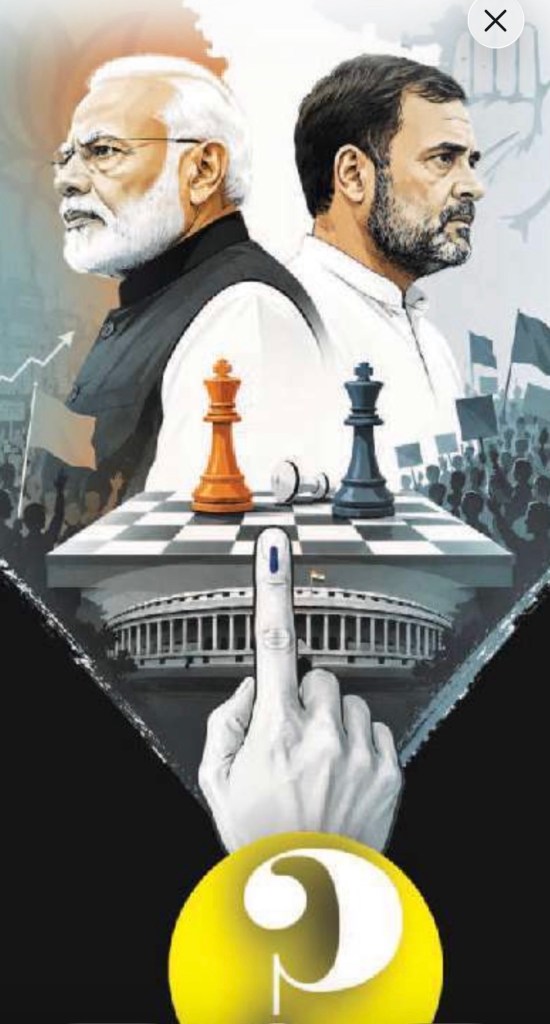
While the BJP seeks to question the patriotism and nationalism of the Congress, the Congress is doing everything possible to paint the saffron party as anti-youth and anti-social justice. Yet, the clarity either party holds regarding nationalism remains questionable. To what extent has the Congress succeeded in taking Nehru’s liberal nationalism to the masses ideologically? It is evident that Congress has failed to adapt Nehru’s ideology—which held that India’s identity is founded on cultural pluralism rather than religious dogma—to contemporary times. Concurrently, the BJP has long drifted away from the philosophy of Deendayal Upadhyaya, who advocated cultural nationalism and Integral Humanism. How many within the party adhere to his teachings, which emphasized formulating an indigenous (Swadeshi) economic policy distinct from unrestrained corporatization and foreign economic models, decentralizing power across all tiers rather than centralizing governance, and leading frugal, austere lives while treating politics purely as public service?
Both parties are merely making tactical maneuvers tailored for electoral gains; neither shows evidence of genuine efforts toward ideological clarity within their ranks. Rahul Gandhi may be raising Manusmriti and the caste census with an eye on the Uttar Pradesh elections, but whether this will secure the votes of Bahujans and OBCs for the Congress remains doubtful. Even after making the caste census a central theme ahead of the Bihar elections, Congress failed to win a substantial number of seats. At the same time, one must ask whether the BJP can consolidate Hindu votes simply by branding the partial singing of Vande Mataram as treason and attacking the Congress. After Rahul’s criticism of Manusmriti, who can stop Hindu nationalists from questioning why he does not critique the Quran or the Bible with equal measure?
While critics argue that the Bharatiya Janata Party revolves entirely around Narendra Modi and that he exercises total control, the exact same condition plagues the Congress. All Congress politics revolve exclusively around Rahul Gandhi and his speeches. Neither Modi nor Rahul consults others before making public pronouncements, nor do they demonstrate any interest in strengthening their parties ideologically. A healthy democratic transformation in the country will only be possible when both national parties move away from personality-centric politics and reconstruct themselves on ideological foundations.
 akrishnarao
Leave a comment