Tag: elections

  • The Great Women’s Reservation Show: Reform or Electoral Strategy?

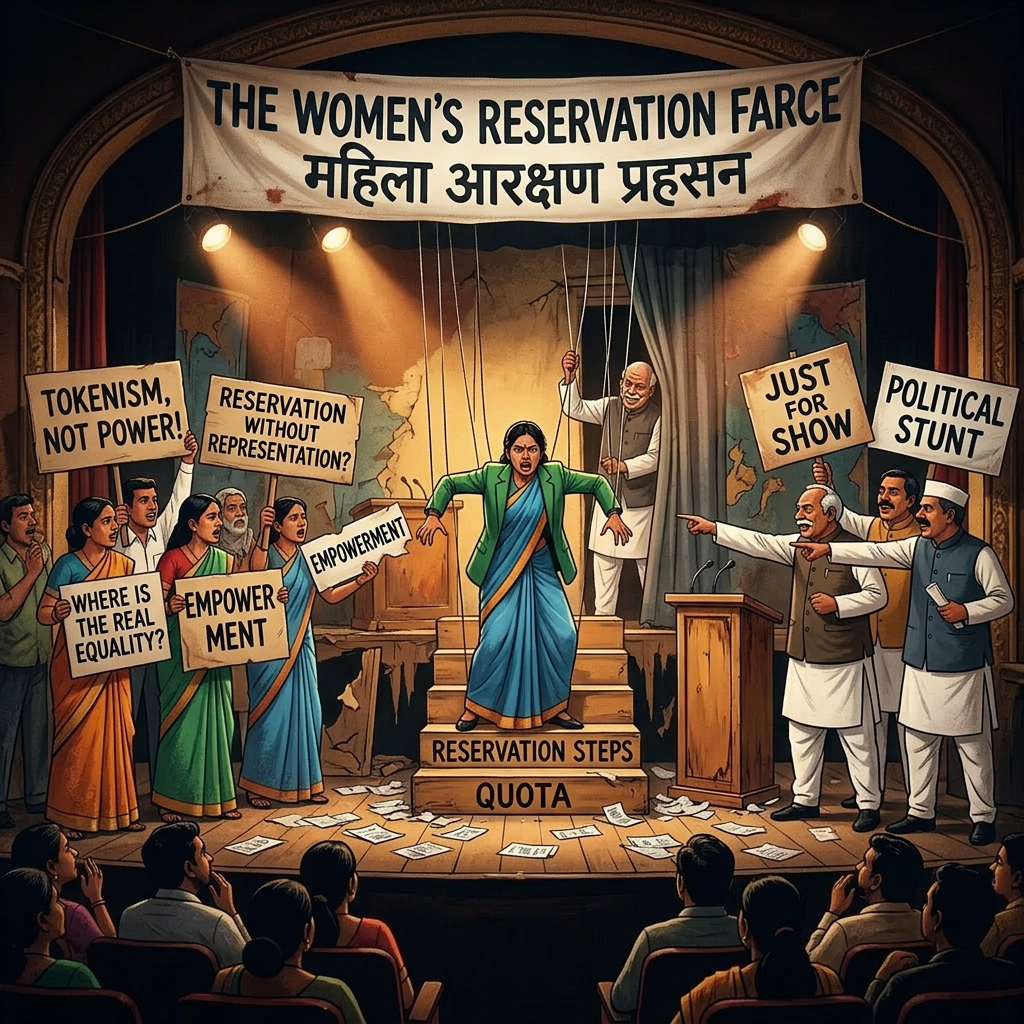
    Illustration of a woman ascending steps labeled Reservation, Quota, and Reservation in a legislative chamber with supporters holding signs for empowerment and equality and opponents debating.
    “Will this bill pass? My boss is asking me again and again,” a friendly-party MP asked Parliamentary Affairs Minister Kiren Rijiju last week. “Why do you have that doubt? As long as Narendra Modi is Prime Minister, whatever he decides will be achieved under any circumstances. A lot of efforts are happening behind the scenes. Many people will lean towards us. Just wait and watch,” he told that leader. “Not only that, I myself will speak to your boss,” he said, personally calling him and assuring, “There are no obstacles for the bill to pass.” Following this, arrangements were made in that state to gather large numbers of women and celebrate.

    In fact, it did not appear that even the Prime Minister had any apprehension that the bill might not be approved. From the second week of April, women from across the country were being brought to Delhi. BJP national president Nitin Nabin called state presidents and key leaders and instructed them to organize women’s conferences in the states and hold press meets on women’s reservation. A large conference with women was held at Vigyan Bhavan, where Prime Minister Narendra Modi spoke. Key women leaders from the party were brought to the central office and trained to go among the public and speak to the media. Documents were prepared and distributed showing how many seats would increase in which states. Eventually, the Lok Sabha galleries were filled with women representatives. The national capital and Parliament premises were vibrant with women. Many women dreamed that they too would soon enter the House; some even identified their prospective seats.
    However, on the very first day of the Parliament session on April 16, it became clear that the opposition was united. Behind-the-scenes efforts intensified to win over or ensure the absence of opposition members. Modi even had to warn, “If this bill fails, women will not forgive the opposition.” Doubts were raised about whether opposition MPs from states going through elections would attend the session. In West Bengal, Trinamool Congress chief Mamata Banerjee is facing unusually tough competition this time, and her party MPs were deeply engaged in campaigning. Despite efforts to stay united, seven Trinamool MPs had to be absent during voting. Even so, since there was a significant gap between the two-thirds majority required in the Lok Sabha and the NDA’s strength, the constitutional amendment inevitably failed.

    Just as there are many reasons behind Karna’s death, there are many reasons behind the failure of this bill. Why did what was considered a historic moment ultimately turn into a farce? When all parties unanimously approved the constitutional amendment bill for women’s reservation in 2023, why was it opposed now? Why was there a need to modify that bill? If it had to be changed, why were efforts not made to build consensus on it as well? If women’s reservation is to be implemented in 2029, there is still three years’ time—then why extend budget sessions and hold special sessions during ongoing assembly elections? In the Bengal elections, which Modi has taken very prestigiously, was the women’s reservation issue used as a move to attract women voters? If so, why link reservation with an increase in seats through a constitutional amendment? Since an increase in seats would also benefit the Samajwadi Party in Uttar Pradesh, was this strategy aimed at drawing that party closer? Did the government not anticipate that basing delimitation on population, the absence of a proposal for a 50% seat increase, and rising concerns about North–South disparities would lead to suspicion? Even though Home Minister Amit Shah said at the last minute that the bill would be modified, the opposition did not agree—this shows the deep mistrust between the ruling party and the opposition. It also did not appear that the government anticipated criticism that using the 2011 census as a basis would ignore OBCs.
    In our country, politics driven by short-term gains and excessive publicity sometimes pushes back even necessary decisions like women’s representation.

    The job of an MP or MLA is to enact new legislation. They have to perform legislative functions. An MP may represent a single Lok Sabha constituency, but when they sit in the Lok Sabha, they are responsible for the 1.4 billion people of the country. They are part of the law-making process. The laws made by their votes apply to every citizen of the country. They determine each citizen’s fate. The Constitution provides for the executive to handle citizens’ daily needs. The executive is responsible for implementing laws made by the legislature. If Parliament or the Legislative Assemblies make good laws and the executive implements them effectively, citizens’ problems will be resolved.

    Therefore, there is a need to work on improving the quality of laws made in Parliament and the state legislatures. There is a need to work on improving the quality of debate and discussion in Parliament or the Legislative Assemblies. Then, arrangements must be made for better implementation of those laws. Increasing the number of MPs or MLAs will not change anything.

    If there is a water, electricity, or sewage problem in an MP’s constituency, the local administration must resolve it. If there is a law and order problem, the police will address it, not the MP. Therefore, it is essential that the number of police stations be increased in proportion to the population growth, the number of police personnel be increased and they be better trained, and the number of civil service staff and officers be increased so that citizens’ problems can be resolved.

    As the population grows, the number of schools and teachers should be increased. As the population grows, the number of hospitals and doctors should be increased. As the population grows, civic amenities should be developed. As the population grows, infrastructure should be developed. While this is not to say that work is not being done in this direction, it is not being done in proportion to the population growth. No one can deny the fact that the quality of civil services is continuously deteriorating.

    Therefore, the entire delimitation debate is a ‘misplaced priority’. It could also be called ‘barking on the wrong tree’. It will not bring any qualitative change to the country’s current legislative or executive system. On the contrary, it will deepen the division between North and South India.
    If, as Modi hopes, women in large numbers shift toward the BJP in the Bengal elections, the party is bound to achieve a major victory. This time, 200,000 more women voters have been added in Bengal. Out of 67.5 million voters, 34.4 million are women. Moreover, in the last elections, more women than men voted—88% of women cast their vote. Not only in Bengal but across the country, women’s voting percentages are rising faster than men’s. In many states, schemes targeting women have benefited ruling parties in elections. Therefore, there is little doubt that Modi used women’s reservation as a strategic move to attract women voters away from Mamata Banerjee. In fact, compared to all parties, Mamata Banerjee has provided greater representation to women—about 33% in her party. Of 29 Trinamool MPs, 11 are women; 20% of her cabinet are women. This time, the party has given tickets to 52 women, more than any other party. Welfare schemes like Kanyashree and Lakshmi Bhandar have also gained popularity. So whether the BJP can attract women voters through the reservation bill remains debatable—but if the BJP wins, it will have the opportunity to claim that women made the difference.
    More than women, the BJP has focused this time on Hindu-majority seats. In West Bengal’s 294 seats, only 234 have less than 40% Muslim population. The BJP had won 77 of these seats in the last election. Before 1977, Muslims supported Congress; until 2006, the Left; and since then, the Trinamool Congress. They have been a key factor in Mamata’s success.

    The BJP, which had virtually no presence in West Bengal until 2014, secured 17% votes in the 2014 Lok Sabha elections and increased it to 40% in 2019. This percentage hasn’t changed much in the last seven years. The gap between Trinamool and BJP is about five percent. To bridge this, consolidation of Hindu votes is necessary—and within that, Hindu women’s votes are crucial.
    Ultimately, increasing the number of MPs and MLAs may create more political positions and even increase women’s representation numerically, but without deeper institutional reforms, it is unlikely to bring meaningful change on the ground.
     
  • “Beyond the Uproar: Elections Will Decide All”

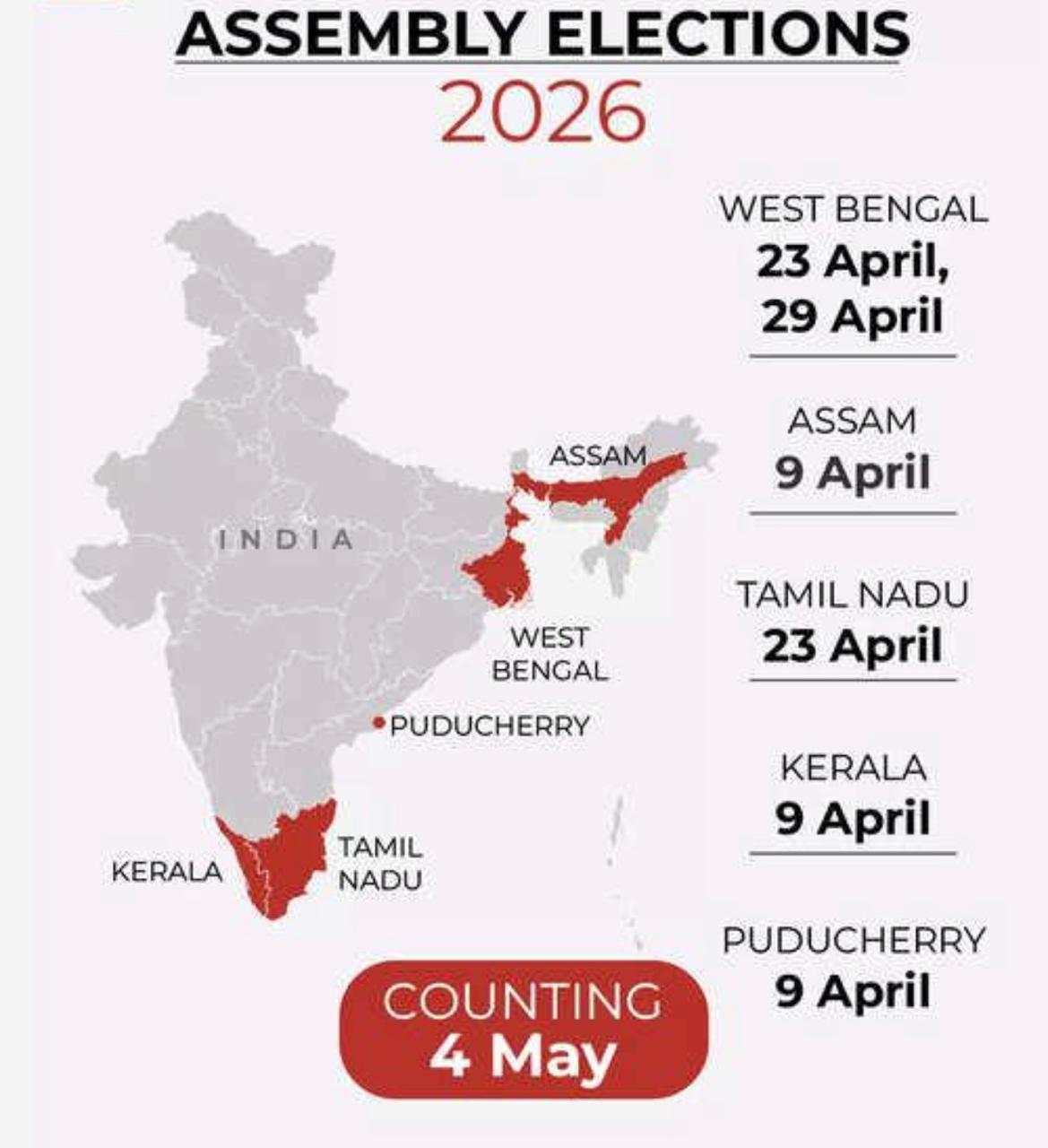
    Elections have been announced in a Union Territory. Now everyone’s attention is on the developments taking place in the election-bound states. For the past two days, parliamentary proceedings have been running smoothly. The government and the Speaker agreeing to lift the suspension of eight MPs who were suspended in previous sessions is an indication that some understanding has been reached between both sides. However, no matter how much uproar is created in Parliament, or how stubbornly the government behaves, ultimately both the ruling party and the opposition must prove their strength before the people, right? Unless public anger against the government erupts and is reflected in election results, there is no benefit in stalling Parliament. After Parliament discussed and rejected the no-confidence motion brought against him over two days, Speaker Om Birla, upon resuming his seat, remarked, “These two days of the House’s time have been wasted.”

    It is surprising that the opposition was not even ready for voting on the no-confidence motion they themselves introduced. Wouldn’t it have been better if a message had gone out that 233 opposition members in the House opposed Om Birla? Perhaps the opposition feared that it would give an impression to the public that they are not united. It is noteworthy that MPs from the Samajwadi Party and Trinamool Congress did not sign the no-confidence motion. Even so, adhering to opposition dharma, they spoke in favor of it. While a discussion was supposed to take place on the no-confidence motion against Om Birla, insisting on discussing West Asia and stalling the House suggests that Congress was not serious about its own motion and had its reasons. Yet, their opposition is directed more at Modi than at Birla, isn’t it?

    In fact, Parliament provides an excellent platform for the opposition to clearly present their views and attract public attention. In the past, leaders like Hiren Mukherjee, Indrajit Gupta, Piloo Mody, Atal Bihari Vajpayee, George Fernandes, Sushma Swaraj, Arun Jaitley, and Venkaiah Naidu made remarkable speeches while in opposition, which established them as national leaders. Compared to them, it must be said that Rahul Gandhi has not yet emerged as a powerful orator in Parliament. It cannot be said that Congress lacks good speakers, but since Rahul Gandhi is the Leader of the Opposition, politics revolves around him. He seems to have developed a style of creating commotion by bringing up topics like Nirav or Epstein just moments after beginning to speak. Perhaps he is missing the opportunity to present the same issues in a powerful, flowing speech that could captivate not only members but the entire nation. On the other hand, Priyanka Gandhi Vadra, though she has delivered only a few speeches so far, has made them widely discussed. After she challenged, “Make all your criticisms against Nehru at once… let’s discuss them,” the ruling party’s criticism of Nehru in Parliament subsided. During the debate on the no-confidence motion against Om Birla, Trinamool MP and 33-year-old actress Sayoni Ghosh spoke so effectively and exposed the BJP’s stance in a way that no one had expected.

    The fortune of the Bharatiya Janata Party, especially Prime Minister Narendra Modi, lies in the fact that the opposition has not only failed to stand strong in elections but is also not effectively using Parliament as a platform. Even though there are many issues to criticize Modi on, Congress’s attacks are not reaching the public strongly. Interestingly, even in states where the BJP is not very strong, there are intellectuals who argue that Modi is extremely powerful. For example, in Karnataka, Tamil Nadu, Kerala, Andhra Pradesh, and Telangana, the BJP is not very strong. Yet, if two people from these regions talk for ten minutes, Modi’s name repeatedly comes up in their conversation. There are more people overestimating Modi’s strength than perhaps necessary. It is said that a German leader once remarked, “Even criticizing me is a crime, and ignoring me is also a crime!” This situation is perhaps pushing Modi to consider simultaneous elections.

    Coming to the southern states, after losing in Karnataka in 2023, the BJP has not yet recovered and is struggling with internal conflicts. B. S. Yediyurappa has completed 50 years in politics but has made it clear that he is not ready to retire. Just as there is uncertainty at the national level about who will succeed Modi, in Karnataka too it is unclear who will lead after Yediyurappa. Even BJP leaders themselves cannot say whether the party will strengthen in Karnataka by the next elections. In Telangana, everyone knows the BJP is struggling to rise above the third position. In Kerala, which is heading into assembly elections, it is not easy to predict whether the BJP will increase its vote share or win even ten seats. In Tamil Nadu, the confusion within the BJP is evident from its own actions. Despite attempts to split the AIADMK or promote Annamalai, the BJP has not gained strength. Ultimately, it has had to ally again with the AIADMK and depend on the seats given by it, even resorting to moves like offering the Deputy Chief Minister post to actor Vijay, who is new to politics. No matter how much the BJP expands in northern India, the people of the southern states have not yet embraced it. It is leaders who are welcoming it with shawls, not the people!

    At the national level, the BJP’s strategy broadly includes consolidating Hindu votes, pursuing politics in the name of nationalism, and projecting Modi as a strong leader. However, in states like West Bengal, Assam, Tamil Nadu, Kerala, and Puducherry, where elections are being held, Hindutva politics is not as strong as in the north and west. A form of sub-nationalism exists in these states, similar to Andhra Pradesh and Telangana. Therefore, making BJP-style politics succeed in these states is a real test for the party and for Modi. The BJP knows that fighting regional parties is not as easy as fighting Congress. Moreover, in states where the BJP has won, even relatively unknown leaders have been accepted as Chief Ministers. But such a situation does not exist in the current election-bound states. When L. K. Advani was BJP president, strong leadership was built in every state, including leaders like Modi. Today, Modi does not have leaders at either the national or regional level who can stand beside him and draw public applause. This is both his strength and his weakness.

    In the southern states, apart from marginally increasing vote share and maintaining alliances, there is little the BJP can achieve. Winning West Bengal is a major challenge for Modi. Modi and Amit Shah are making every possible effort to defeat Mamata Banerjee this time. They are well aware that Hindutva politics alone cannot secure victory in Bengal. Efforts such as revising voter lists and allegedly removing over six million voters, replacing the governor with IPS officer R. N. Ravi, making administrative changes, conducting ED raids, and consolidating Hindu votes are all being undertaken. Addressing a rally at Kolkata’s Parade Ground a day before the election announcement, Modi expressed concern that Hindus might become a minority in Bengal. The BJP’s strength in Bengal is gradually increasing. However, Modi and Amit Shah failed to defeat Mamata Banerjee in 2016 and 2021. Now they are facing her for the third time. Although they could not defeat Arvind Kejriwal in Delhi in 2015 and 2020, they managed to secure victory in 2025 on the third attempt. Will they be able to repeat that success in Bengal this time? Can Bengal be compared with Delhi? In any case, past elections are one thing, and the upcoming elections are another. These elections can be seen as a trial by fire for the strategies Modi has pursued over the past twelve years. Will Modi be able to withstand the challenges emerging at both national and international levels, counter questions about his policies, and outmaneuver opposition strategies to stand tall like a formidable leader?