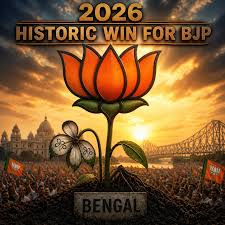
“I will not resign. It is not the BJP that has defeated me, but the Election Commission,” declared Trinamool Congress leader Mamata Banerjee after the electoral setback. For years, many believed that the Trinamool Congress’s hold over Bengal—strengthened by welfare politics, village-level networks, and appeals to Bengali identity—would remain unshaken. The state’s complex social fabric, including the decisive influence of minority votes in several constituencies, further reinforced that assumption.
Yet the Bharatiya Janata Party’s rise in West Bengal marks one of the most significant political developments in post-independence India. Overcoming deep-rooted regional loyalties and decades of ideological resistance, the BJP transformed itself from a marginal force into a major political contender in Bengal. To its supporters, this was not merely an electoral breakthrough but the re-emergence of a long-suppressed nationalist current within Bengal’s political consciousness.
In many ways, Bengal’s historical and cultural evolution always contained strands that could eventually align with the BJP’s ideological narrative. Bengal has never been untouched by religious or identity politics. The 1905 partition of Bengal by British Viceroy Lord Curzon triggered the Swadeshi movement and ignited a powerful wave of anti-colonial nationalism. Long before independence, Bengal had already become a battleground of competing religious, cultural, and political identities.
Thinkers and spiritual leaders such as Ramakrishna Paramahamsa, Swami Vivekananda, and Bankim Chandra Chattopadhyay profoundly shaped Bengali consciousness. Vivekananda envisioned Bengal’s youth as custodians of India’s spiritual resurgence, while Bankim Chandra’s writings fused cultural pride with patriotic fervor. His novel Anandamath became closely associated with early nationalist sentiment.
Bengal also produced some of the fiercest critics of both colonial rule and mainstream Congress politics. Revolutionary figures such as Sri Aurobindo, Chittaranjan Das, and Subhas Chandra Bose challenged conventional political approaches and inspired militant nationalism. During Partition, communal violence—including the Calcutta killings and the Noakhali riots—left deep scars on Bengal’s collective memory.
It was in this atmosphere that Syama Prasad Mukherjee emerged as a major political figure. Opposing both communal violence and special constitutional status for Kashmir, Mukherjee later founded the Bharatiya Jana Sangh, the ideological predecessor of today’s BJP.
Despite these historical undercurrents, Bengal did not embrace the BJP for decades. Instead, the state evolved into one of India’s strongest centers of liberal, intellectual, and left-wing politics. Bengal nurtured social reform movements, literary modernism, trade union activism, and revolutionary thought. The Congress once dominated the state, only to decline before the rise of the Left Front, which ruled for more than three decades. Later, the Trinamool Congress under Mamata Banerjee displaced the Left and established its own political dominance.
At the same time, Bengal remained a cradle of artistic and intellectual achievement. From Rabindranath Tagore to generations of filmmakers, musicians, actors, and writers, Bengal became synonymous with cultural sophistication, pluralism, and ideological debate.
The BJP’s advance into such a political landscape therefore raises an important question: what changed?
Part of the answer lies in long-term organizational work. The Rashtriya Swayamsevak Sangh steadily expanded its grassroots presence across Bengal over several years. The BJP combined this organizational machinery with a carefully crafted political narrative centered on nationalism, border security, religious identity, and allegations of minority appeasement under the Trinamool Congress government.
Another major controversy during the elections was the debate surrounding the Special Intensive Revision (SIR) of electoral rolls and the role of the Election Commission. Opposition parties, especially the Trinamool Congress, alleged that large-scale deletions of voter names disproportionately affected minority-dominated districts such as Murshidabad, Malda, and North 24 Parganas. The BJP, however, defended the exercise as a necessary step to remove duplicate and ineligible voters and to strengthen the integrity of the electoral process. The controversy intensified political polarization, with the opposition accusing the Election Commission of acting in a partisan manner, while the BJP projected the revision as part of a broader campaign against illegal infiltration and electoral manipulation. Regardless of the competing narratives, the issue became a crucial psychological and political factor shaping the atmosphere of the election.
The party also demonstrated a level of electoral planning and discipline that many opposition parties struggled to match. Having already secured close to 40 percent of the vote share in previous parliamentary and assembly elections, the BJP focused on incremental expansion constituency by constituency. Elections were approached not merely as campaigns but as highly coordinated political operations involving booth management, cadre mobilization, and targeted messaging.
Former CPI(M) leader Sitaram Yechury himself acknowledged that even sections of traditional Left voters had shifted toward the BJP in recent years. This reflected not only ideological polarization but also the collapse of older political structures that once anchored Bengal’s electoral landscape.
The opposition now faces a broader national challenge. Regional leaders who once treated Congress as politically irrelevant increasingly recognize the need for coordination against the BJP. Yet the Congress party continues to struggle with organizational weakness, inconsistent strategy, and the absence of a durable grassroots network comparable to that of the BJP.
The contrast between the two parties is striking. The BJP invests continuously in cadre-building, ideological outreach, and local organizational structures. Congress, by contrast, often appears reactive rather than strategic. Electoral alliances and parliamentary tactics alone cannot compensate for the absence of sustained grassroots engagement.
This is perhaps the larger lesson emerging from Bengal. Modern politics is not sustained by rhetoric alone. It requires organization, ideological clarity, long-term planning, and the ability to emotionally connect with voters across social divisions. One may agree or disagree with the BJP’s politics, but its capacity to build a disciplined political machine is difficult to ignore.
Whether Bengal’s political transformation represents a temporary shift or a deeper civilizational realignment remains uncertain. But one fact is clear: Bengal, which has repeatedly shaped the course of Indian political history, is once again at the center of a major national turning point.


Leave a Reply