Tag: mamata banerjee

  • Modi’s Ascendancy and the Opposition’s Search for Direction

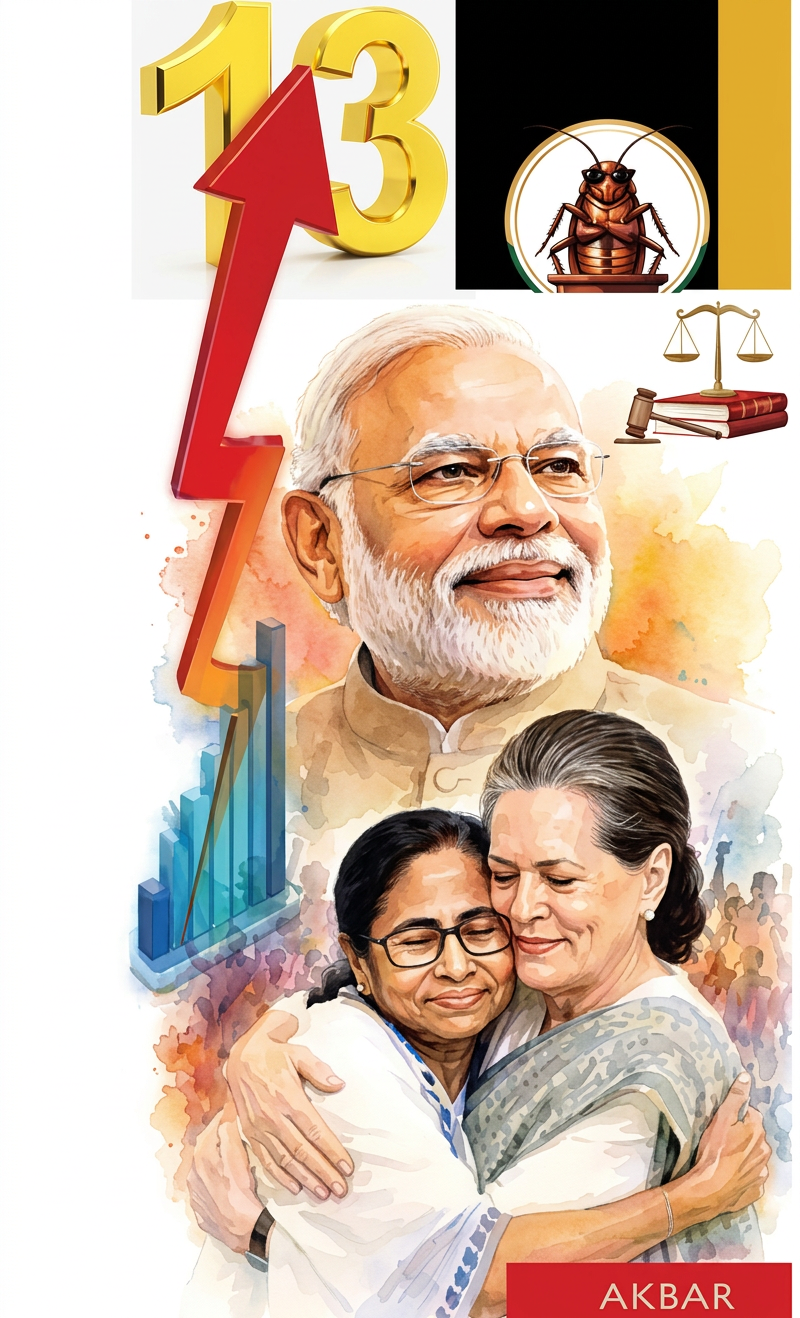
    On Monday, at the INDIA alliance meeting held in Delhi, Trinamool Congress supremo Mamata Banerjee, who appeared with a faded face, was tightly embraced by former Congress president Sonia Gandhi. Who other than one woman can understand another woman’s heart? “Some scenes cannot be expressed in words,” remarked a senior leader.

    These two were once described by international organizations as the most powerful leaders in the country. While Sonia ruled the country’s politics for more than ten years, Mamata Banerjee ruled Bengal politics for 15 years. But they are not unaware that the present circumstances are different.

    After the results of the five state elections announced last month, anti-BJP forces met again in Delhi. Mamata Banerjee and the Left parties, forgetting that until yesterday they were also fighting Congress, have become ready to join hands with Congress at the national level. Mamata Banerjee also appears to have forgotten that Rahul Gandhi, the Leader of the Opposition in the Lok Sabha, had only recently criticized her harshly over her anarchic and corrupt rule. She also may not now remember that in 2021 she dreamed of the Prime Minister’s post and declared, “Congress has become ineffective in the country. I alone will play the key role at the national level.”

    The tigress-like Mamata Banerjee, who rebelled against Congress in 1998 and launched her party by holding a rally in Kolkata while the AICC plenary session was taking place, now appears to have had her claws removed. Public representatives belonging to her party in both the Lok Sabha and the Assembly have declared rebellion against her. Her right-hand man Abhishek Banerjee, MP Kalyan Banerjee, and other party leaders are facing attacks on the streets. The same methods Mamata Banerjee once employed against her opponents are now being used against her by her rivals. While Mamata Banerjee and her followers are now crying in the wilderness on the streets of Kolkata, Congress leaders have become the ones standing by her. In this context, it appears that Mamata Banerjee has realized that Congress alone is her refuge if she is to face a mighty force like the BJP both in the state and in Delhi. Though Congress and the Left did not win many seats in the Bengal Assembly elections, they were able to damage the Trinamool considerably. In minority-dominated areas such as Murshidabad, Malda, and Uttar Dinajpur, the Congress–Left alliance ensured that Trinamool did not receive its traditional support. In 32 Assembly constituencies where Muslims constitute more than 50 percent of the population, Trinamool did not win even a single seat. In the Jangipur constituency, the Congress candidate secured 31,000 votes while the Trinamool candidate received only 10,542 votes. Likewise, in the Karandighi constituency, CPI(M) secured 39,000 votes, while the BJP candidate won with 20,000 votes. Perhaps the manner in which these results came has taught Mamata Banerjee lessons about her arrogance, authoritarian approach, and disregard for allies. That is why she is now seen on the streets of Delhi.

    Likewise, for the Left parties, whose ground is slipping from beneath their feet in the country, the streets of Delhi have also become a refuge. In the 140-member Kerala Assembly, the Congress-led UDF winning more than 100 seats, the BJP winning three seats, and the defeat of most ministers in Pinarayi Vijayan’s cabinet cannot be ignored. Analysts described the Left alliance’s defeat there as the result of Pinarayi Vijayan’s centralized and arrogant governance, severe disappointment among farmers, youth, and ASHA workers, dissatisfaction among party cadres, and public resentment against ten years of rule. Congress leaders such as Rahul Gandhi and Revanth Reddy criticized Pinarayi Vijayan, alleging that he was colluding with the BJP and encouraging corrupt elements. They questioned why central agencies had not investigated Vijayan. Be that as it may, the Left parties, which have reached a situation where they are not in power anywhere in the country for the first time in five decades, have realized that they have no option except to work together with other anti-BJP forces. Left leaders D. Raja and John Brittas, who attended the INDIA alliance meeting, have that clarity.

    The late CPI(M) General Secretary Sitaram Yechury, who passed away two years ago, understood the present situation in the country very well. When Congress inducted Prasenjit Bose, who had been expelled by CPI(M), Rahul Gandhi joked with Yechury, saying, “We have taken your comrade into our party.” Laughing, Yechury replied, “What is yours and ours? In this struggle, both of us are travelling in the same boat.” He had long ago understood the need for all anti-BJP forces to shed their narrow-mindedness and work together to confront the BJP, which was advancing unchecked across the country. Today, none of the parties in the NDA are fighting among themselves. But the parties in the INDIA alliance do not possess that level of unity. How much sincerity of purpose do the 23 parties that met at Delhi’s Constitution Club after nearly two years really have? What is the significance of the DMK and Aam Aadmi Party not attending? After the Emergency, in 1977, opposition parties contested against Congress under a single election symbol in the name of the Janata Party. How many parties today possess that same sincerity and fighting spirit? Can Congress provide leadership to other parties in the same way that the BJP has been able to guide even its allies along its ideological path?

    Two days after the INDIA alliance meeting, Prime Minister Narendra Modi organized a meeting of NDA allies on the occasion of completing 12 years in power. Though nominally an NDA meeting, it is in reality a BJP meeting. Leaving aside small states like Nagaland, Meghalaya, and Puducherry, Andhra Pradesh is the largest state where NDA rule is currently in effect. Until recently, Janata Dal (United) chief Nitish Kumar was the Chief Minister in Bihar. Now, even there, a BJP leader is Chief Minister. With his entry into the Rajya Sabha, the 12 JD(U) MPs in the Lok Sabha will have to regard Modi as their leader. While Trinamool has 28 MPs in the Lok Sabha, 20 MPs under the leadership of party chief whip Kakoli Ghosh Dastidar have decided to write to Speaker Om Birla seeking recognition as a separate group after rebelling against Mamata Banerjee. At some auspicious moment, they too may have no option but to join the BJP and wear the saffron scarf as BJP MPs. That means the BJP effectively already has a full majority in the Lok Sabha even without the support of the Telugu Desam Party. Moreover, seven MPs from Shiv Sena, five from Lok Janshakti Party, two from Janata Dal (Secular), two from Rashtriya Lok Dal, one from the NCP Pawar group, two from Apna Dal and Hindustani Awam Morcha, along with six MPs from northeastern states, are already supporting the BJP. Since Modi came to power, the Bharatiya Janata Party has earned the distinction of splitting several regional parties such as Shiv Sena, NCP, Lok Janshakti Party, Rashtriya Lok Samata Party, Aam Aadmi Party, and Trinamool, and also attracting many leaders from other parties into its fold. Not only that, during Modi’s tenure, parties such as BSP, BJD, DMK, and AIADMK have faced tests of survival, making their future uncertain. A situation has arisen in the country where many regional parties feel that their survival will be difficult unless they surrender to Modi.

    In this context, as Modi enters his 13th year in power today, no one can deny that his political strength is increasing day by day, despite social media commentary about how intense his politics may become, developments such as the “cockroach party,” the weakening of democratic institutions, allegations that the judiciary has surrendered, and the flood of criticism over the failure of institutions such as NEET and CBSE to conduct examinations properly. Without eliminating their internal contradictions and creating an equally compelling alternative vision, what change can opposition parties or other non-BJP forces achieve, no matter how many meetings they conduct?
  • The Lotus Emerging from Bengal’s Cultural Roots

    “I will not resign. It is not the BJP that has defeated me, but the Election Commission,” declared Trinamool Congress leader Mamata Banerjee after the electoral setback. For years, many believed that the Trinamool Congress’s hold over Bengal—strengthened by welfare politics, village-level networks, and appeals to Bengali identity—would remain unshaken. The state’s complex social fabric, including the decisive influence of minority votes in several constituencies, further reinforced that assumption.

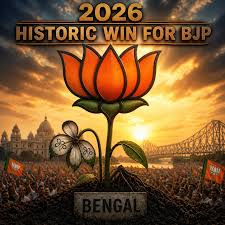
    Yet the Bharatiya Janata Party’s rise in West Bengal marks one of the most significant political developments in post-independence India. Overcoming deep-rooted regional loyalties and decades of ideological resistance, the BJP transformed itself from a marginal force into a major political contender in Bengal. To its supporters, this was not merely an electoral breakthrough but the re-emergence of a long-suppressed nationalist current within Bengal’s political consciousness.

    In many ways, Bengal’s historical and cultural evolution always contained strands that could eventually align with the BJP’s ideological narrative. Bengal has never been untouched by religious or identity politics. The 1905 partition of Bengal by British Viceroy Lord Curzon triggered the Swadeshi movement and ignited a powerful wave of anti-colonial nationalism. Long before independence, Bengal had already become a battleground of competing religious, cultural, and political identities.

    Thinkers and spiritual leaders such as Ramakrishna Paramahamsa, Swami Vivekananda, and Bankim Chandra Chattopadhyay profoundly shaped Bengali consciousness. Vivekananda envisioned Bengal’s youth as custodians of India’s spiritual resurgence, while Bankim Chandra’s writings fused cultural pride with patriotic fervor. His novel Anandamath became closely associated with early nationalist sentiment.

    Bengal also produced some of the fiercest critics of both colonial rule and mainstream Congress politics. Revolutionary figures such as Sri Aurobindo, Chittaranjan Das, and Subhas Chandra Bose challenged conventional political approaches and inspired militant nationalism. During Partition, communal violence—including the Calcutta killings and the Noakhali riots—left deep scars on Bengal’s collective memory.

    It was in this atmosphere that Syama Prasad Mukherjee emerged as a major political figure. Opposing both communal violence and special constitutional status for Kashmir, Mukherjee later founded the Bharatiya Jana Sangh, the ideological predecessor of today’s BJP.

    Despite these historical undercurrents, Bengal did not embrace the BJP for decades. Instead, the state evolved into one of India’s strongest centers of liberal, intellectual, and left-wing politics. Bengal nurtured social reform movements, literary modernism, trade union activism, and revolutionary thought. The Congress once dominated the state, only to decline before the rise of the Left Front, which ruled for more than three decades. Later, the Trinamool Congress under Mamata Banerjee displaced the Left and established its own political dominance.

    At the same time, Bengal remained a cradle of artistic and intellectual achievement. From Rabindranath Tagore to generations of filmmakers, musicians, actors, and writers, Bengal became synonymous with cultural sophistication, pluralism, and ideological debate.

    The BJP’s advance into such a political landscape therefore raises an important question: what changed?

    Part of the answer lies in long-term organizational work. The Rashtriya Swayamsevak Sangh steadily expanded its grassroots presence across Bengal over several years. The BJP combined this organizational machinery with a carefully crafted political narrative centered on nationalism, border security, religious identity, and allegations of minority appeasement under the Trinamool Congress government.

    Another major controversy during the elections was the debate surrounding the Special Intensive Revision (SIR) of electoral rolls and the role of the Election Commission. Opposition parties, especially the Trinamool Congress, alleged that large-scale deletions of voter names disproportionately affected minority-dominated districts such as Murshidabad, Malda, and North 24 Parganas. The BJP, however, defended the exercise as a necessary step to remove duplicate and ineligible voters and to strengthen the integrity of the electoral process. The controversy intensified political polarization, with the opposition accusing the Election Commission of acting in a partisan manner, while the BJP projected the revision as part of a broader campaign against illegal infiltration and electoral manipulation. Regardless of the competing narratives, the issue became a crucial psychological and political factor shaping the atmosphere of the election.

    The party also demonstrated a level of electoral planning and discipline that many opposition parties struggled to match. Having already secured close to 40 percent of the vote share in previous parliamentary and assembly elections, the BJP focused on incremental expansion constituency by constituency. Elections were approached not merely as campaigns but as highly coordinated political operations involving booth management, cadre mobilization, and targeted messaging.

    Former CPI(M) leader Sitaram Yechury himself acknowledged that even sections of traditional Left voters had shifted toward the BJP in recent years. This reflected not only ideological polarization but also the collapse of older political structures that once anchored Bengal’s electoral landscape.

    The opposition now faces a broader national challenge. Regional leaders who once treated Congress as politically irrelevant increasingly recognize the need for coordination against the BJP. Yet the Congress party continues to struggle with organizational weakness, inconsistent strategy, and the absence of a durable grassroots network comparable to that of the BJP.

    The contrast between the two parties is striking. The BJP invests continuously in cadre-building, ideological outreach, and local organizational structures. Congress, by contrast, often appears reactive rather than strategic. Electoral alliances and parliamentary tactics alone cannot compensate for the absence of sustained grassroots engagement.

    This is perhaps the larger lesson emerging from Bengal. Modern politics is not sustained by rhetoric alone. It requires organization, ideological clarity, long-term planning, and the ability to emotionally connect with voters across social divisions. One may agree or disagree with the BJP’s politics, but its capacity to build a disciplined political machine is difficult to ignore.

    Whether Bengal’s political transformation represents a temporary shift or a deeper civilizational realignment remains uncertain. But one fact is clear: Bengal, which has repeatedly shaped the course of Indian political history, is once again at the center of a major national turning point.

  • How long will these unethical politics continue?

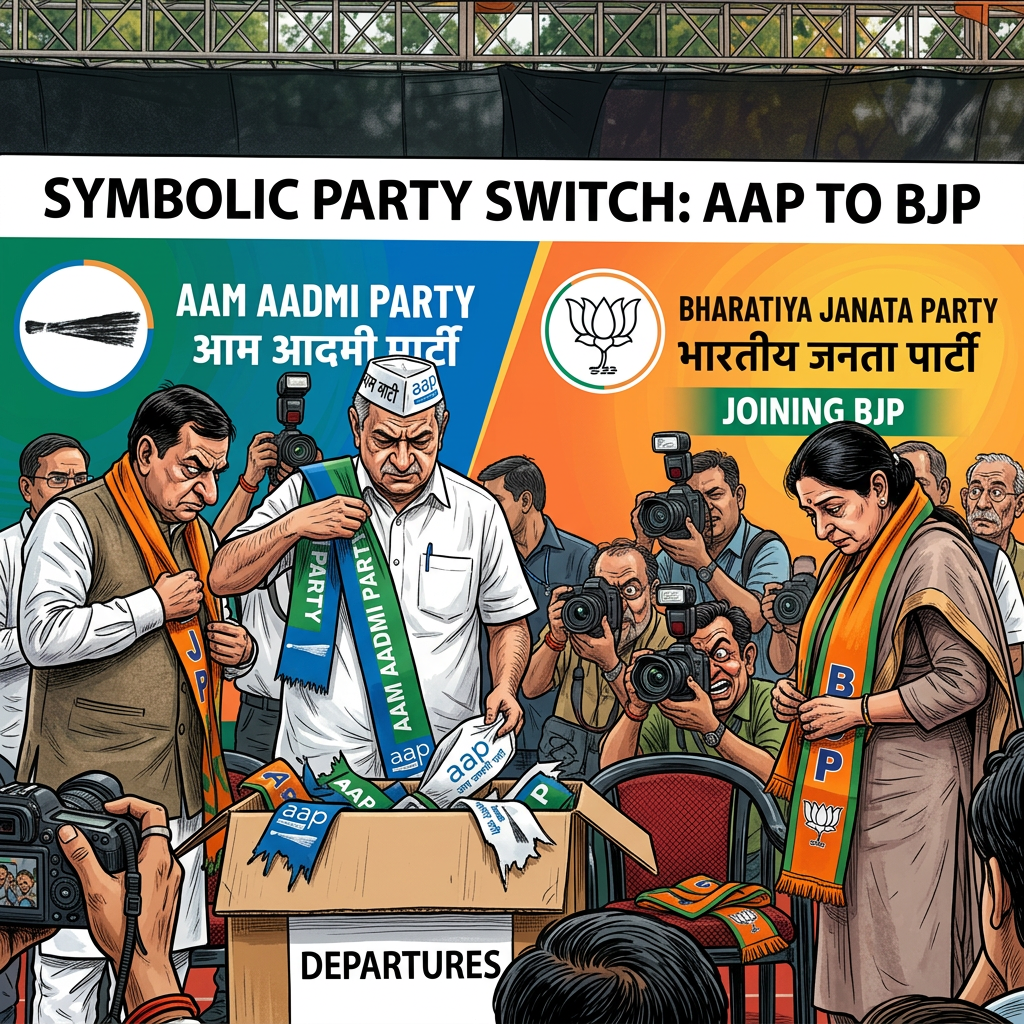
    Leaders exchanging party scarves during symbolic switch from AAP to BJP
    Leaders symbolically switch from Aam Aadmi Party to Bharatiya Janata Party

    On the last day of the election campaign, Prime Minister Narendra Modi confidently declared, “After May 4, I will have to come to Bengal once again for the swearing-in ceremony of a BJP government.” He expressed confidence that “after Odisha and Bihar, the lotus will bloom in Bengal.” The Election Commission has deployed CAPF forces across Bengal. Union Home Minister Amit Shah said, “Even after the elections are over, these forces will remain in Bengal for another two months.”

    While Modi’s campaign efforts aim to attract the masses, especially women voters, Amit Shah, who stayed in Bengal for 15 days, is an expert strategist working at a micro level. This leadership duo prepares meticulous strategies well in advance to win a state. They craft narratives necessary for victory, employ all possible tactics—persuasion, incentives, division, and force—and make use of every system available. With 250,000 security personnel, Bengal has been turned into a battleground. Even after all this, can the BJP come to power in Bengal? If people desire change, if Hindu voters consolidate, if women support in large numbers, and if institutions fully cooperate, BJP’s victory is certain. However, if the people of Bengal view Mamata Banerjee as a symbol of their identity and resist Hindutva influence, the Trinamool Congress will return to power for a fourth consecutive term.

    In reality, even the Congress party under Rahul Gandhi does not want Mamata Banerjee to win in Bengal. When the Women’s Reservation Bill was collectively opposed in Parliament by the INDIA alliance, Trinamool supported it. The very next day, Rahul Gandhi toured Bengal and sharply criticized Mamata Banerjee’s corrupt governance. He argued that her policies are responsible for the consolidation of Hindu voters. While leaders like Tejashwi Yadav and Jharkhand Chief Minister Hemant Soren campaigned in her support, Congress and the Left parties strongly criticized her. This approach not only exposes divisions within the INDIA alliance but may also benefit the BJP to some extent. As Venkaiah Naidu once described, Congress behaves like “friendship in Delhi, wrestling in the streets.” While the BJP unites forces at both national and regional levels under the NDA, Congress has failed to build a strong coalition capable of challenging BJP across the country, highlighting its weakness.

    Not just with Mamata Banerjee, but even in the case of Kejriwal, Congress follows a similar approach. There are reasons for this, but it also reflects how independent regional parties in the country are becoming isolated and forced into defensive positions.

    Even as the Bengal elections are underway, a significant development is that seven Aam Aadmi Party MPs have joined the BJP. What does this indicate? Even before the current assembly battles conclude, BJP leaders have turned their attention to Punjab, where elections are due in eight months. Considering the growing anti-incumbency against the AAP government there, BJP seems to have devised a strong strategy to strengthen itself in the state. Though there are allegations that leaders like Raghav Chadha were pressured and others intimidated using ED and CBI cases, Kejriwal’s leadership style has also contributed to this situation. BJP is making every effort to weaken AAP, a one-man party, both in Punjab and Delhi, and to draw its leaders into their fold. This reflects BJP’s political strategy—using every possible tool to assert dominance and weaken opposition parties.

    The way AAP handled Rajya Sabha seats also contributed to this moral decline. Selling seats and later intimidating or re-buying those who purchased them is not difficult. By sidelining people like Yogendra Yadav, Prashant Bhushan, Ashutosh, and Shazia Ilmi and elevating industrialists and millionaires instead, AAP weakened itself morally. In contrast, Mamata’s party, though regional, sent individuals like journalist Sagarika Ghose, lawyer Menaka Guruswamy, and marginalized representative Mamata Bala Thakur to the Rajya Sabha. Similarly, CPI(M) sent journalist John Brittas from Kerala. Can BJP lure such individuals? This episode shows how carefully regional parties must choose whom they send to Parliament.

    The fact that seven AAP MPs left their party overnight to join another highlights how degraded Indian politics has become. Leaders like Raghav Chadha, who once labeled BJP as a party using agencies like CBI and ED as tools of intimidation, and Ashok Mittal, now joining BJP, what message are they sending? Are parliamentary seats being expanded just to accommodate such leaders? Rajya Sabha MPs are not directly elected by the people but chosen by party MLAs. When those MLAs remain in the same party, how is it legal for MPs to defect? The current anti-defection law appears not to prevent defections but to enable them through loopholes.

    When ideological commitment and political ethics are abandoned for selfish gains, can other systems remain unaffected? Recently, former U.S. President Trump calling India a “hellhole” was completely inappropriate. His remark recalls Russian writer Alexander Kuprin’s novel “The Pit,” which exposed prostitution. Kuprin’s observation—that systems often promote the very evils they claim to prevent—applies equally to the anti-defection law. The provision for “merger” within the law creates room for legal defections. The law mentions party merger but not parliamentary party merger. How can a parliamentary party be considered the real party? The Supreme Court’s constitutional bench in the Eknath Shinde case ruled that legislative or parliamentary parties cannot act independently of the political party’s stance. Should this not apply to the AAP MPs’ merger? As early as 2003, the Supreme Court clarified that defining a parliamentary party as the real party would render the Tenth Schedule meaningless. However, in 2019, the Bombay High Court’s Goa bench ruled differently, validating Congress defections as mergers. The Supreme Court’s delay in hearing the appeal rendered it irrelevant, as the assembly term ended and fresh elections were held in 2022. Now, it remains uncertain when the Supreme Court will address the petition challenging AAP’s merger into BJP in the Rajya Sabha.

    The BJP government claims to enact useful laws for the country, but why does it not introduce a law to curb unethical political defections? Until such a law is enacted, MPs and MLAs will continue defecting at will. BJP, which claims to be different, is behaving no differently from Congress, which once popularized the “Aaya Ram, Gaya Ram” culture. Its focus remains on winning elections and expanding nationwide rather than fostering ethical political values. It was Congress’s past mistakes that led people to embrace BJP. For years, people supported BJP despite its flaws, keeping Congress’s misdeeds in mind. However, just as medicine has an expiry date, political support too has a time limit. Until recently, Raghav Chadha enjoyed immense popularity on social media, but after joining BJP, over two million people distanced themselves from him. Once leaders begin to decline morally, it does not take long for people to see them as corrupt.