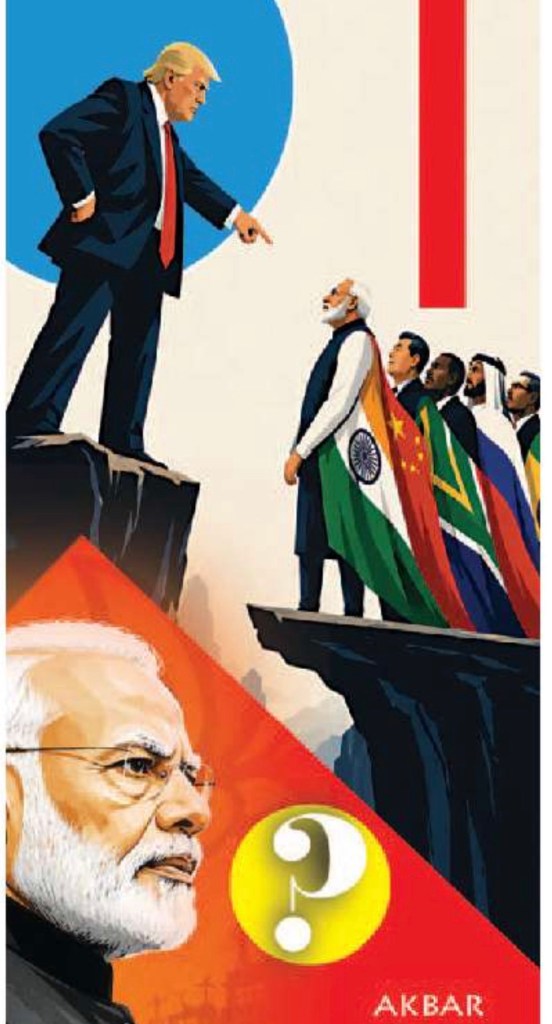
‘In this world, if a powerful man says it, even unrighteousness becomes righteousness. The same righteousness, however great it may be, when spoken by a weak man, will not be accepted by anyone,’ Bhishma says in the Kuru assembly during the episode of Draupadi’s disrobing in the Mahabharata. But Vidura warns in the same assembly, ‘The humiliation suffered by the Pandavas will, in the future, unite all the opponents against the Kauravas.’ Just as Vidura said that ‘an alliance of the weak, united by fear, is more powerful than the strength of the powerful,’ the Panchala, Matsya, Yadava, Magadha, Chedi, Kashi, Pandya, Chola, Kekaya and several other kingdoms all unite on the side of the Pandavas. Whether it was Chanakya or the Italian statesman Machiavelli, neither thought very differently from this. The diplomatic strategy of the Mahabharata was clearly reflected in the BRICS summit that concluded in New Delhi last week.
The BRICS countries delivered a clear message to U.S. President Donald Trump, who considered himself the most powerful man, without personally speaking a word against him. The New Delhi Declaration strongly condemned unilateral coercive actions and tariffs that undermine trade. The atmosphere necessary for many countries seeking different interests to come together on the BRICS platform was inadvertently created by Trump. A turbulent democracy like India, authoritarian China and Russia, Gulf countries that have close security relations with the United States, and Iran, which is facing American attacks, were all provided an opportunity to share a strategic global outlook. The reason for this is that all these countries are facing pressure because of Trump’s aggressive policies. Even though Trump warned that the highest tariffs would be imposed on countries challenging the dominance of the dollar, he helped BRICS countries explore alternative payment mechanisms. The New Delhi Declaration supported the use of local national currencies for trade. This gave member countries an impetus to reduce their dependence on Western economic systems.
Although it is an alliance comprising countries with different political systems and security interests, the ability to issue one of the most comprehensive and powerful unanimous declarations at the BRICS summit without any saber-rattling is evidence of the common understanding that has developed among these countries. The common perception that the present international system is being subjected to unilateral economic pressures brought all of them together. Since India hosted the summit, Prime Minister Narendra Modi naturally became the focal point of the two-day summit.
At present, India’s situation is like walking on the edge of a sword more than that of any other country. India had to simultaneously coordinate relations marked by several contradictions. These included border clashes with China and discussions with its leader in a cordial atmosphere despite the economic dominance of that country, continuing the strategic partnership with Russia, holding discussions with Iran amid turmoil in West Asia, and attempting to emerge as the voice of the developing countries and the Global South. Not only that, India made it clear that it would not give up cooperation with Russia in the defence and energy sectors under any circumstances. While joining hands with Western alliances, it declared strategic autonomy, making it clear that it would not ignore traditional allies. At the same time, Prime Minister Narendra Modi adopted a delicate diplomatic strategy at the New Delhi summit. India demonstrated the position that completely rejecting Western countries was not its strategy, and that it wanted to continue relations with those countries while simultaneously protecting the interests of developing countries. India attempted to present itself as a practical alternative between American pressure and Chinese dominance. At the same time, the special feature of these BRICS meetings was that the stronger Washington’s pressure became, the more India could say that it could develop mechanisms without depending on Washington.
Chinese President Xi Jinping’s speech at these summits was the most powerful. ‘A world without rules is like an intersection without traffic signals. International rules should be formulated with the participation of all countries and should be the same for everyone. The principle of “might makes right” should have no place in international affairs. The countries of the Global South should collectively protect the rule of law in international affairs,’ he said. Russian President Putin declared that no one could change the idea of a multipolar world, and that attempts to turn the world into a beautiful garden for themselves and a wilderness for others would not succeed. He said that some old leaders were creating sanctions and obstacles to protect their slipping leadership, but that these were accelerating alternative and independent trade routes. Prime Minister Narendra Modi’s speech also contained strong remarks. ‘We need to grow from being rule-takers to becoming rule-shapers,’ he said. He warned against using technology and critical minerals as weapons. He made it clear that if these resources were blocked, global progress would come to a halt and developing countries would suffer.
The most important development at the BRICS summit was the nearly 45-minute bilateral meeting between Prime Minister Narendra Modi and Chinese President Xi Jinping. Despite strategic differences, signals emerged that they were prepared to work for mutual economic interests. India showed willingness to forget the bitter memories of the Galwan clashes, establish peace along the Line of Actual Control, and restore economic and diplomatic channels.
What developments does this episode indicate? Will the hostile atmosphere that has existed between China and India for several decades change? The Congress party questioned whether the restoration of India-China relations indicates a strategic compromise rather than a diplomatic victory. Some others believe that, rather than calling it a compromise, it may also be a historic necessity in the present turbulent international environment. It is not insignificant that Chinese Foreign Minister and Communist Party Politburo member Wang Yi said that the most important consensus between India and China had been reached at this meeting, and that the two leaders had held clear and in-depth discussions on strategic, long-term and directional issues. He said that their President had stated that India and China should use each other’s strengths and stand by each other. It is noteworthy that Chinese newspapers described these meetings as the beginning of the third golden decade of BRICS. They portrayed the summit as evidence of the strength of multilateralism and the growing importance of the ‘Greater BRICS’ system. The Chinese media’s main observation was that despite unilateralism and hegemonic politics continuing in other parts of the world, BRICS was moving towards a more equal and alternative international system. They carried Xi Jinping’s comments that India and China were not rivals but partners as banner headlines. These comments can also be understood to mean that, with China taking over the leadership of BRICS in 2027, it could achieve little by ignoring a powerful India.
The American media also commented that the BRICS meetings indicated a changing world order and changes in international relations. The American media particularly analysed the fact that Iran, which has tensions with the United States, was given a prominent place in BRICS as reflecting changing alignments in the global order. The American media believed that the tariff policies followed by U.S. President Donald Trump themselves had acted as a binding agent that brought together countries with significant internal differences. ‘Bloomberg’ praised New Delhi’s diplomatic achievement in reaching consensus even amid internal contradictions.
To analyse it clearly, it was America itself that created favourable tailwinds for BRICS. It cannot be said that American policies and international relations will remain this way permanently. It can be argued that the time has come for changes in the functioning of the Security Council, the IMF and the World Bank to accommodate a multipolar world; otherwise, BRICS could become a stronger alternative system.
In Indian politics too, against this backdrop, leaders need to realise that our style of dealing with opponents determines their relative strengths. For the past few years, unable to withstand the aggression of Prime Minister Modi and his right-hand man Amit Shah, all the opposing forces have been attempting to unite. Recently, even NDA allies have expressed disagreement over the Uniform Civil Code. Will there be any change, at least after the BRICS experience, in Modi’s approach of directing the NDA parties to organise the ‘Seva Sankalp Abhiyan’ from September 17, his birthday, on the occasion of completing 25 years of his political rule? We cannot say.
 akrishnarao
Leave a comment