Hanuman initially destroyed the Ashoka Vatika, and later killed the Kinkaras. Jambumali, the sons of ministers, and army commanders all fell. He smashed Ravana’s son, Akshakumara, to the ground and killed him. Ultimately, Hanuman’s prowess only diminished after Indrajit deployed the Brahmastra. Watching the scenes unfolding in the national capital over the past two or three months brings to mind the episodes of the Sundara Kanda from Valmiki’s Ramayana.
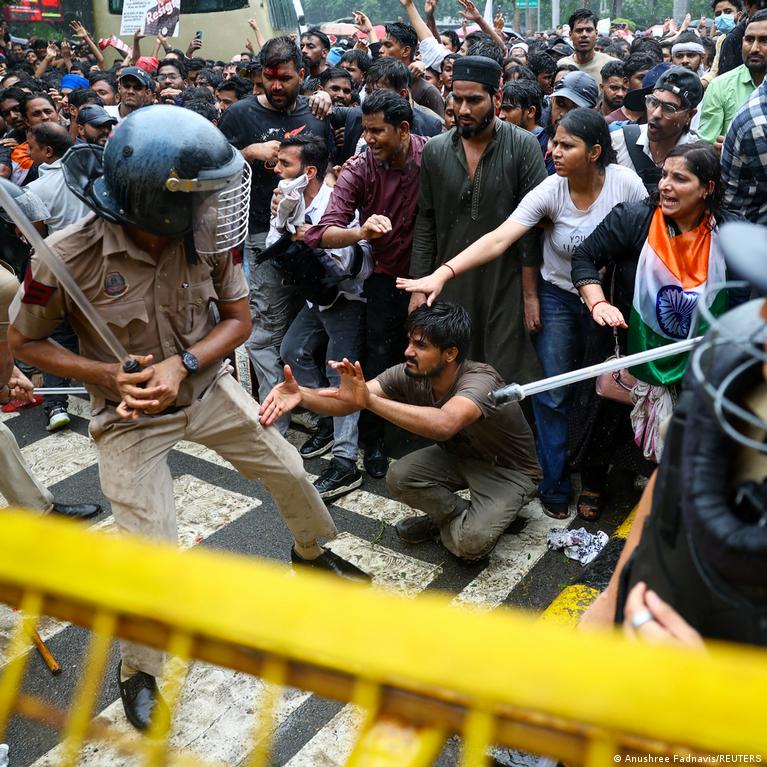
In July and August, Prime Minister Modi’s government was shaken by the Cockroach Janata Party (CJP). It became inevitable for Modi to remove Dharmendra Pradhan—who has mastered numerous electoral battles—from the Union Cabinet. When the CJP announced that it would stage another protest at Jantar Mantar on October 10, demanding the resignation of Election Commissioner Gyanesh Kumar, the Modi administration went on high alert. Two days prior, Border Security Forces, armed police, the Central Reserve Police Force (CRPF), paramilitary units, and the Rapid Action Force were deployed. It is estimated that private forces joined nearly 50,000 security personnel. Barricades were placed at every step, and police wielded lathis. For two or three days, the air in New Delhi seemed to come to a complete standstill. CJP leaders Abhijit Dipke, Saurav Das, and Ashutosh Rankas were arrested on flights and diverted to different locations. Nearly 10,000 people were arrested in Delhi alone. Numerous online commentators and activists were taken into custody. Majority metro stations were shut down, more than 250 trains coming to Delhi were cancelled, and internet services were suspended. Nevertheless, young men and women who pushed through to Connaught Place and Jantar Mantar were detained. The media was not spared either; to prevent people from escaping the buses, lockups made of iron rods were constructed right inside them. These actions made it clear that the government was terrified of what might happen if a youth wave erupted in the national capital.
Surprisingly, banners under Section 163 of the Bharatiya Nagarik Suraksha Sanhita (BNSS) were put up even inside the Supreme Court, the highest court of the land. Security personnel entered the lawyers’ chambers in front of the Supreme Court and arrested lawyers as well. Lawyers marching in a procession from the Supreme Court to Mandi House were arrested and taken to the Yamuna Complex. Senior advocate Dinesh Dwivedi was one of them; he is the biological brother of Rakesh Dwivedi, who argues on behalf of the Election Commission. When senior advocate Gopal Sankaranarayanan asked Chief Justice Justice Surya Kant, “Did you even take permission to impose prohibitory orders inside and in front of the Supreme Court?”, the CJI had no answer. Solicitor General Tushar Mehta, the government’s chief law officer, stated that he too was unaware of these prohibitory orders. The Supreme Court Bar Association, High Court Bar Associations, and the Advocates-on-Record Association condemned the arrest of the lawyers. Eventually, with the intervention of the Chief Justice of India, the lawyers were released. Citing the 2020 judgment by Justice Ramana’s bench in the Anuradha Basin case—which ruled that suspending internet and telecommunication facilities in Jammu and Kashmir violates constitutionally guaranteed fundamental rights—several lawyers compelled CJI Surya Kant to direct the Centre to lift the prohibitory orders in Delhi. The heat generated by the movement launched over Gyanesh Kumar’s resignation seems to have reached the Supreme Court, as the helplessness of being unable to intervene at the right time has put the apex court on the defensive.
Against this backdrop, the INDIA bloc organized a protest march up to the Supreme Court on October 12. The government played a near-spectator role. According to Congress, despite prohibitory orders, nearly 2.5 lakh people participated in the four-hour protest demonstration in New Delhi. Connaught Place and its surrounding areas were packed with crowds as students, youth, and civil society members responded to the Cockroach Party’s call alongside workers from the Congress and partner parties of the INDIA bloc. For the first time, Congress fully centralized its strength, bringing thousands of leaders and workers from various states to Delhi. For the first time, a fear of incurring the high command’s wrath if they failed to show up in Delhi was visible among Congress leaders. It became evident that the march to the Supreme Court was merely a pretext, and Rahul Gandhi’s strategy was to ignite the spirit of movement and street-fighting resolve throughout the party. Careerist Congress leaders who live for positions and lobbying sweated it out for the first time. How could Congress workers not be stirred when Rahul and Priyaank argued with police, resisted them, and pushed past barricades? In a way, this was the moment that infused life into every nerve of the Congress party. Rahul and Priyaank appeared ready to fan this spark even further, first staging marches up to the Election Commission office and then to the Supreme Court. It remains to be seen with what revolutionary spirit Congress executes its announced action plan across the states. Unless this movement, initiated over vote theft, gathers momentum in raising voter awareness about their right to vote, desired results will not be achieved.
At the same time, there are currently no metrics to measure how much damage the controversy surrounding EVMs and the credibility of institutions has inflicted on Modi and BJP’s prestige. It is impossible to say how long the deadlock surrounding Chief Election Commissioner Gyanesh Kumar will continue. Forcing Gyanesh Kumar to resign would amount to the government conceding the opposition’s criticisms regarding vote theft. However, top BJP leaders do not appear to have lost confidence that, regardless of how much noise the opposition makes or how intensely they escalate their fight, they can still secure victories in elections through their machinery, strategic planning, emotional appeals in campaigns, and social coalitions. They have adopted the strategy that as long as they win elections, the opposition will wither away.
There is no doubt that public life will be thrown into disarray during this period of crisis. Unseating Modi has become a life-and-death matter for Congress and other forces. As these forces intensify their struggle, the government is likely to resort to even harsher measures. Train cancellations, metro station closures, prohibitory orders in public spaces, traffic jams, and internet restrictions are bound to cause severe inconvenience to thousands of ordinary people. Political and public movements are expected to expand not just in Delhi, but primarily across the 22 NDA-ruled states. Far from the government being in a position to hold a special session for delimitation, even the winter session scheduled for November and December risks being disrupted. There are no signs of the crisis subsiding; rather, it threatens to intensify right up to the five state assembly elections coming up next April.
The government failed in its attempts to thwart the protests and could not control the agitators despite imposing prohibitory orders. Making Jantar Mantar inaccessible as a hub for protests was easy, but it could not stop the lava flowing from the volcano of public anger—that flow simply found another path. Furthermore, shifting public opinion by tying protest demonstrations to patriotism, nationalism, and foreign conspiracies is no longer easy. The current generation may not know the days of the Emergency, but the perception is growing among them that an undeclared Emergency is currently in place. Rulers must ponder what impression the younger generation forms in this social media age when suppression and violence are enforced by the government itself. To achieve a major victory, those in power cannot avoid being prepared for minor setbacks. The chapter of the NEET paper leak ended with Dharmendra Pradhan’s resignation; now, any action taken against Gyanesh Kumar—who is becoming an increasingly heavy and burdensome liability for the government day by day—must be weighed carefully, lest it turn into a trap of having a tiger by the tail.


Leave a Reply