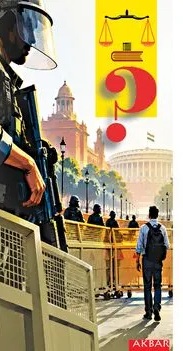
To understand what a police state looks like, one must currently try traveling through New Delhi. Within a radius of a few kilometers around Union Home Minister Amit Shah’s residence, the Election Commission, Parliament, and Jantar Mantar, police have erected barricades and deployed personnel at every step. Media personnel are not being allowed through unless they show their identity cards. Vehicles have to be parked somewhere afar, leaving people with no choice but to walk. Hearing the warnings broadcast through loudspeakers set up every few feet on the roads sends a chill down one’s spine. These loudspeakers warn that strict action will be taken under Section 160 of the Bharatiya Nyaya Sanhita, 2023, for acts aiding rebellion and incitement in the armed forces, and under Section 223 for defying or showing disobedience toward orders issued by government authorities. Warnings are also being issued to stay away from protesters and not to obstruct the measures taken by the police in the interest of law and maintenance of public order.
This has been the situation ever since Gandhi Jayanti, when the Cockroach Party and opposition parties announced protests, alleging that the names of crores of voters across the country are being deleted and that vote theft is helping the BJP win. Security measures were tightened further on Tuesday to block opposition MPs from taking out a procession from Parliament to the Election Commission. Although a sit-in organized by CJP in Mumbai saw the participation of 10,000 people and ended peacefully, the imposition of prohibitory orders and the massive deployment of forces in the Jantar Mantar area of Delhi give it the feel of a war zone. It appears the government has realized that if protest demonstrations are permitted in the national capital, it will be difficult to prevent them from escalating.
Why on earth is the government causing the situation to intensify? Ever since it was forced to rely on allies after coming to power for a third time in 2024 with 240 seats, the Modi government has appeared to be on the defensive. Opposition parties have successfully managed to raise doubts among the public regarding the manner in which the Modi government has won every assembly election held since then. While the opposition can easily be branded as anti-national, the protests have now outgrown the level of political parties. Following the emergence of the Cockroach Janata Party, the massive response from lakhs of youth is clearly visible. Now, with judges, former judges, former election commissioners, and various other sections joining them, anti-government sentiment is spilling over. Developments took another turn last week with news leaking that two election commissioners had also submitted multiple internal notes protesting the unilateral actions of CEC Gyanesh Kumar. There are also auto-drivers and other common sections expressing doubts about the BJP’s electoral victories. “We fought and won against Mamata Banerjee’s lawless rule in West Bengal, yet we cannot claim it was a genuine victory”—the anguish expressed by a senior BJP leader reflects how day by day, the government’s credibility is plunging.
The primary reason things have reached this pass is the persistent attempt to bring institutions under one’s grip. Respect for the functioning of institutions eroded long ago when agencies like the ED and CBI were weaponized ruthlessly to crush opponents while ignoring criminals who joined hands with the ruling side, and when bodies like the CVC, CAG, and the Central Information Commission were reduced to toothless entities. In this process, the functioning of the Election Commission and the judiciary also became suspicious. While it is true that past regimes also used institutions, critics point out that the blatant and brazen manner in which all institutions have been utilized in the current tenure is unprecedented. Amidst all this, constructive discussions on the Modi government’s achievements or developmental actions are getting swept away by the wind. It is a paradox that these developments are unfolding precisely during the implementation of the Sewa Sankalp announced by Modi to mark 25 years of his governance. When he won 282 seats in 2014 and 303 seats in 2019, forming governments without needing anyone and turning a massive nationwide “Hindu wave” in his favor, no one blamed the Election Commission. But it must be said that many of the steps taken by the government out of the confidence inspired by those victories are responsible for the current state of affairs.
Above all institutions, the higher judiciary in the country cannot escape blame. A situation where grand thieves are bred arises precisely because petty thefts were not stopped in the past. There are no longer judges like Justice Jagmohan Reddy of the Allahabad High Court—who courageously unseated an unquestionable figure like Indira Gandhi for six years for electoral malpractice—or Justice Krishna Iyer of the Supreme Court, who stripped Indira Gandhi of her right to speak and vote in Parliament. Where are the judges who laid down through the Kesavananda Bharati judgment that fundamental rights in the Constitution cannot be touched, or the judges who struck down the 39th Constitutional Amendment designed to keep the Prime Minister’s election beyond judicial review? Judges who give utmost importance to citizens’ voting rights by declaring criminals immediately disqualified and by introducing NOTA are also dwindling.
In fact, a constitution bench headed by Justice Joseph delivered a bold verdict in 2023 stating that the appointment of Election Commissioners had been unilateral for the past seven decades and that they should be appointed by a high-powered committee consisting of the Prime Minister, the Leader of the Opposition, and the Chief Justice of India. But which government wants to lose its grip on Election Commissioners? The Modi government promptly enacted a law in Parliament removing the Chief Justice from the committee and replacing him with a Union Minister. This law cleared all hurdles for appointing Gyanesh Kumar as the CEC. Curiously, the Supreme Court did not even agree to place an interim stay on the legislation passed against its own constitution bench’s verdict. Moreover, the apex court did not strike down the bill designed to shield the CEC and the two commissioners from any civil or criminal action. Furthermore, the petition filed by various organizations alleging massive voter deletions was dismissed by Chief Justice Surya Kant, who stated that the maintenance of electoral rolls is an internal administrative exercise and that the court cannot interfere. It was only after this that CEC Gyanesh Kumar expanded the voter deletion program nationwide under the name of SIR. Even though the Supreme Court issued orders on paper, justice was not delivered to voters in West Bengal prior to the elections. Out of more than 2.7 million voters whose names were deleted, 22 lakh filed appeals with the 19 tribunals. Against these, CEC Gyanesh Kumar unilaterally filed 1.61 million counter-appeals. Buoyed by the soft stance of the Supreme Court, the audacity was taken to delete 13 crore voter names nationwide. The apex court did not feel the need to take stringent measures to make people believe that these deletions were carried out lawfully. On top of that, casual remarks made by Justice Surya Kant—stating that some youth have become idle like cockroaches and have made it a habit to attack everyone in media and social media—created a sensation. These very remarks led to the formation of the “Cockroach Party” and massive support for them from the youth. Those who initially forced Education Minister Dharmendra Pradhan to resign are now joining opposition voices demanding Gyanesh Kumar’s resignation.
Now, the number of protesting sections is increasing day by day. “Whether it is a rickshaw puller or a millionaire, the right to vote is equal. No one has the right to take it away,” remarked Supreme Court judge Justice Ujjal Bhuyan at a NALSAR event in Hyderabad, while another judge, Justice Rohinton Nariman, observed that the right to vote—the lifeblood of democracy—is in danger. Rohinton Nariman is the son of Fali S. Nariman, who was nominated to the Rajya Sabha by the Vajpayee government. Moreover, even past election commissioners appointed by the Modi government are protesting Gyanesh Kumar’s actions.
Perhaps witnessing the remarks of sitting judges and the rising public agitation, the Supreme Court may have had a change of heart, as it has now taken up a petition filed against the removal of Gyanesh Kumar. It also rejected the Election Commission’s argument that changes to Form 6 were made with the Supreme Court’s permission. Whatever may happen, if the credibility of institutions is to be restored, there must be a change in the government’s attitude. Otherwise, the higher judiciary must intervene and salvage its own credibility, facilitating balanced, data-driven corrections. Failure to do so risks a scenario where institutions, gripped by insecurity and losing all sense of proportion, take actions that could plunge society into turmoil.


Leave a comment