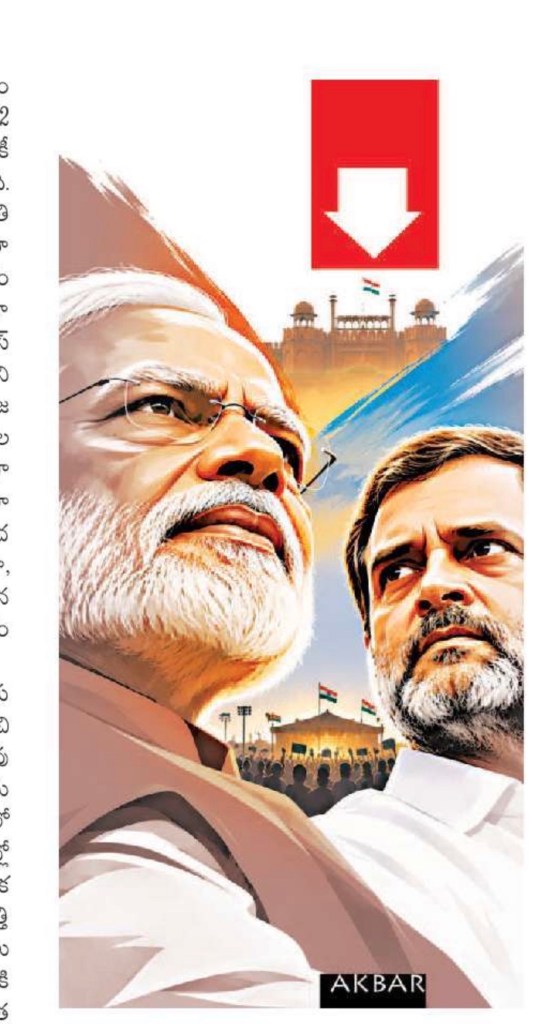
UP: The First Battle in the Final War
The Congress rally held in the national capital on November 1 demonstrated the enormous organisational strength of theparty’s central leadership, despite having remained out of power for 12 years. The party high command assigned targets tochief ministers, ministers, Pradesh Congress Committee (PCC) presidents and elected representatives, mobilising partyworkers and leaders from across the country through various means to bring them to Delhi. While Congress leadersclaimed that Ramlila Maidan was packed to capacity, the BJP maintained that several areas remained visibly empty.Nevertheless, it was evident that the Congress high command had deployed its full organisational strength.
The actual number of people who attended the rally, whether in the hundreds of thousands or otherwise, may be a matterof debate. But what matters more is the strength of the message conveyed against alleged electoral malpractice. TheOpposition’s ability to come together through the mock Parliament and the Ramlila Maidan rally is certainly significant.However, the million-dollar question is whether the Opposition can recreate the impact of the protests held at RamlilaMaidan during the Emergency and in the final days of the UPA government.
Will the Opposition be able to send Chief Election Commissioner Gyanesh Kumar to prison, as it has demanded, orremove Prime Minister Narendra Modi from office and initiate legal proceedings against him? Can it actually forceGyanesh Kumar out of office in Parliament simply because he was symbolically removed through a mock Parliament?Neither Congress nor the other Opposition parties are unaware that none of these things is likely to happen anytime soon.They know that when they are unable to defeat their opponents in a real battle, a symbolic victory in a mock battle offerslittle more than temporary satisfaction. The real fight still lies ahead. In the meantime, they will have to wage several suchsymbolic battles to turn public opinion in their favour as much as possible.
Through the protests against the Special Intensive Revision (SIR) of electoral rolls in the national capital, the Oppositionmay have succeeded in generating national and international attention. But unless it takes this campaign to the grassroots,Congress will not achieve the results it hopes for. BJP spokesperson Sambit Patra asked: “If it is true that the voting rightsof crores of people have been taken away, why are those crores of people not coming out onto the streets?”
To prove Patra wrong, Congress must reach out to those who have allegedly lost their votes and mobilise voters in therespective states to fight for their voting rights. That is no easy task. Even if it cannot accomplish this, the party must atleast use every Assembly election from now on to create awareness among voters and win them over to its side. In otherwords, what is needed is a sustained political struggle that builds public confidence in the party.
Elections are scheduled next year in Uttar Pradesh, Punjab, Gujarat and seven other states. In 2028, nine states, includingKarnataka, Madhya Pradesh, Rajasthan and Telangana, will go to the polls. How capable are Congress and the Oppositionparties of defeating the BJP in a majority of these states and, eventually, at the national level in 2029?
Even as the Opposition was protesting in Delhi, Union Home Minister Amit Shah and Uttar Pradesh Chief Minister YogiAdityanath were reviewing the BJP’s electoral preparedness. Subsequently, Amit Shah also visited Telangana andpersonally participated in a padayatra organised as part of the “Save Democracy – Eradicate Anarchy” campaign.
To put it bluntly, the perception that “the BJP knows how to do politics, while Congress knows only how to raise slogans”has taken root even within the Congress party itself.
To overcome this negative image, Congress must strengthen itself organisationally and rebuild the party from thegrassroots upwards. The most important challenge, however, is funding. The campaign against the Election Commissionin Delhi must have involved enormous expenditure. For how many such battles can chief ministers, ministers and partyleaders continue to spend their own resources? The party also needs substantial funds for the Assembly electionsscheduled over the next two years. By the time the 2029 general election arrives, its coffers could be empty, with financialsupport drying up. The BJP does not face this problem. With the backing of major industrialists, it can fight any numberof elections with relative ease and mount whatever publicity campaigns are necessary to counter the Opposition.
Another major problem for Congress is its own political culture. In Karnataka, barely a hundred days after Chief MinisterD.K. Shivakumar assumed office, the party suffered defeat in four Legislative Council seats. The defeat may have beenpartly due to the controversy surrounding attempts to remove OBC leader Siddaramaiah from the Chief Minister’s postand allegations that party leaders themselves had conducted a sting operation against him.
In Delhi, a Telangana minister and an MLA who had travelled to participate in the Vote Chori rally reportedly engaged inan abusive altercation at a hotel over the appointment of District Congress Committee presidents. In Punjab, Congress isfinding it extremely difficult to contain the internal differences among Charanjit Singh Channi, Sukhjinder SinghRandhawa and Partap Singh Bajwa and bring them together for the elections. Almost every state has its own share offactional conflicts among party leaders.
It may be a significant achievement that Congress has managed to unite its leaders over the SIR issue. But unless ittightens its grip on the party organisation in every state and builds a robust political machinery to take on the BJP, noamount of protest rallies will produce meaningful results.
In the past, stalwarts such as Ahmed Patel, Ghulam Nabi Azad, Veerappa Moily and Digvijaya Singh were regular visitorsto party offices. They would listen to the grievances of party workers and leaders and provide appropriate guidance.Today, there seems to be no one performing that role. Rahul Gandhi is said to give greater importance to NGO-styleorganisational approaches, while Congress general secretary in charge of organisation, K.C. Venugopal, faces criticism forbeing inaccessible to most leaders, except a select few. Congress needs to change this perception and transform itself onceagain into a party driven by its grassroots workers.
For better or worse, Rahul Gandhi has gradually emerged as the leader not just of Congress but also of the widerOpposition. However, BJP circles remain confident that if Rahul Gandhi becomes the Opposition’s prime ministerialcandidate, Narendra Modi will have little difficulty in taking him on. Rahul’s efforts to change this perception cannot yetbe considered sufficient.
The BJP has so far secured electoral victories in several states by projecting Narendra Modi as its principal campaigner.Not only Rahul Gandhi but also local Congress leaders have struggled to withstand Modi’s political appeal. Congress andthe INDIA bloc may provide shelter to all those sections of society that are disillusioned and frustrated with the currentpolitical situation. But they must evolve into a platform representing diverse social groups, particularly the weaker andunderprivileged sections of society.
The Opposition celebrated the fact that the BJP had won only 240 seats in the 2024 Lok Sabha elections. However, thepolitical landscape of the Opposition has changed considerably since then. Mamata Banerjee suffered defeat in WestBengal. M.K. Stalin was voted out of power in Tamil Nadu. In Bihar, RJD leader Tejashwi Yadav’s strength fell from 80seats to 25. Sharad Pawar’s NCP and Uddhav Thackeray’s Shiv Sena have split into factions. The political relevance of theLeft parties is increasingly being questioned.
The DMK is no longer part of the INDIA bloc, while parties such as the Aam Aadmi Party (AAP), Bahujan Samaj Party(BSP), YSR Congress Party (YSRCP), Biju Janata Dal (BJD) and Bharat Rashtra Samithi (BRS) also remain outside it.How, then, can the INDIA bloc under Rahul Gandhi mount an effective challenge against a formidable NDA?
“BJP is like Angada’s foot; nobody can move it,” Amit Shah declared in Uttar Pradesh. “The Mahabharata war has begunat Ramlila Maidan. The road to Delhi passes through Lucknow,” Akhilesh Yadav proclaimed at the Ramlila Maidan rally.
It was only after registering a major victory in Uttar Pradesh in 1991 that the BJP was able to come to power at theCentre. The Opposition is now dreaming of repeating that achievement.
But does it have the strength and organisational capability to turn that dream into reality?


Leave a Reply